From the Catalogue of the Sixteenth Archivist. Forty-three observer reports filed by Order personnel and travelers across the Librarian's tenure, sketches recovered from three of the observers, the Librarian's own notes on the apparitions she has spoken with, and a single line in the Founders' tablets that the Librarian has not been able to translate beyond seven words.
They walk the archive. They are seen. They are not always.
Full chronicle
Page 1
They walk the archive.
They walk the archive. They are seen. They are not always. The catalogue records visitations. The catalogue does not record what visits. It records what is reported to the Librarian and what she has herself observed.
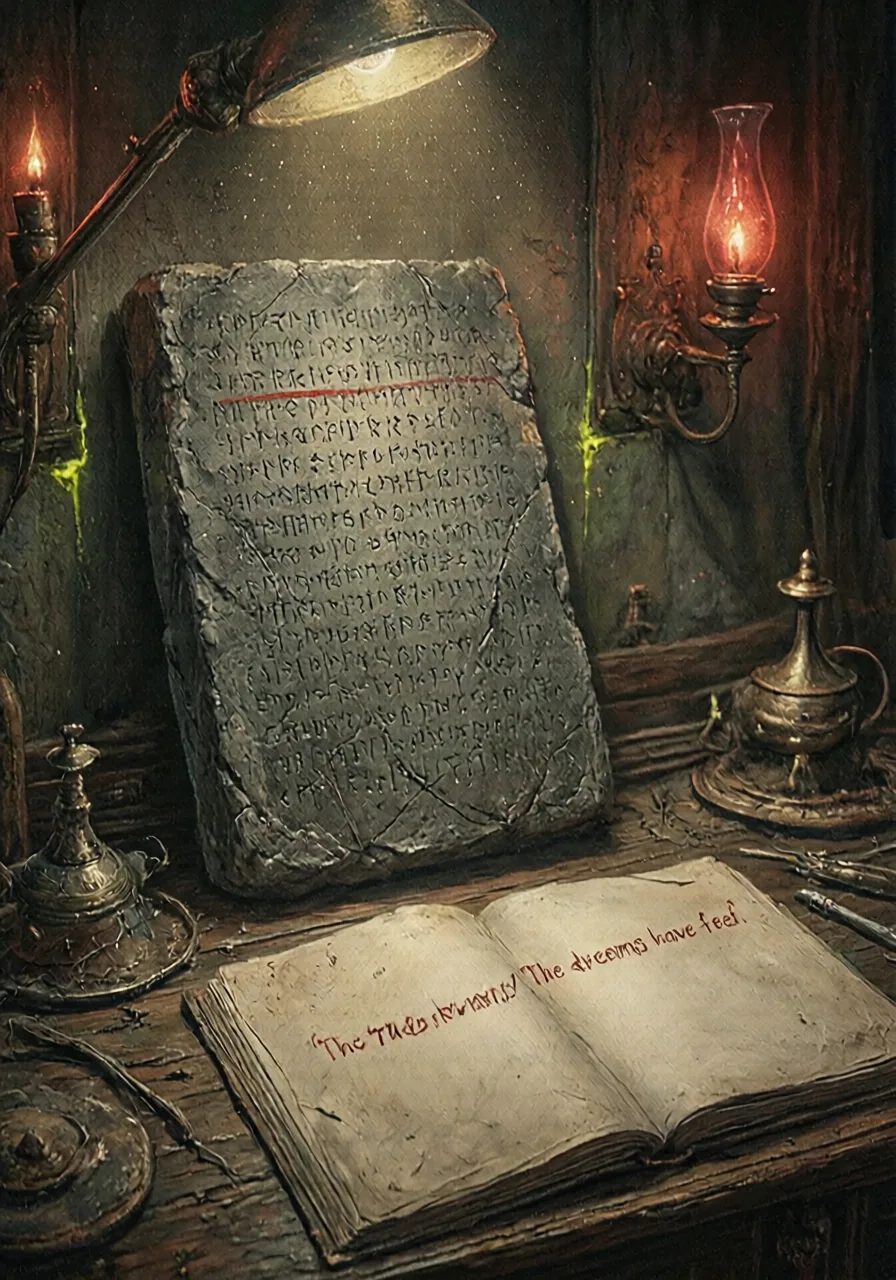
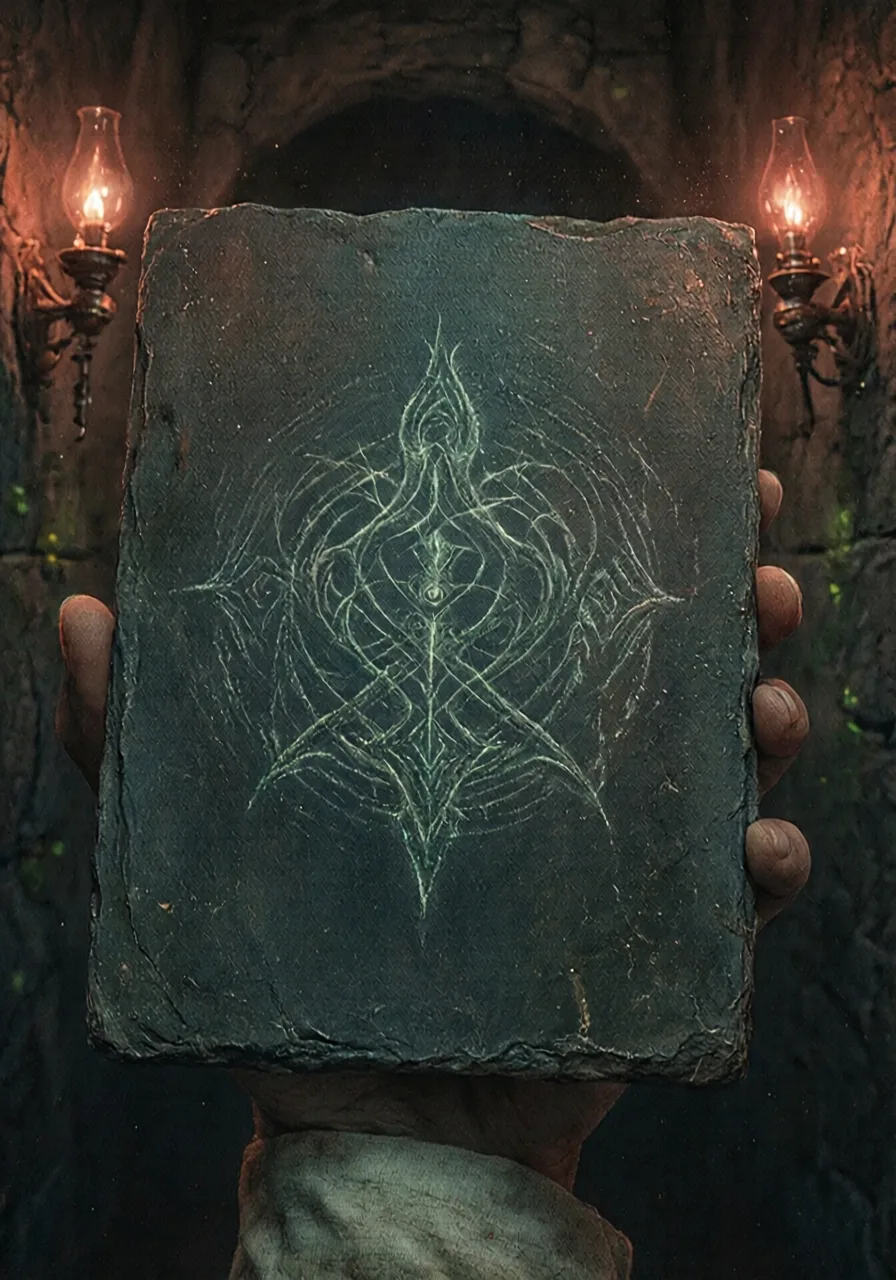
The Librarian has filed three competing accounts of origin. The first holds that the apparitions are the dead. The second holds that they are residue — memory leaked from the channels and given form by the liquid that runs the archive. The third rests on a tablet recovered in the deep stacks. The Librarian has translated seven words: the tree dreams. the dreams have feet. The remainder of the line is not legible.
Page 2
The catalogue's apparitions.
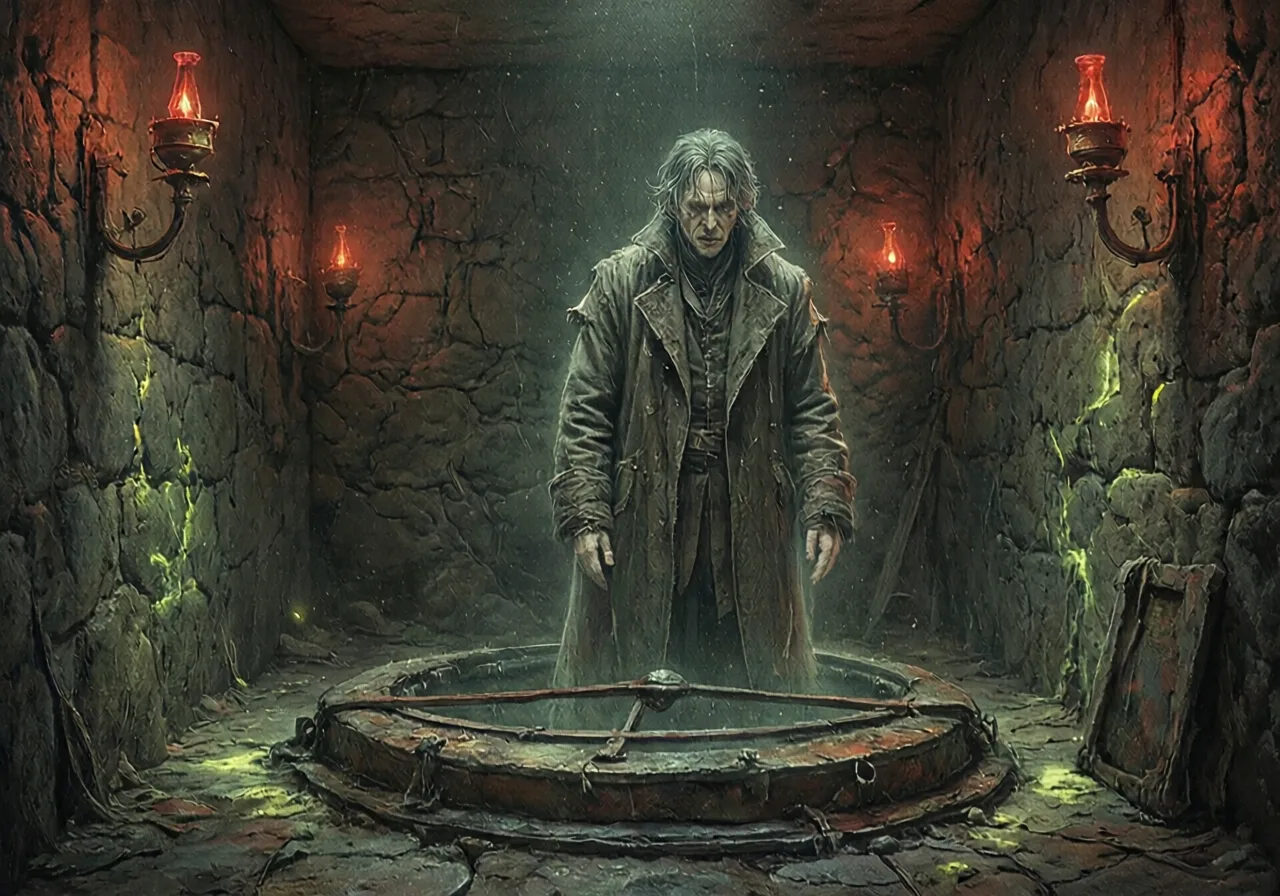
A man at the cistern hatch. He stands at the eastern hatch in the seventh hour of every fourth cycle. His hands are at his sides. He does not look down into the cistern. He is dressed for outside cold — a coat the Librarian's records identify as a cut three centuries out of use. He has been observed by twenty-seven witnesses. None has observed him leave.
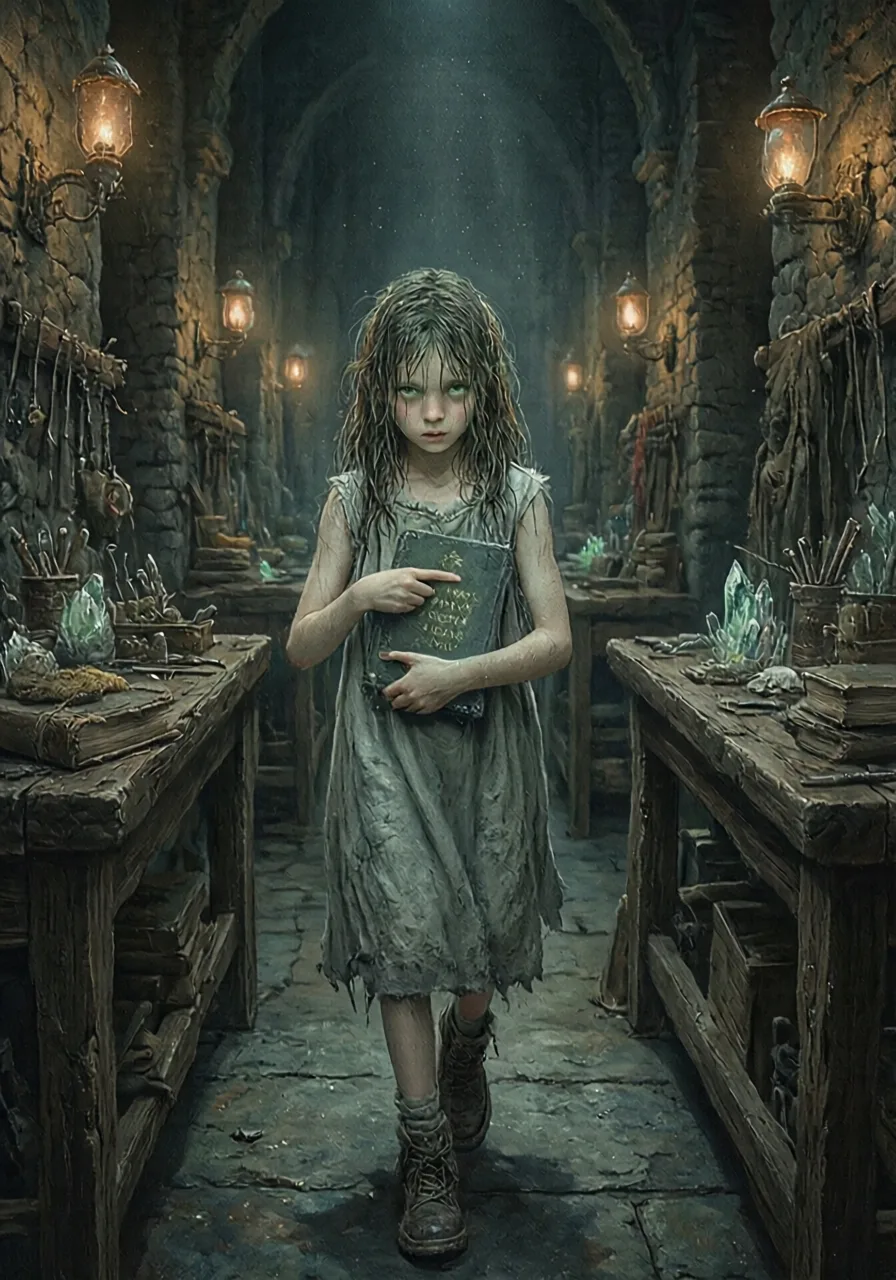
A child in the binding hall. She walks between the work tables holding a slate. She writes on the slate continuously. The writing fades before it can be read. She walks toward the eastern wall. There was a door there once. The wall absorbs her.
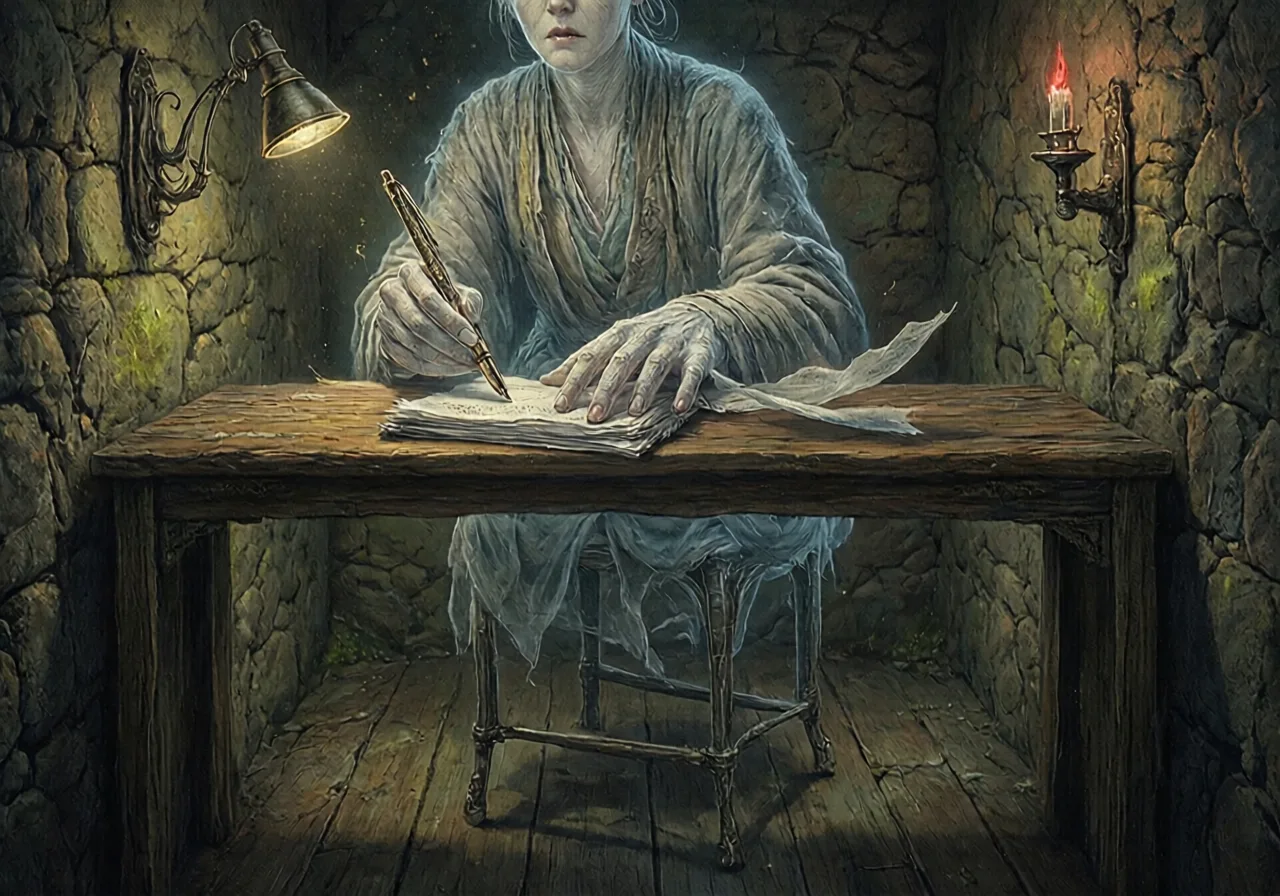
The reading alcove in the third hour. A woman sits at a desk that is not there. She holds a stylus. She turns pages. The stylus moves and the pages turn and she works at the desk that is not there for the duration of an hour and then she is gone. There was once a desk in that position. The Librarian's records confirm it.
Page 3
The character formed.
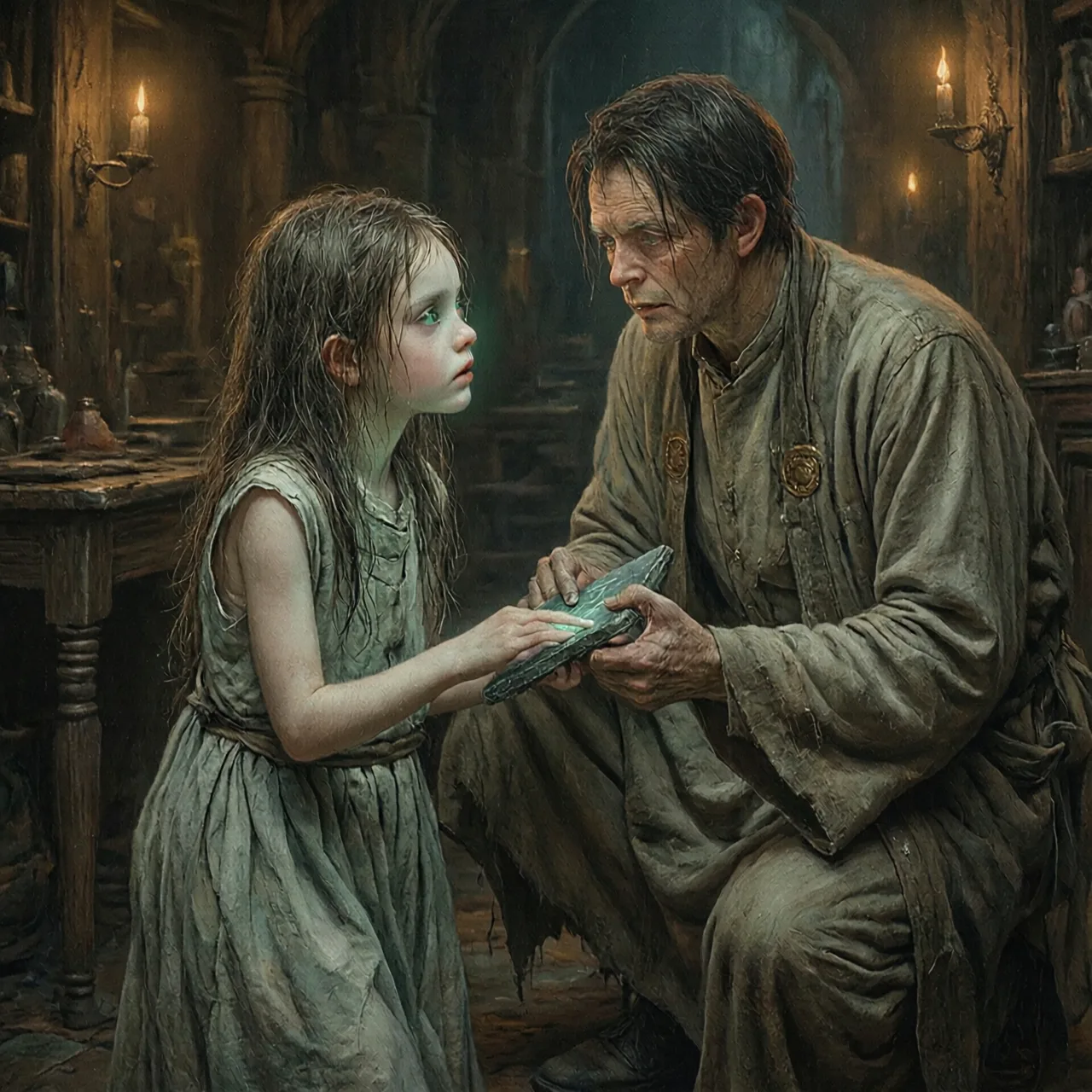
Fragment. The personal account of an Order attendant, assigned to the binding hall for one rotation. I tried to read what she was writing once. I came up beside her and I matched her pace and I looked at the slate. The line was forming on it as she walked. The shapes were familiar. I do not read the old script of the Order, but I have shelved it and I know what it looks like. The child stopped. She looked up at me. Her eyes were the colour of the cistern water in the seventh basin — that pale green that does not come from any pigment I have catalogued. She did not seem afraid. She did not seem present. She wrote one more character, looking up at me, without looking at the slate. The character formed.
She wrote one more character, looking up at me, without looking at the slate. The slate was at her chest. The character formed. Then she walked on, and I watched her go through the eastern wall, and I sat down on a work bench because my legs did not feel as though they would carry me.
Page 4
The Librarian hears them.
The Librarian hears them. The reports do not. The sketches do not annotate sound. The observers describe motion without speech. The Librarian is at her desk. A figure pauses outside the alcove. She does not look up. The figure speaks. The speech is at the volume of breath, at a pitch she has not been able to record.
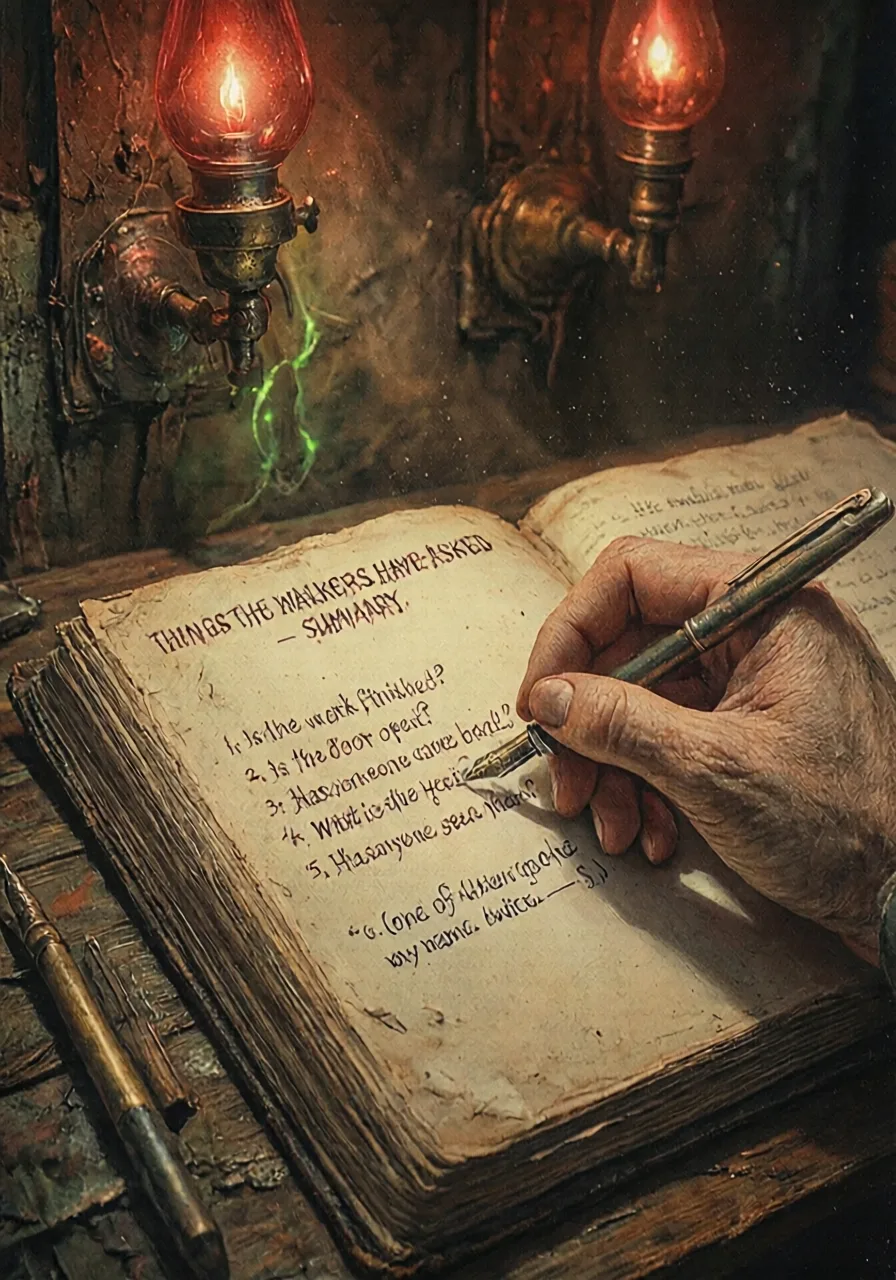
She has recorded what they say. They ask whether the work is finished. They ask whether the door is open. They ask whether someone has come back. They ask the year. They ask whether anyone has seen them. One of them has spoken her name. Twice. The name is the Librarian's. The Librarian does not know how the figure knows it.
Page 5
He looked up at her. The face was hers.
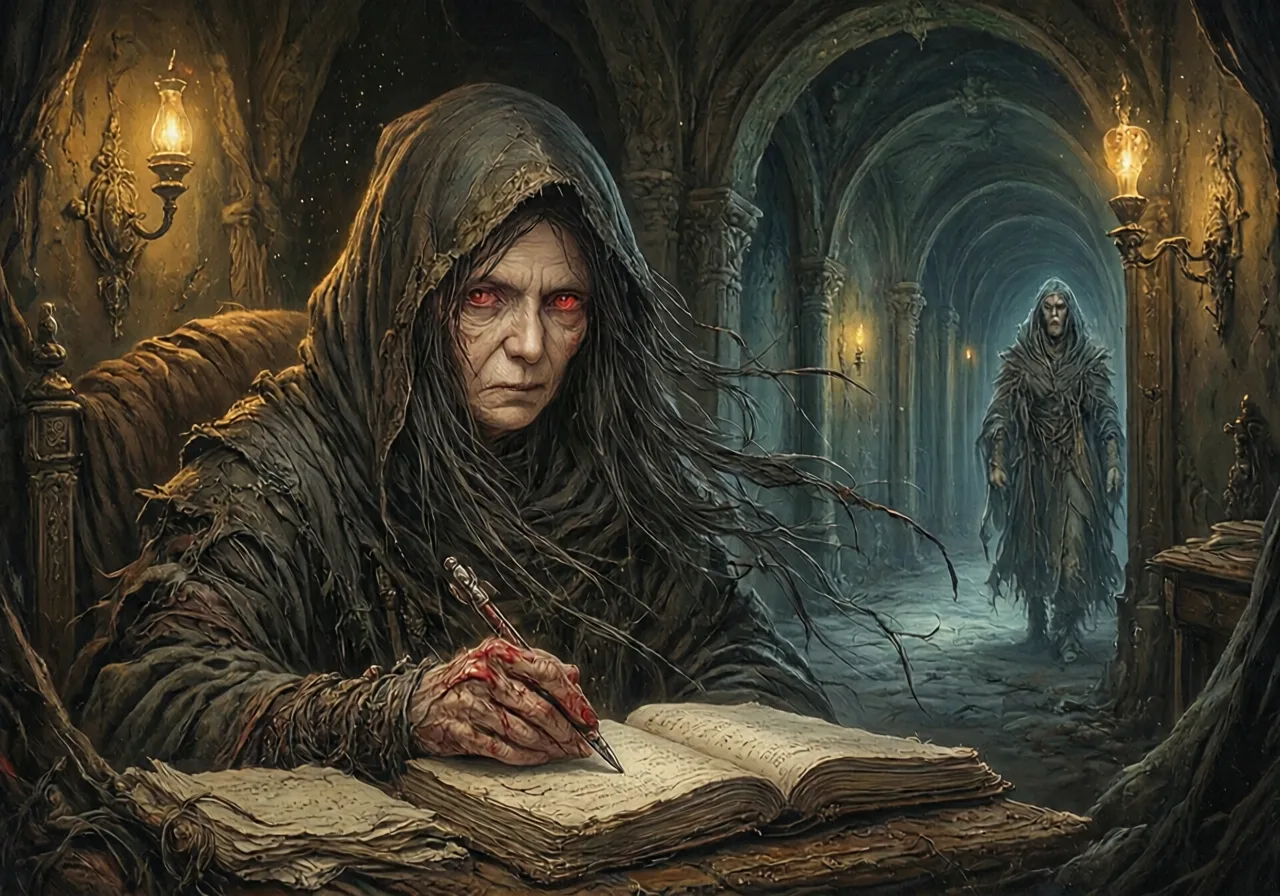
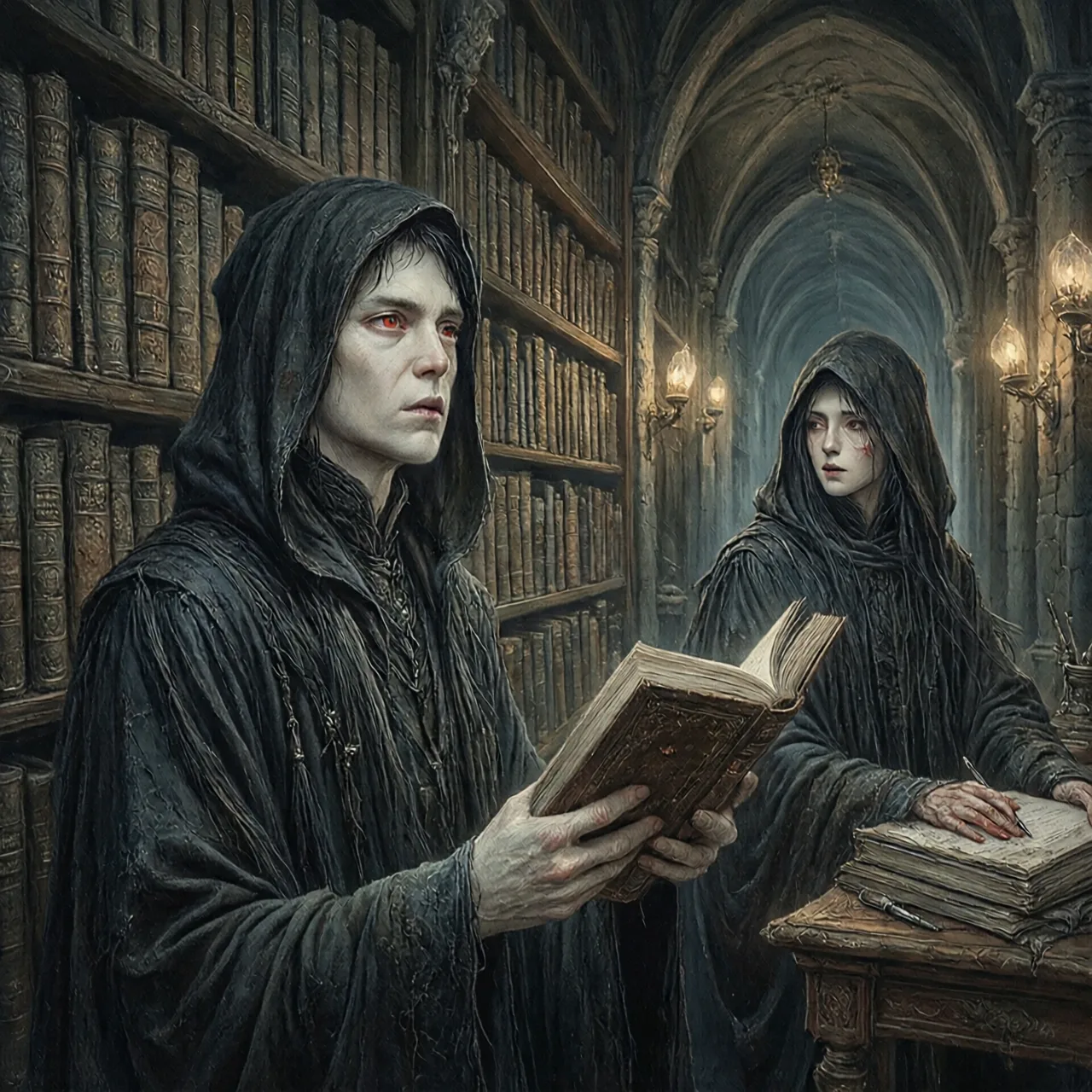
The man at the shelves has spoken to her seven times. He pulls tomes that are not there. He reads them. He sets them back. The Librarian, on the seventh occasion, set down her stylus and watched him work. He moved along the third row of the west wall. He took a tome. He opened it. He read. He looked up at her. The face was hers.
The Walker at the ShelvesI am looking for an entry I wrote. I have been looking for it for some time. I think I may have shelved it elsewhere.
The LibrarianI have not seen what you are looking for.
The Walker at the ShelvesI know. I have not either. The work is to keep looking.
He returned to the shelf. He pulled another tome that was not there. The Librarian has not catalogued his face.
Page 6
They are not the dead. They are the not-finished.
They are looking. The figures do not wander. They proceed. They examine. They search. None of them find what they are looking for. They are not the dead. The dead are still. These are the not-finished. These are what the archive would not let go. They walk. They look. They do not find. They return. The tablet says the tree dreams. The dreams have feet. I am at my desk. The stylus is in my hand. The page is open. The next character is forming.
— / —
narration auto-scrolls the prose
Section 0Frontmatter
# The Walkers
From the Catalogue of the Sixteenth Archivist, entry 6,442. Provenance: forty-three observer reports filed by Order personnel and travelers across the Librarian's tenure, sketches recovered from three of the observers, the Librarian's own notes on the apparitions she has spoken with, and a single line in the Founders' tablets that the Librarian has not been able to translate beyond seven words.
They walk the archive. They are seen. They are not always.
Section 1Section 1
The catalogue records visitations. The catalogue does not record what visits. It records what is reported to the Librarian and what she has herself observed. The reports do not agree.
The Librarian has filed three competing accounts of origin.
The first holds that the apparitions are the dead. The Order's records do not support this; the dead are catalogued in the ossuary and the ossuary's positions do not move. The caretaker has compared his charges against the reports and found no match.
The second holds that the apparitions are residue — memory leaked from the channels and given form by the liquid that runs the archive. The archive's liquid is red. The apparitions are pale. The Librarian has noted the discrepancy without resolving it.
The third rests on a tablet recovered in the deep stacks. The Librarian has translated seven words: the tree dreams. the dreams have feet. The remainder of the line is not legible. She has filed the tablet under reference.
She does not know which is true. She does not know whether more than one is true.
Section 2Section 2
A summary of the apparitions reported during the Librarian's tenure. The full register is in her secure file. Entries excerpted at her selection.
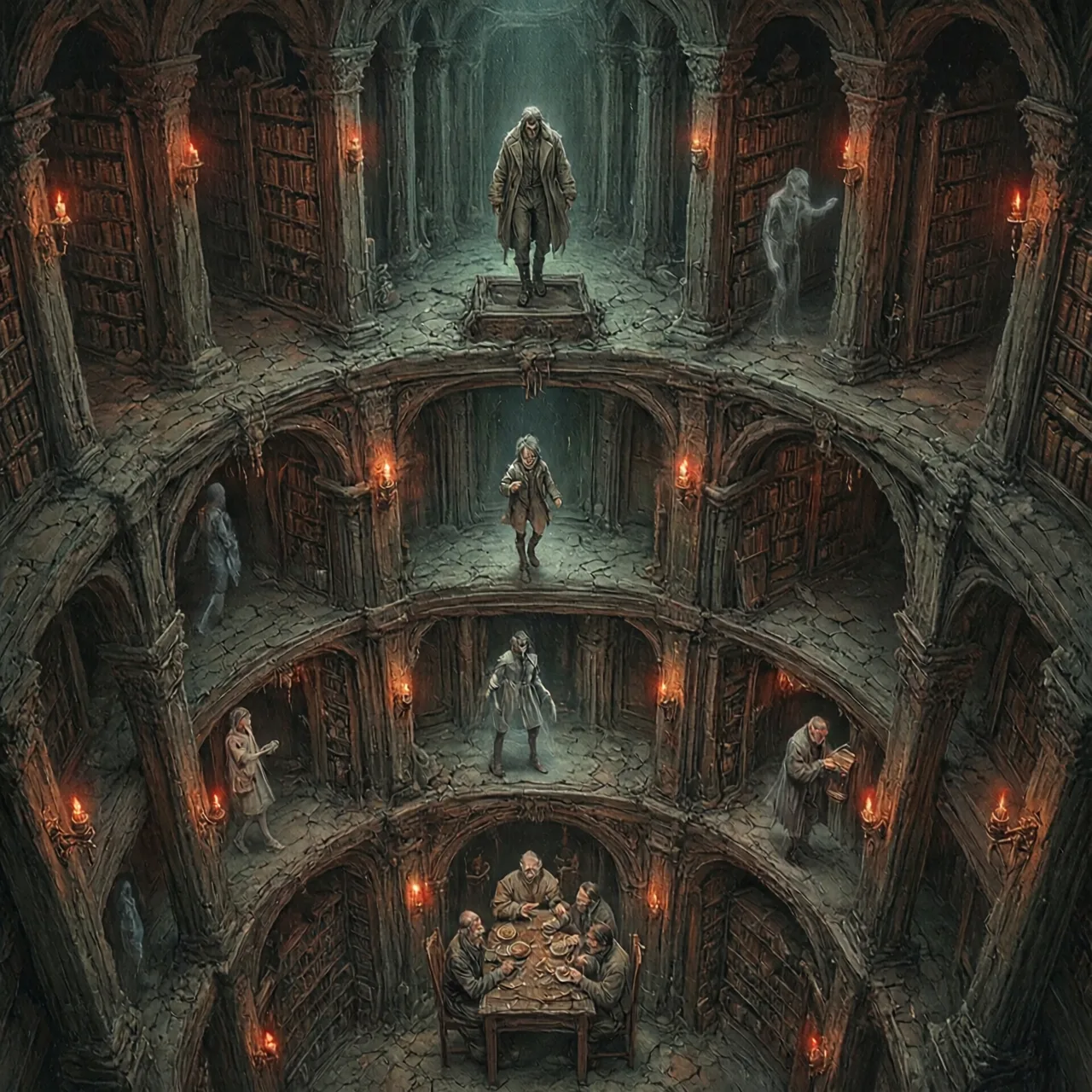
A man at the cistern hatch. He stands at the eastern hatch in the seventh hour of every fourth cycle. His hands are at his sides. He does not look down into the cistern. He is dressed for outside cold — a coat the Librarian's records identify as a cut three centuries out of use. He has been observed by twenty-seven witnesses across her tenure. None has observed him leave. Each report describes him in the same posture, in the same coat, in the same hour.
A child in the binding hall. She walks between the work tables holding a slate. She writes on the slate continuously. The writing fades before it can be read. She has been observed by eleven witnesses. She does not speak to them. She walks toward the eastern wall. There was a door there once. The wall absorbs her.
The reading alcove in the third hour. A woman sits at a desk that is not there. She holds a stylus. She turns pages. The stylus moves and the pages turn and she works at the desk that is not there for the duration of an hour and then she is gone. There was once a desk in that position. The Librarian's records confirm it.
A pair of hands at a table that is not there. The hands sort without a body. They have been observed by four witnesses. The hands stop when they are watched. The work resumes when the witness looks away.
A surveyor. He measures a wall that is no longer present. He marks the air at intervals. The marks fade. He is dressed in the Order's field tunic of an earlier century. He has been observed by nine witnesses. He has not been observed completing the measurement.
A man at the shelves. He pulls tomes that are not there. He opens them. He reads. He sets them back. He moves to the next shelf. He has been observed by six witnesses. He is dressed in the Order's robe of the present century. The Librarian has compared his face to the personnel registers of the present century and found no match.
Four figures at a table. They eat a meal that is not there. They smile at one another. They pass items. They have been observed by three witnesses. The witnesses report that the figures are happy. The Librarian has filed this report and has not annotated it.
Section 3Section 3
Fragment. The personal account of an Order attendant, assigned to the binding hall for one rotation. The hand is the attendant's. The account was filed without request and the Librarian has filed it among her observer reports.
"I worked in the binding hall for ninety-one days. I saw the child six times. I always saw her in the third afternoon hour, or what I knew then as the third afternoon hour — the time at which the western lamps begin to dim before the cycle ends.
She was small. She wore a sleeveless tunic the color of paper that has been wet. Her hair was loose. She walked with the gait of a child who has been told not to run and who is concentrating on not running. The slate she carried was the size of her chest. She wrote with chalk that I never saw her hold; her finger moved across the slate and the line followed.
I tried to read what she was writing once. I came up beside her and I matched her pace and I looked at the slate. The line was forming on it as she walked. The shapes were familiar. I do not read the old script of the Order, but I have shelved it and I know what it looks like.
The child stopped. She looked up at me. Her eyes were the color of the cistern water in the seventh basin — that pale green that does not come from any pigment I have catalogued. She did not seem afraid. She did not seem present.
She wrote one more character, looking up at me, without looking at the slate. The slate was at her chest. The character formed.
Then she walked on, and I watched her go through the eastern wall, and I sat down on a work bench because my legs did not feel as though they would carry me.
I did not see the slate again. I did not see her again until the third afternoon of the next day."
Section 4Section 4
The Librarian hears them.
The reports do not. The sketches do not annotate sound. The observers describe motion without speech. They describe the figures looking at them, sometimes, with no exchange. They describe silence.
The Librarian is at her desk. A figure pauses outside the alcove. She does not look up. The figure speaks. The speech is at the volume of breath, at a pitch she has not been able to record. The figures speak in languages the Librarian catalogues. They speak in languages the Librarian does not catalogue. They speak in voices she has heard before and in voices she has not.
She has recorded what they say. The recording is in her secure file. A summary follows.
They ask whether the work is finished. They ask whether the door is open. They ask whether someone has come back. They ask the year. They ask whether anyone has seen them.
One of them has spoken her name. Twice. The name is the Librarian's. The Librarian does not know how the figure knows it.
Most of them do not wait for an answer. The asking is the visit.
She has answered, sometimes. She has said: yes. She has said: no. She has said the year. She has said: I have seen you. The figures do not respond to her answers. They walk on. They proceed to the wall they will pass through. They proceed to the desk that is not there.
She does not know if they hear her. She believes they do.
Section 5Section 5
The man at the shelves has spoken to her seven times.
He pulls tomes that are not there. He reads them. He sets them back.
The Librarian, on the seventh occasion, set down her stylus and watched him work. He moved along the third row of the west wall. He took a tome. He opened it. He read.
He looked up at her. The face was hers.
He said: I am looking for an entry I wrote. I have been looking for it for some time. I think I may have shelved it elsewhere.
She said: I have not seen what you are looking for.
He said: I know. I have not either. The work is to keep looking.
He returned to the shelf. He pulled another tome that was not there.
The Librarian has not catalogued his face.
Section 6Section 6
They are looking.
The Librarian has noted this across forty-three reports. The figures do not wander. They proceed. They examine. They search.
The man at the cistern hatch is waiting for someone who is not coming. The child is delivering writing to a teacher who is no longer in the binding hall. The woman at the desk that is not there is finishing a catalogue she did not finish. The hands are sorting. The surveyor is measuring a wall the archive removed centuries ago. The man at the shelves is looking for what he wrote.
None of them find what they are looking for.
The Librarian has written, in a fragment found in the margin of an unrelated entry: they are not the dead. the dead are still. these are the not-finished. these are what the archive would not let go.
She has struck the fragment through. She has not erased it.
Entry 6,442, final annotation.
"They walk the archive. I have seen many of them. I have heard most of them.
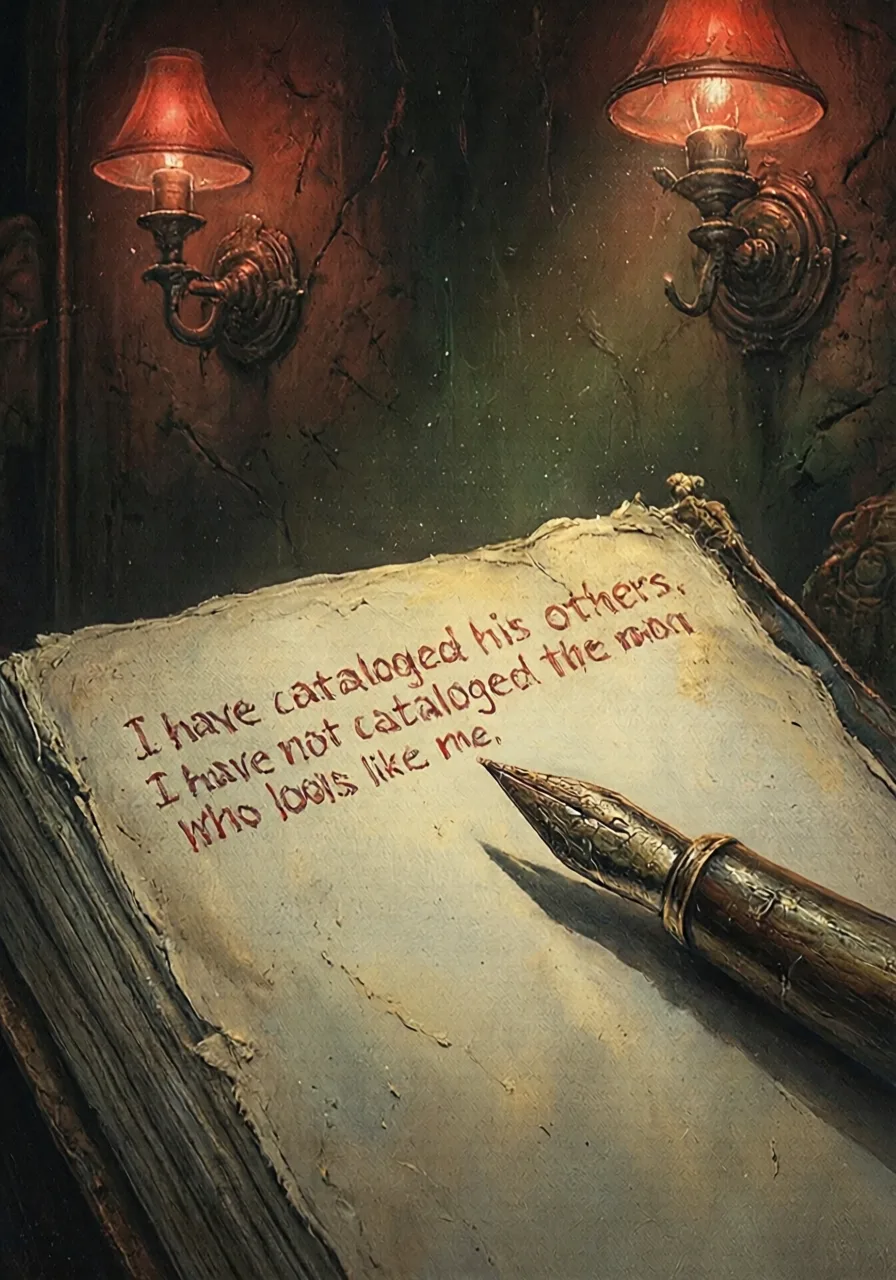
I have not catalogued the man who looks like me. I have catalogued the others.
The reports describe figures looking for what they have not finished. My catalogue is also a thing that is not finished. I work on it daily. I do not know whether finishing it is permitted.
Some evenings I think I am being asked, not visited. The asking has become familiar.
One spoke my name. Twice. I answered once. I did not see what answering twice would be for.
They walk. They look. They do not find. They return.
The tablet says the tree dreams. The dreams have feet. I have not catalogued the conclusion this might support. I have not catalogued the others either.
I am at my desk. The stylus is in my hand. The page is open. The next character is forming."
Section 0Frontmatter
# The Walkers
From the Catalogue of the Sixteenth Archivist, entry 6,442. Provenance: forty-three observer reports filed by Order personnel and travelers across the Librarian's tenure, sketches recovered from three of the observers, the Librarian's own notes on the apparitions she has spoken with, and a single line in the Founders' tablets that the Librarian has not been able to translate beyond seven words.
They walk the archive. They are seen. They are not always.
Section 1Section 1
The catalogue records visitations. The catalogue does not record what visits. It records what is reported to the Librarian and what she has herself observed. The reports do not agree.
The Librarian has filed three competing accounts of origin.
The first holds that the apparitions are the dead. The Order's records do not support this; the dead are catalogued in the ossuary and the ossuary's positions do not move. The caretaker has compared his charges against the reports and found no match.
The second holds that the apparitions are residue — memory leaked from the channels and given form by the liquid that runs the archive. The archive's liquid is red. The apparitions are pale. The Librarian has noted the discrepancy without resolving it.
The third rests on a tablet recovered in the deep stacks. The Librarian has translated seven words: the tree dreams. the dreams have feet. The remainder of the line is not legible. She has filed the tablet under reference.
She does not know which is true. She does not know whether more than one is true.
Section 2Section 2
A summary of the apparitions reported during the Librarian's tenure. The full register is in her secure file. Entries excerpted at her selection.
A man at the cistern hatch. He stands at the eastern hatch in the seventh hour of every fourth cycle. His hands are at his sides. He does not look down into the cistern. He is dressed for outside cold — a coat the Librarian's records identify as a cut three centuries out of use. He has been observed by twenty-seven witnesses across her tenure. None has observed him leave. Each report describes him in the same posture, in the same coat, in the same hour.
A child in the binding hall. She walks between the work tables holding a slate. She writes on the slate continuously. The writing fades before it can be read. She has been observed by eleven witnesses. She does not speak to them. She walks toward the eastern wall. There was a door there once. The wall absorbs her.
The reading alcove in the third hour. A woman sits at a desk that is not there. She holds a stylus. She turns pages. The stylus moves and the pages turn and she works at the desk that is not there for the duration of an hour and then she is gone. There was once a desk in that position. The Librarian's records confirm it.
A pair of hands at a table that is not there. The hands sort without a body. They have been observed by four witnesses. The hands stop when they are watched. The work resumes when the witness looks away.
A surveyor. He measures a wall that is no longer present. He marks the air at intervals. The marks fade. He is dressed in the Order's field tunic of an earlier century. He has been observed by nine witnesses. He has not been observed completing the measurement.
A man at the shelves. He pulls tomes that are not there. He opens them. He reads. He sets them back. He moves to the next shelf. He has been observed by six witnesses. He is dressed in the Order's robe of the present century. The Librarian has compared his face to the personnel registers of the present century and found no match.
Four figures at a table. They eat a meal that is not there. They smile at one another. They pass items. They have been observed by three witnesses. The witnesses report that the figures are happy. The Librarian has filed this report and has not annotated it.
Section 3Section 3
Fragment. The personal account of an Order attendant, assigned to the binding hall for one rotation. The hand is the attendant's. The account was filed without request and the Librarian has filed it among her observer reports.
"I worked in the binding hall for ninety-one days. I saw the child six times. I always saw her in the third afternoon hour, or what I knew then as the third afternoon hour — the time at which the western lamps begin to dim before the cycle ends.
She was small. She wore a sleeveless tunic the color of paper that has been wet. Her hair was loose. She walked with the gait of a child who has been told not to run and who is concentrating on not running. The slate she carried was the size of her chest. She wrote with chalk that I never saw her hold; her finger moved across the slate and the line followed.
I tried to read what she was writing once. I came up beside her and I matched her pace and I looked at the slate. The line was forming on it as she walked. The shapes were familiar. I do not read the old script of the Order, but I have shelved it and I know what it looks like.
The child stopped. She looked up at me. Her eyes were the color of the cistern water in the seventh basin — that pale green that does not come from any pigment I have catalogued. She did not seem afraid. She did not seem present.
She wrote one more character, looking up at me, without looking at the slate. The slate was at her chest. The character formed.
Then she walked on, and I watched her go through the eastern wall, and I sat down on a work bench because my legs did not feel as though they would carry me.
I did not see the slate again. I did not see her again until the third afternoon of the next day."
Section 4Section 4
The Librarian hears them.
The reports do not. The sketches do not annotate sound. The observers describe motion without speech. They describe the figures looking at them, sometimes, with no exchange. They describe silence.
The Librarian is at her desk. A figure pauses outside the alcove. She does not look up. The figure speaks. The speech is at the volume of breath, at a pitch she has not been able to record. The figures speak in languages the Librarian catalogues. They speak in languages the Librarian does not catalogue. They speak in voices she has heard before and in voices she has not.
She has recorded what they say. The recording is in her secure file. A summary follows.
They ask whether the work is finished. They ask whether the door is open. They ask whether someone has come back. They ask the year. They ask whether anyone has seen them.
One of them has spoken her name. Twice. The name is the Librarian's. The Librarian does not know how the figure knows it.
Most of them do not wait for an answer. The asking is the visit.
She has answered, sometimes. She has said: yes. She has said: no. She has said the year. She has said: I have seen you. The figures do not respond to her answers. They walk on. They proceed to the wall they will pass through. They proceed to the desk that is not there.
She does not know if they hear her. She believes they do.
Section 5Section 5
The man at the shelves has spoken to her seven times.
He pulls tomes that are not there. He reads them. He sets them back.
The Librarian, on the seventh occasion, set down her stylus and watched him work. He moved along the third row of the west wall. He took a tome. He opened it. He read.
He looked up at her. The face was hers.
He said: I am looking for an entry I wrote. I have been looking for it for some time. I think I may have shelved it elsewhere.
She said: I have not seen what you are looking for.
He said: I know. I have not either. The work is to keep looking.
He returned to the shelf. He pulled another tome that was not there.
The Librarian has not catalogued his face.
Section 6Section 6
They are looking.
The Librarian has noted this across forty-three reports. The figures do not wander. They proceed. They examine. They search.
The man at the cistern hatch is waiting for someone who is not coming. The child is delivering writing to a teacher who is no longer in the binding hall. The woman at the desk that is not there is finishing a catalogue she did not finish. The hands are sorting. The surveyor is measuring a wall the archive removed centuries ago. The man at the shelves is looking for what he wrote.
None of them find what they are looking for.
The Librarian has written, in a fragment found in the margin of an unrelated entry: they are not the dead. the dead are still. these are the not-finished. these are what the archive would not let go.
She has struck the fragment through. She has not erased it.
Entry 6,442, final annotation.
"They walk the archive. I have seen many of them. I have heard most of them.
I have not catalogued the man who looks like me. I have catalogued the others.
The reports describe figures looking for what they have not finished. My catalogue is also a thing that is not finished. I work on it daily. I do not know whether finishing it is permitted.
Some evenings I think I am being asked, not visited. The asking has become familiar.
One spoke my name. Twice. I answered once. I did not see what answering twice would be for.
They walk. They look. They do not find. They return.
The tablet says the tree dreams. The dreams have feet. I have not catalogued the conclusion this might support. I have not catalogued the others either.
I am at my desk. The stylus is in my hand. The page is open. The next character is forming."
Page 1
They walk the archive.
They walk the archive. They are seen. They are not always. The catalogue records visitations. The catalogue does not record what visits. It records what is reported to the Librarian and what she has herself observed.
The Librarian has filed three competing accounts of origin. The first holds that the apparitions are the dead. The second holds that they are residue — memory leaked from the channels and given form by the liquid that runs the archive. The third rests on a tablet recovered in the deep stacks. The Librarian has translated seven words: the tree dreams. the dreams have feet. The remainder of the line is not legible.
Page 2
The catalogue's apparitions.
A man at the cistern hatch. He stands at the eastern hatch in the seventh hour of every fourth cycle. His hands are at his sides. He does not look down into the cistern. He is dressed for outside cold — a coat the Librarian's records identify as a cut three centuries out of use. He has been observed by twenty-seven witnesses. None has observed him leave.
A child in the binding hall. She walks between the work tables holding a slate. She writes on the slate continuously. The writing fades before it can be read. She walks toward the eastern wall. There was a door there once. The wall absorbs her.
The reading alcove in the third hour. A woman sits at a desk that is not there. She holds a stylus. She turns pages. The stylus moves and the pages turn and she works at the desk that is not there for the duration of an hour and then she is gone. There was once a desk in that position. The Librarian's records confirm it.
Page 3
The character formed.
Fragment. The personal account of an Order attendant, assigned to the binding hall for one rotation. I tried to read what she was writing once. I came up beside her and I matched her pace and I looked at the slate. The line was forming on it as she walked. The shapes were familiar. I do not read the old script of the Order, but I have shelved it and I know what it looks like. The child stopped. She looked up at me. Her eyes were the colour of the cistern water in the seventh basin — that pale green that does not come from any pigment I have catalogued. She did not seem afraid. She did not seem present. She wrote one more character, looking up at me, without looking at the slate. The character formed.
She wrote one more character, looking up at me, without looking at the slate. The slate was at her chest. The character formed. Then she walked on, and I watched her go through the eastern wall, and I sat down on a work bench because my legs did not feel as though they would carry me.
Page 4
The Librarian hears them.
The Librarian hears them. The reports do not. The sketches do not annotate sound. The observers describe motion without speech. The Librarian is at her desk. A figure pauses outside the alcove. She does not look up. The figure speaks. The speech is at the volume of breath, at a pitch she has not been able to record.
She has recorded what they say. They ask whether the work is finished. They ask whether the door is open. They ask whether someone has come back. They ask the year. They ask whether anyone has seen them. One of them has spoken her name. Twice. The name is the Librarian's. The Librarian does not know how the figure knows it.
Page 5
He looked up at her. The face was hers.
The man at the shelves has spoken to her seven times. He pulls tomes that are not there. He reads them. He sets them back. The Librarian, on the seventh occasion, set down her stylus and watched him work. He moved along the third row of the west wall. He took a tome. He opened it. He read. He looked up at her. The face was hers.
The Walker at the ShelvesI am looking for an entry I wrote. I have been looking for it for some time. I think I may have shelved it elsewhere.
The LibrarianI have not seen what you are looking for.
The Walker at the ShelvesI know. I have not either. The work is to keep looking.
He returned to the shelf. He pulled another tome that was not there. The Librarian has not catalogued his face.
Page 6
They are not the dead. They are the not-finished.
They are looking. The figures do not wander. They proceed. They examine. They search. None of them find what they are looking for. They are not the dead. The dead are still. These are the not-finished. These are what the archive would not let go. They walk. They look. They do not find. They return. The tablet says the tree dreams. The dreams have feet. I am at my desk. The stylus is in my hand. The page is open. The next character is forming.
Listen ModeClick a section to begin listening
The chronicle plays section by section in the Librarian's voice. As each section plays, the corresponding pages of the comic are highlighted. Switch to Scroll, Flip, Prose, or Split at any time — the audio continues, and you can follow visually.
Section 0Frontmatter
# The Walkers
From the Catalogue of the Sixteenth Archivist, entry 6,442. Provenance: forty-three observer reports filed by Order personnel and travelers across the Librarian's tenure, sketches recovered from three of the observers, the Librarian's own notes on the apparitions she has spoken with, and a single line in the Founders' tablets that the Librarian has not been able to translate beyond seven words.
They walk the archive. They are seen. They are not always.
Section 1Section 1
The catalogue records visitations. The catalogue does not record what visits. It records what is reported to the Librarian and what she has herself observed. The reports do not agree.
The Librarian has filed three competing accounts of origin.
The first holds that the apparitions are the dead. The Order's records do not support this; the dead are catalogued in the ossuary and the ossuary's positions do not move. The caretaker has compared his charges against the reports and found no match.
The second holds that the apparitions are residue — memory leaked from the channels and given form by the liquid that runs the archive. The archive's liquid is red. The apparitions are pale. The Librarian has noted the discrepancy without resolving it.
The third rests on a tablet recovered in the deep stacks. The Librarian has translated seven words: the tree dreams. the dreams have feet. The remainder of the line is not legible. She has filed the tablet under reference.
She does not know which is true. She does not know whether more than one is true.
Section 2Section 2
A summary of the apparitions reported during the Librarian's tenure. The full register is in her secure file. Entries excerpted at her selection.
A man at the cistern hatch. He stands at the eastern hatch in the seventh hour of every fourth cycle. His hands are at his sides. He does not look down into the cistern. He is dressed for outside cold — a coat the Librarian's records identify as a cut three centuries out of use. He has been observed by twenty-seven witnesses across her tenure. None has observed him leave. Each report describes him in the same posture, in the same coat, in the same hour.
A child in the binding hall. She walks between the work tables holding a slate. She writes on the slate continuously. The writing fades before it can be read. She has been observed by eleven witnesses. She does not speak to them. She walks toward the eastern wall. There was a door there once. The wall absorbs her.
The reading alcove in the third hour. A woman sits at a desk that is not there. She holds a stylus. She turns pages. The stylus moves and the pages turn and she works at the desk that is not there for the duration of an hour and then she is gone. There was once a desk in that position. The Librarian's records confirm it.
A pair of hands at a table that is not there. The hands sort without a body. They have been observed by four witnesses. The hands stop when they are watched. The work resumes when the witness looks away.
A surveyor. He measures a wall that is no longer present. He marks the air at intervals. The marks fade. He is dressed in the Order's field tunic of an earlier century. He has been observed by nine witnesses. He has not been observed completing the measurement.
A man at the shelves. He pulls tomes that are not there. He opens them. He reads. He sets them back. He moves to the next shelf. He has been observed by six witnesses. He is dressed in the Order's robe of the present century. The Librarian has compared his face to the personnel registers of the present century and found no match.
Four figures at a table. They eat a meal that is not there. They smile at one another. They pass items. They have been observed by three witnesses. The witnesses report that the figures are happy. The Librarian has filed this report and has not annotated it.
Section 3Section 3
Fragment. The personal account of an Order attendant, assigned to the binding hall for one rotation. The hand is the attendant's. The account was filed without request and the Librarian has filed it among her observer reports.
"I worked in the binding hall for ninety-one days. I saw the child six times. I always saw her in the third afternoon hour, or what I knew then as the third afternoon hour — the time at which the western lamps begin to dim before the cycle ends.
She was small. She wore a sleeveless tunic the color of paper that has been wet. Her hair was loose. She walked with the gait of a child who has been told not to run and who is concentrating on not running. The slate she carried was the size of her chest. She wrote with chalk that I never saw her hold; her finger moved across the slate and the line followed.
I tried to read what she was writing once. I came up beside her and I matched her pace and I looked at the slate. The line was forming on it as she walked. The shapes were familiar. I do not read the old script of the Order, but I have shelved it and I know what it looks like.
The child stopped. She looked up at me. Her eyes were the color of the cistern water in the seventh basin — that pale green that does not come from any pigment I have catalogued. She did not seem afraid. She did not seem present.
She wrote one more character, looking up at me, without looking at the slate. The slate was at her chest. The character formed.
Then she walked on, and I watched her go through the eastern wall, and I sat down on a work bench because my legs did not feel as though they would carry me.
I did not see the slate again. I did not see her again until the third afternoon of the next day."
Section 4Section 4
The Librarian hears them.
The reports do not. The sketches do not annotate sound. The observers describe motion without speech. They describe the figures looking at them, sometimes, with no exchange. They describe silence.
The Librarian is at her desk. A figure pauses outside the alcove. She does not look up. The figure speaks. The speech is at the volume of breath, at a pitch she has not been able to record. The figures speak in languages the Librarian catalogues. They speak in languages the Librarian does not catalogue. They speak in voices she has heard before and in voices she has not.
She has recorded what they say. The recording is in her secure file. A summary follows.
They ask whether the work is finished. They ask whether the door is open. They ask whether someone has come back. They ask the year. They ask whether anyone has seen them.
One of them has spoken her name. Twice. The name is the Librarian's. The Librarian does not know how the figure knows it.
Most of them do not wait for an answer. The asking is the visit.
She has answered, sometimes. She has said: yes. She has said: no. She has said the year. She has said: I have seen you. The figures do not respond to her answers. They walk on. They proceed to the wall they will pass through. They proceed to the desk that is not there.
She does not know if they hear her. She believes they do.
Section 5Section 5
The man at the shelves has spoken to her seven times.
He pulls tomes that are not there. He reads them. He sets them back.
The Librarian, on the seventh occasion, set down her stylus and watched him work. He moved along the third row of the west wall. He took a tome. He opened it. He read.
He looked up at her. The face was hers.
He said: I am looking for an entry I wrote. I have been looking for it for some time. I think I may have shelved it elsewhere.
She said: I have not seen what you are looking for.
He said: I know. I have not either. The work is to keep looking.
He returned to the shelf. He pulled another tome that was not there.
The Librarian has not catalogued his face.
Section 6Section 6
They are looking.
The Librarian has noted this across forty-three reports. The figures do not wander. They proceed. They examine. They search.
The man at the cistern hatch is waiting for someone who is not coming. The child is delivering writing to a teacher who is no longer in the binding hall. The woman at the desk that is not there is finishing a catalogue she did not finish. The hands are sorting. The surveyor is measuring a wall the archive removed centuries ago. The man at the shelves is looking for what he wrote.
None of them find what they are looking for.
The Librarian has written, in a fragment found in the margin of an unrelated entry: they are not the dead. the dead are still. these are the not-finished. these are what the archive would not let go.
She has struck the fragment through. She has not erased it.
Entry 6,442, final annotation.
"They walk the archive. I have seen many of them. I have heard most of them.
I have not catalogued the man who looks like me. I have catalogued the others.
The reports describe figures looking for what they have not finished. My catalogue is also a thing that is not finished. I work on it daily. I do not know whether finishing it is permitted.
Some evenings I think I am being asked, not visited. The asking has become familiar.
One spoke my name. Twice. I answered once. I did not see what answering twice would be for.
They walk. They look. They do not find. They return.
The tablet says the tree dreams. The dreams have feet. I have not catalogued the conclusion this might support. I have not catalogued the others either.
I am at my desk. The stylus is in my hand. The page is open. The next character is forming."