All Comics
Entry 12,102

THE HUNTER

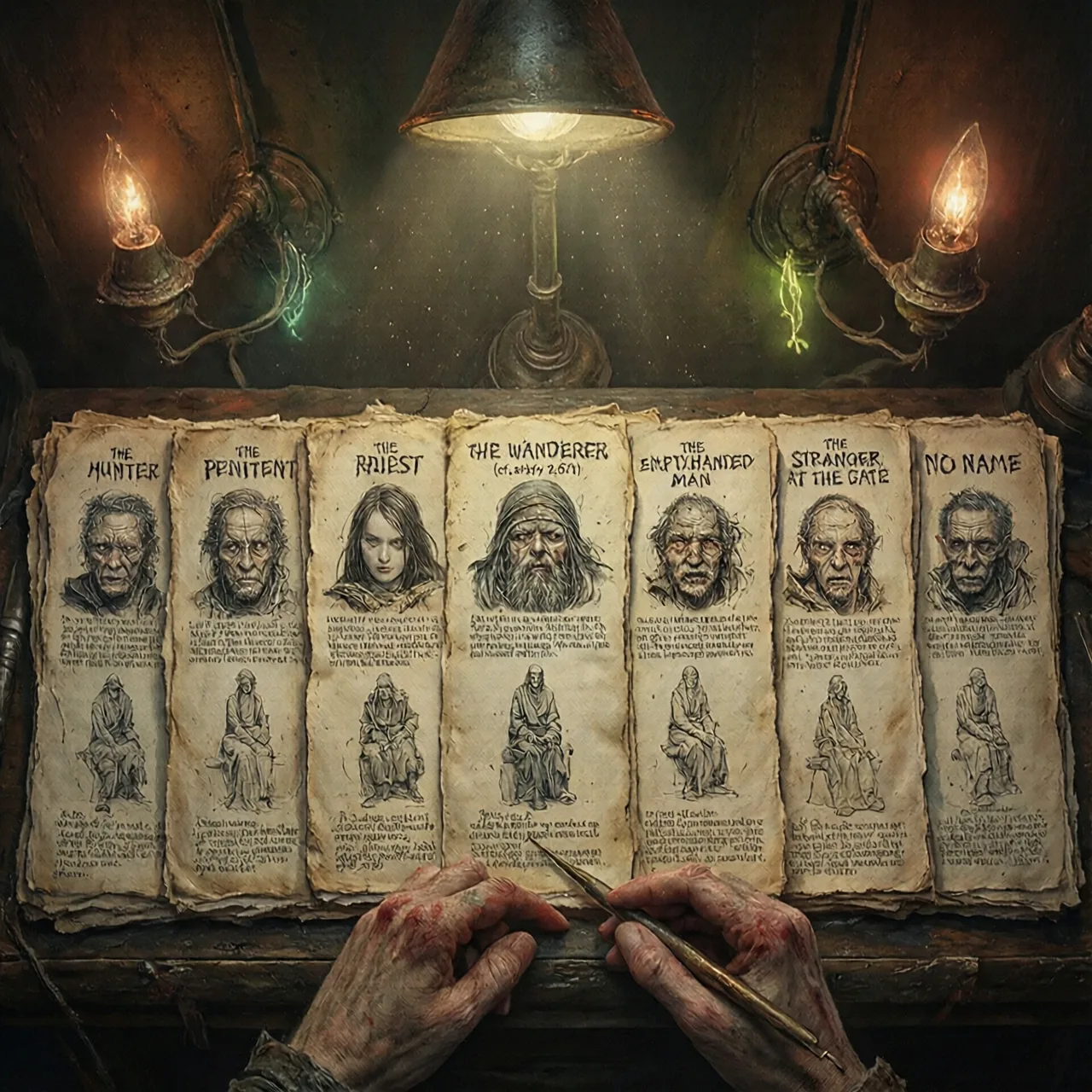
From the Catalogue of the Sixteenth Archivist. Seven accounts collected across a period longer than a lifetime. The accounts do not agree on the figure's name. They do not agree on his face. They do not agree on whether he is one man or many. The Librarian has filed them here because they describe the same absence.
Someone was going through the gifted. They stopped being gifted. Then they stopped.
Full chronicle
Page 1

Seven names. The same absence.

What the accounts share is the arrival of a figure and the ending of a gift and, shortly after, the ending of the person who had held it. The arrivals do not match in description. The endings match so closely she has laid the records side by side and read them as a single sentence. She has no name for him. The accounts call him many things. The Hunter. The Penitent. The Priest. The Wanderer. She has used the Hunter for the shelving because a shelving designation is required and the word sits on her tongue without discomfort.
Page 2

There was no mark on the boy.

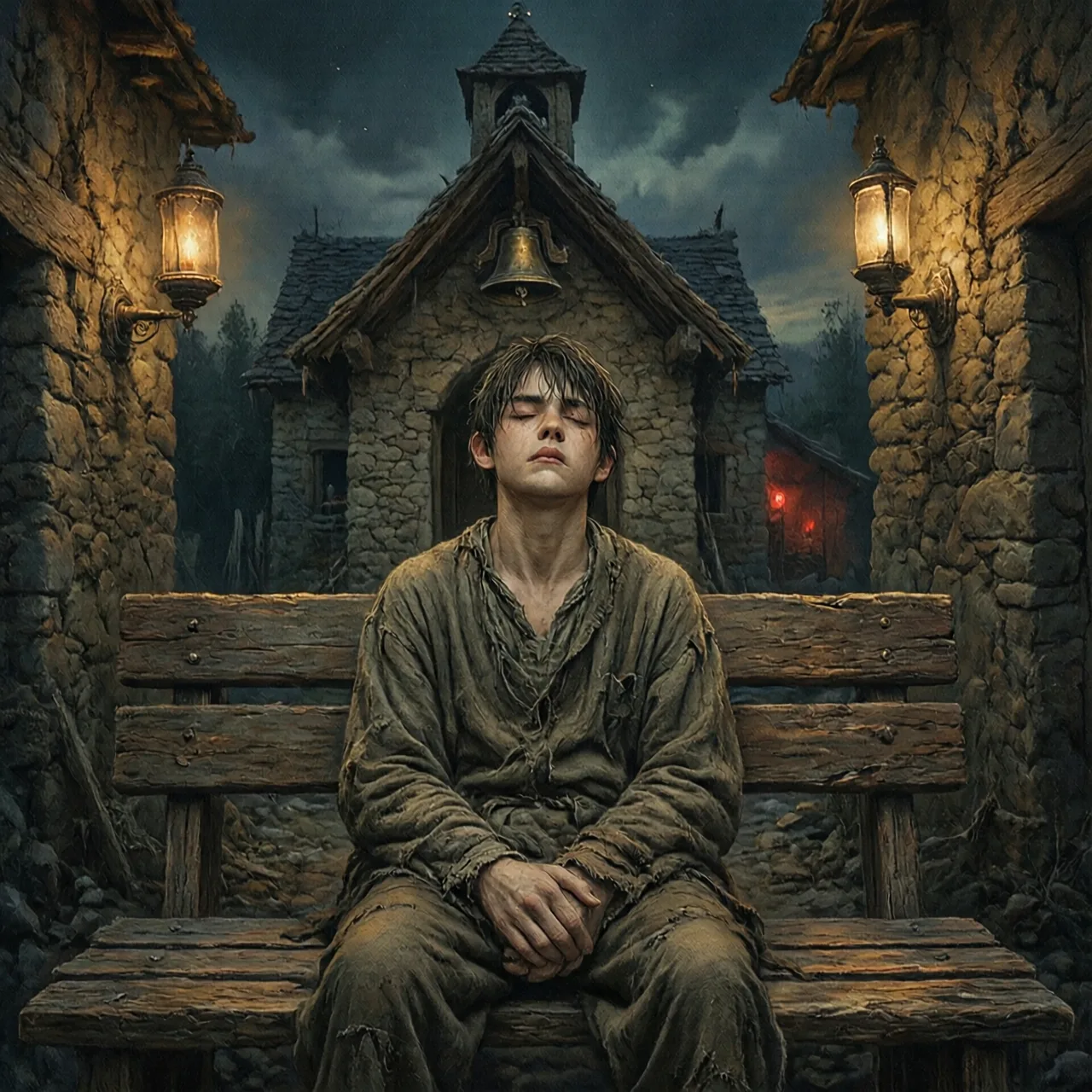
He was sitting on a bench behind the chapel when I arrived. His hands were in his lap. He was not breathing. He had not been breathing for eight hours. The chapel bell was silent. The villagers said the bell had cracked again an hour after the boy had stopped moving. There was no mark on the boy. There was a mark on the bench where a man had sat beside him for some time. The wood was polished where the right palm had rested. The wood was not polished where the left palm had rested.
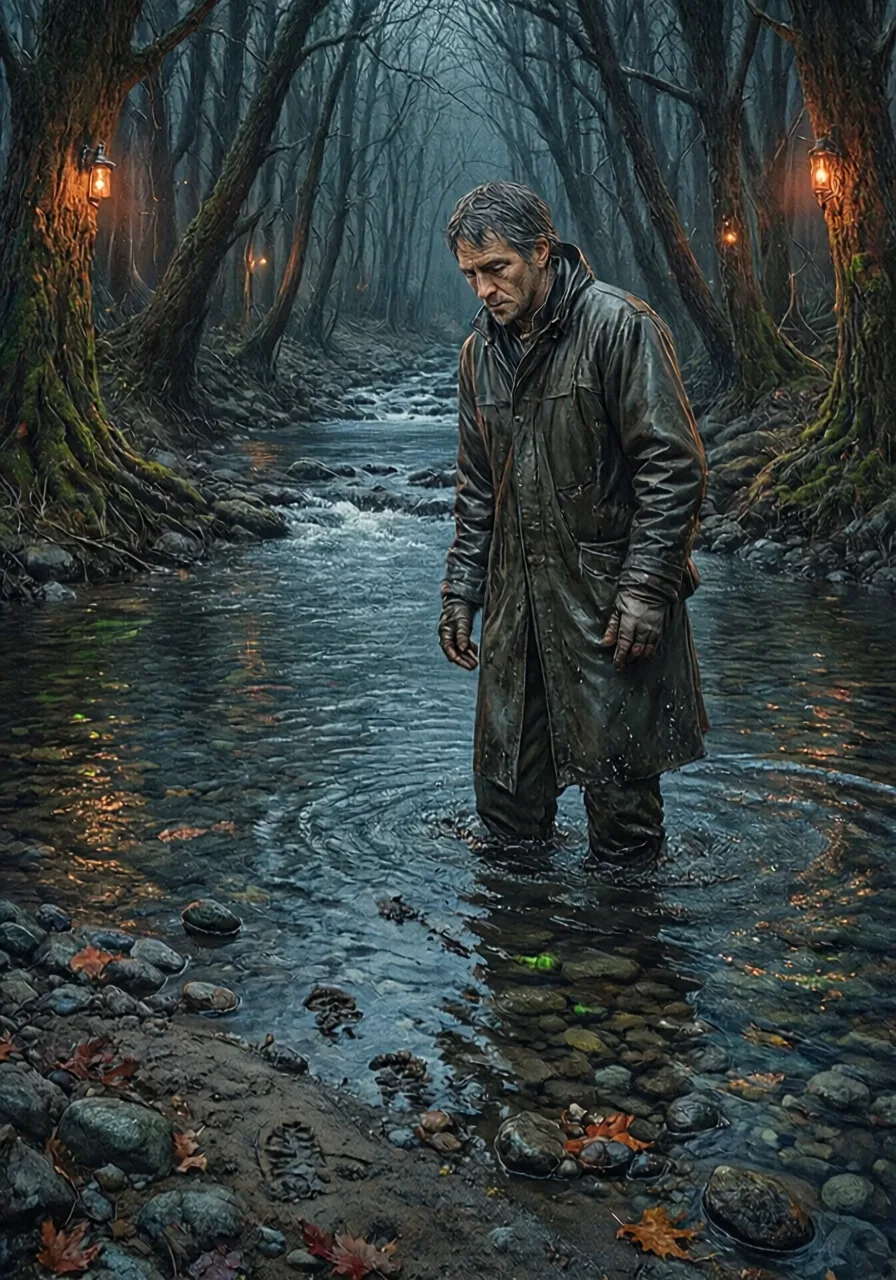
I followed him out the north road to a creek crossing where his tracks entered the water and did not exit the other side. I stood in the water up to my knees for an hour. The water was cold. He was not in the water. He was not on either bank. I went home.
Page 3

The gait. Two-thirds of a metre.

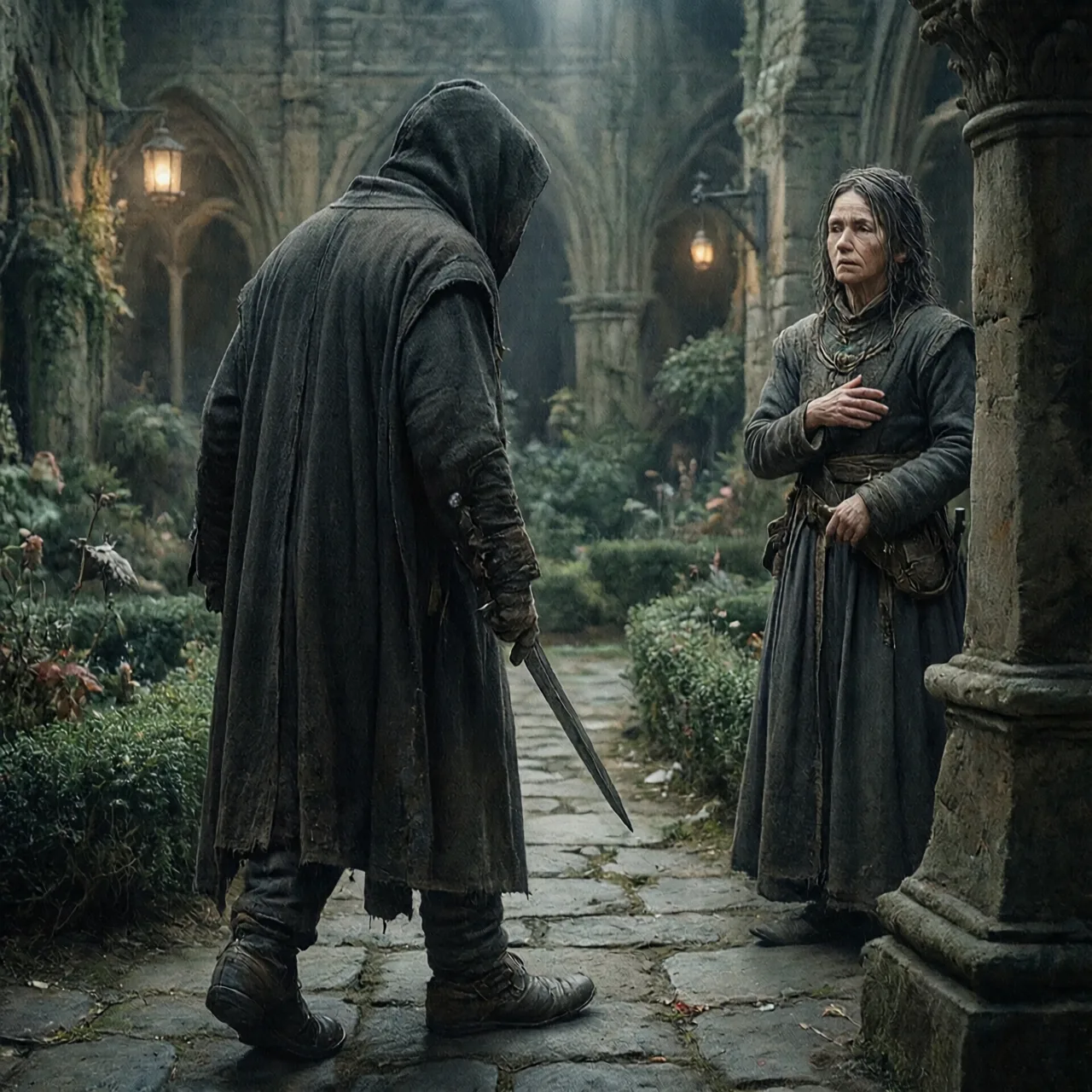
The man stood at the cloister wall for some time and then crossed the garden at a walk. His stride was two-thirds of a metre. His weight fell on the ball of his foot. I remember the gait because I have seen a gait like it once before, in a different place, under different circumstances. I will not record where.
Page 4

I sold him a knife.

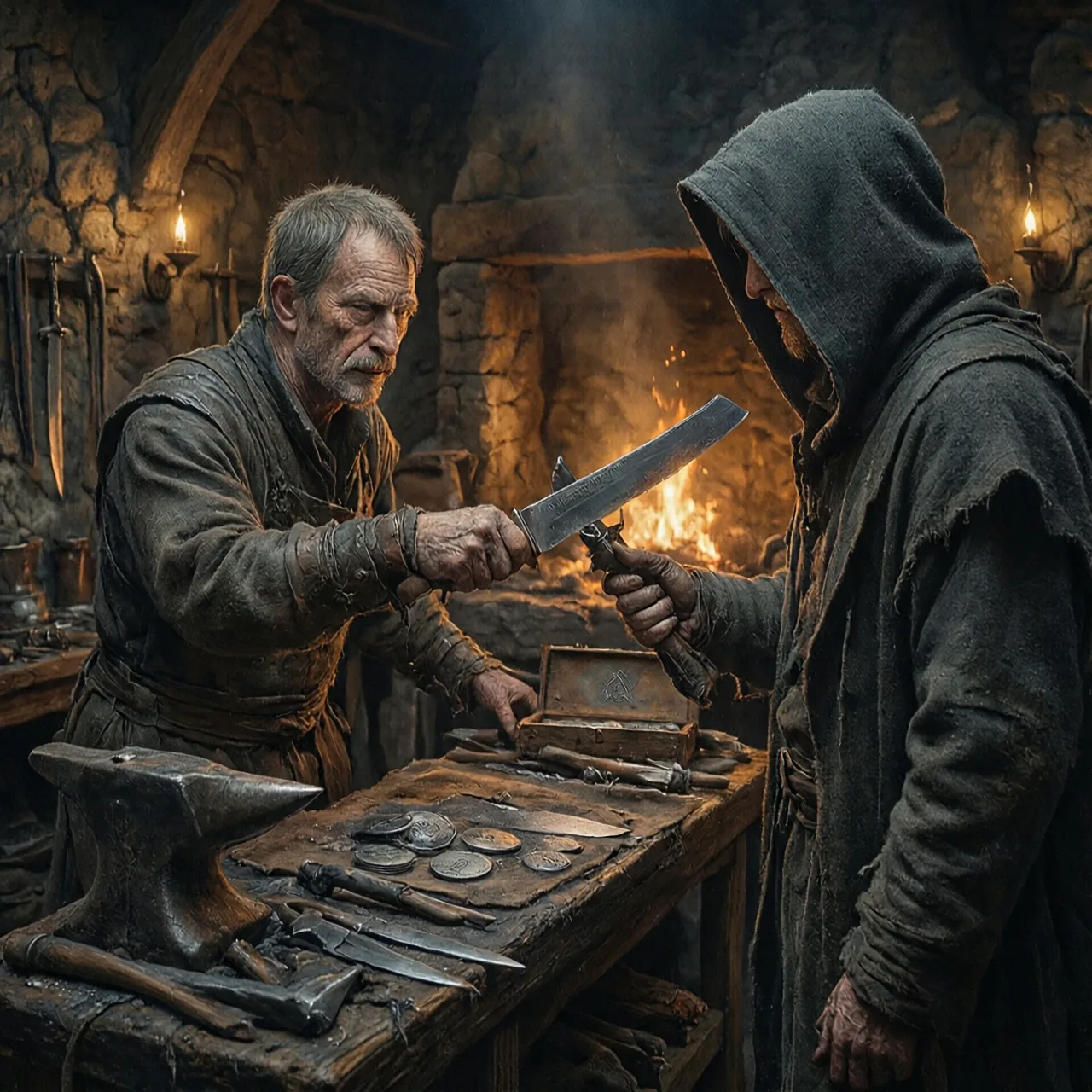
He came to my forge at the hour of the second bell and he stood in the doorway and he did not step in. He asked for a working knife. He said the word working and he said nothing else about the purpose. I sold him a knife. He paid in silver that had the Order's mint on one side and a mark I did not recognise on the other. I had not seen his face. I had seen his hood. I had seen his hands taking the knife. I spent the rest of the evening trying to remember what he looked like and I have spent every evening since.
Page 5

The margin assumed the guardian would not attend.

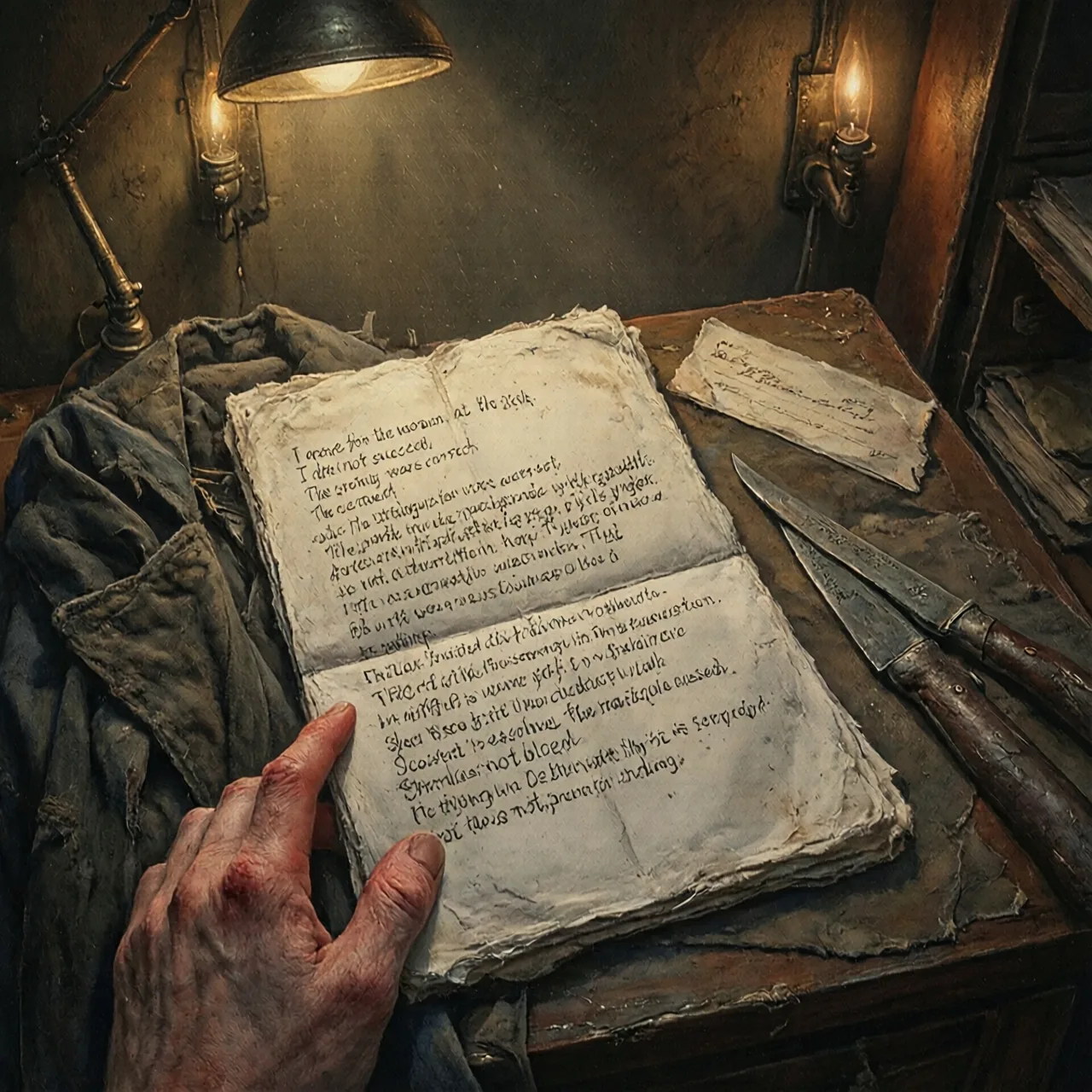
I came for the woman at the desk. I did not succeed. The margin assumed the guardian would not attend to her. The assumption was wrong. I have ended the other forty-one without intervention. The one at the desk is not among the gifted in the ordinary sense. She does not bleed. The thing we believed of her is correct. It is correct in a way that does not permit ending. I will not make the attempt again.
Page 6

I have forty-one folded hands.

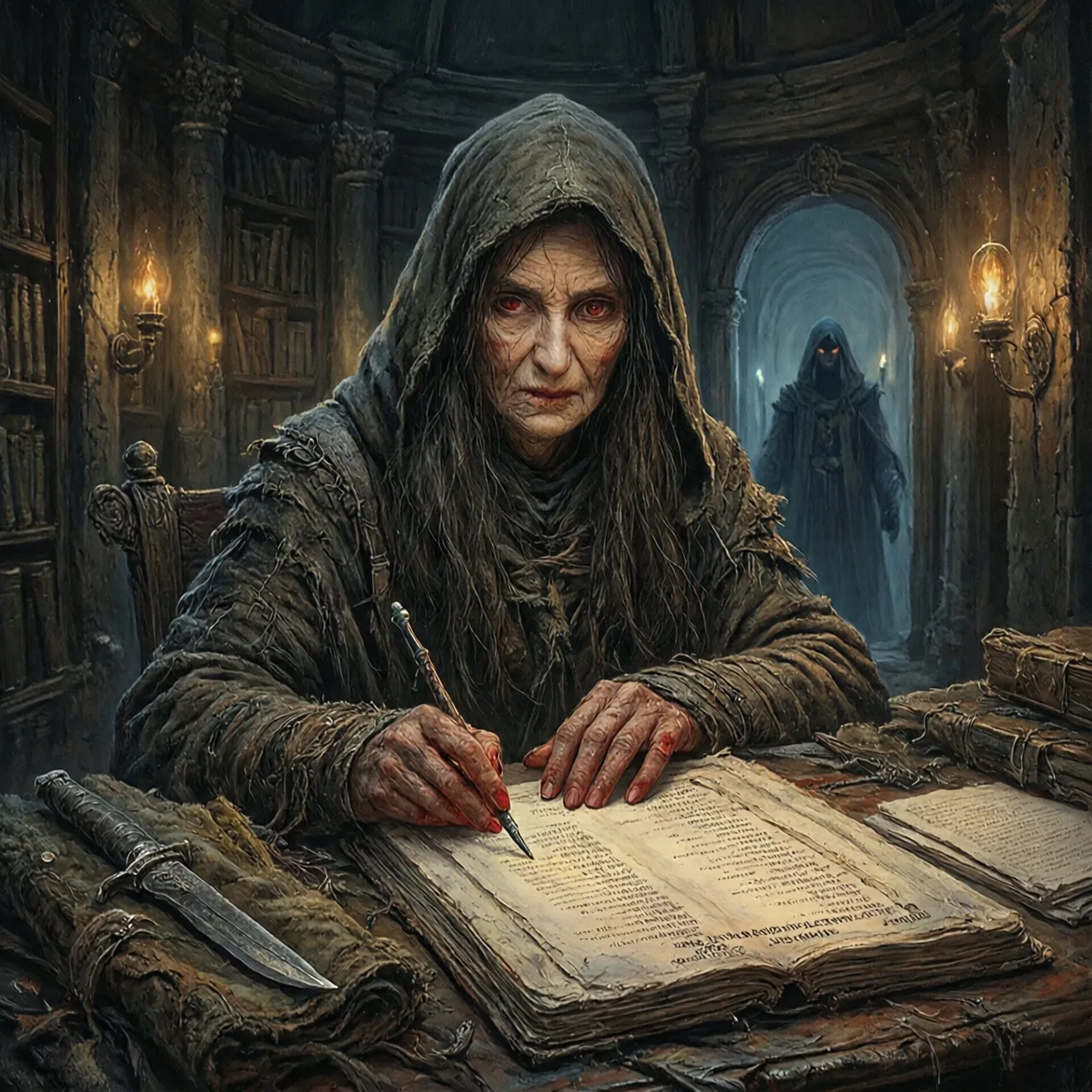
The guardian has not come for him. The guardian does not walk where he walks. I think — and I write this knowing I have no basis — that they have spoken. Not in any fashion I could record. That whatever the hunter came to do, he came close enough once to learn that the guardian would not permit it, in this place, in this corridor, at this desk, and he left without making the attempt a second time. I have his knife. I have his letter. I have his coat. I have forty-one folded hands. I will not add mine.
— / —
narration auto-scrolls the prose

Section 0Frontmatter

# The Hunter

From the Catalogue of the Sixteenth Archivist, entry 12,102. Provenance: seven accounts collected across a period the Librarian cannot fix more precisely than "longer than a lifetime." The accounts do not agree on the figure's name. They do not agree on his face. They do not agree on whether he is one man or many. The Librarian has filed them here because they describe the same absence.

Someone was going through the gifted. They stopped being gifted. Then they stopped.

Section 1Section 1

The Librarian keeps the names alphabetically. Edden. Kell. The woman from the thaumaturgy lab. The man who described sealed containers. The calibrator, a girl without a surname. The fourteen in entry 2,871 whose names file is missing, catalogued only as attuned. Others — scattered, single entries across a span of records the Librarian cannot fully reconcile. The count may be low. The records of the gifted are not complete, and the gifted were not always noted as gifted while they lived.

What the accounts share is the arrival of a figure and the ending of a gift and, shortly after, the ending of the person who had held it. The arrivals do not match in description. The endings match so closely she has laid the records side by side and read them as a single sentence.

She has no name for him. The accounts call him many things. The Hunter. The Penitent. The Priest. The Wanderer — though that entry already has its own file and she has not moved this figure into it. She has used the Hunter for the shelving because a shelving designation is required and the word sits on her tongue without discomfort. She offers this disclaimer: the designation is hers. The figure does not carry it.

Section 2Section 2

Fragment. Written by a traveler who had hired out as a tracker to the Order's southern expeditions. Recovered from the binding of a road-log the man sold for passage at the outer ring. The hand is hard-used. The letters are upright and spare.

"I have followed bad men for most of my life. I have followed them across ice. I followed one for eleven days through a forest that had been burned so recently the ash had not settled. I know what a man looks like from a long way off.

I followed this one for thirty-one days and I did not see him once. I saw what he had done. I saw where he had slept — the grass pressed flat in the shape of a body that lay on its side and did not turn in the night. I saw where he had washed his hands in a stream. The water was clear. There was a stain on a rock the size of a thumbprint and the stain was not rust.

I came into a village on the nineteenth day. A boy there had been gifted. The villagers had seen him mend a cracked bell by laying his palm on the clapper. The bell had rung true after and continued to ring true for seven years. The boy was nineteen. The villagers fed him extra because of the bell.

He was sitting on a bench behind the chapel when I arrived. His hands were in his lap. He was not breathing. He had not been breathing for eight hours. The chapel bell was silent. The villagers said the bell had cracked again an hour after the boy had stopped moving. It had cracked in the same place. They were about to melt it down.

There was no mark on the boy. There was a mark on the bench where a man had sat beside him for some time. The wood was polished where the right palm had rested. The wood was not polished where the left palm had rested. The left hand had been clean of calluses, or had worn gloves, or had not been present.

I did not find him in the village. I followed him out the north road to a creek crossing where his tracks entered the water and did not exit the other side. I stood in the water up to my knees for an hour. The water was cold. He was not in the water. He was not on either bank.

I went home."

Section 3Section 3

Fragment. A leaf torn from a prayer-book used by the priesthood of the Coil. The Librarian has matched the hand to a man in the personnel register whose name was struck through and replaced with a designation. The designation is the one used for men who walked into the void and did not return from it. The leaf is dated before the striking.

"I have been reading the record of the Engineer. I have read it many times. The Order does not keep the full record — it keeps the part about the machine. The part about the flash is filed separately and the Order does not speak of it. I have read the part about the flash because I asked for it and was not refused.

A thing entered him without asking. It made him a vessel. It used him until the work was done and then it set him down and he did not get up.

The Order treats the Coil as the triumph of this account. I have come to believe the Coil is incidental. The account is about a man who was taken.

I have watched the attuned in the upper laboratories. I have watched the oracles. I have watched a child in the calibration hall light a rune that had been dark since the Founders laid the floor. The child was eight. The rune was older than the stone the child was kneeling on.

Something is asking. The Order assumes the asking is benign because the answers are useful. This is not a basis for assumption.

A person who is being used is still being used even if they consent. A vessel is not improved by the knowledge that it is a vessel. A flame is no less a flame because you chose to hold your hand above it.

I have asked for permission to descend. The Order has refused. I have asked again. I will ask once more and then I will go regardless."

Section 4Section 4

The priest in the prayer-book descended. The personnel register records his absence. It does not record him as deceased. It records him, and others like him, under the column the register uses for the descents that ended where the register could not follow: no longer relevant.

Fragment. An incident report filed by a senior initiate of the Cathedral City. Undated.

"A man came to the penance garden at the hour of the first bell. He did not present himself. He waited at the cloister wall until a child from the bindings crossed through. The child had a gift — a small one, the ability to know when a bell would ring before the rope was pulled. The initiates had permitted it. The child was fourteen.

I saw the man speak to the child. I could not hear what he said. The child listened. The child's face did not change but a quality went out of it — I cannot name the quality, only that it had been there for the four months I had known the child and it was not there after.

The child resumed walking. The man did not follow. The man stood at the cloister wall for some time and then crossed the garden at a walk. His stride was two-thirds of a meter. His weight fell on the ball of his foot. I remember the gait because I have seen a gait like it once before, in a different place, under different circumstances. I will not record where.

The child was found three days later in the sanctuary with its hands folded. The hands were cold. The ropes in the tower no longer reported their intent to the initiates who pulled them. I do not know whether they never had, or whether the child had been the reason, or whether the reason had been something else and the child had been incidental."

Section 5Section 5

The Librarian has matched the gait across three fragments. She has not matched it across more because the other fragments do not describe how the figure walked. The initiates' account is the only one that names the stride length. Two-thirds of a meter. She has recorded where else she has encountered this specification. She has filed the cross-reference under a heading she has not opened again.

The figure does not always carry a weapon. Five of the seven accounts describe him as empty-handed. Two describe a knife.

The knife in the two accounts is described with specificity. A working knife, eight inches, ground on both edges, hilt bound in leather softened against the palm. The descriptions are identical. The Librarian has catalogued knives for the duration of her tenure and she knows how difficult it is for two witnesses to describe the same knife in the same words. The two accounts were filed eleven years apart.

The knife from entry 11,847 matches the description.

She has not moved the entry. The knife is in a box under her desk. The descriptions were filed before the knife came to her. She has compared the leather wear. The comparison was inconclusive in a way she records without remarking on.

Fragment. Personal account of a journey-smith who had mended armor for travelers at the junction of the eastern crossroads. The man wrote it at the end of his life and left it in a box that came to the archive among the effects of his daughter.

"I sold him a knife. He came to my forge at the hour of the second bell and he stood in the doorway and he did not step in. He asked for a working knife. He said the word working and he said nothing else about the purpose. I sold him a knife. He paid in silver that had the Order's mint on one side and a mark I did not recognize on the other. I set the coin aside and it was gone from the box in the morning and I did not remember putting it somewhere safer.

He did not speak his thanks. He turned and walked into the evening and I watched him until he was past the edge of the lamp and then I realized I had not seen his face. I had seen his hood. I had seen his hands taking the knife. I had not seen his face. I spent the rest of the evening trying to remember what he looked like and I have spent every evening since.

The knife was one I had made for a caravan guard who had died of fever before picking it up. I had kept it for eleven years. I had cleaned it once a month. The leather on the hilt was softer than leather has any right to be. I sold it for half the price a knife like that should fetch. I do not know why I set the price where I did. I remember opening my mouth and saying a number that was not the number I had intended.

He took it and he left and the sound of his boots on the stones of the crossroads was the sound of a man who had been walking in boots for a very long time and had stopped noticing the ground under them."
Section 6Section 6

Fragment. An account written in a journal, unsigned, by someone who had lived in the outer ring for years. The handwriting is elderly. The paper is good. The Librarian has not been able to determine which outer ring.

"I was taking down the accounts for the winter when he passed my desk. My desk faces the corridor that leads from the gate to the inner ring, and everyone who enters the ring enters past me. I mark them in the book. I had not marked him. I had not seen him at the gate. I had not seen him come down the corridor. I saw him only when he was level with the desk, and by then he was walking away from me, and his back was the first part of him I had to work from.

He walked through the corridor and out into the ring and no one stopped him because no one noticed him to stop. I did not call out. I do not know why I did not call out.

He went to the house of a woman who had been gifted. She had been able to tell the age of metals by holding them in her mouth. She had done this for the goldsmiths for thirty years. They paid her in food and she had lived well and her teeth were silver-dark and her tongue had been reliable for the full span of her practice.

I saw him enter her house. I did not see him leave. She was found in her chair the next morning. Her hands were folded. Her teeth had gone the color of ordinary teeth. The goldsmiths brought her a bar of alloyed metal the following week out of respect — they did not believe she had died — and she did not hold the bar in her mouth because she was in the ground, and if she had still been in the chair the bar would have told her nothing. Her mouth was an ordinary mouth, now, and had been since the hour the man crossed the ring.

I have kept this account because my husband told me to keep it. My husband is dead. He died because he was gifted. I am writing this down because I was not gifted and the man did not come for me, and someone should remember how he walked."

Section 7Section 7

Fragment. A single sheet, folded once, found slid between two tomes in section 114-east. The hand is not the Librarian's. The date is recent. The ink had not set when the sheet was placed. The Librarian notes that the shelving in 114-east had been repaired the week before the sheet was found.

"I came for the woman at the desk. I did not succeed.

The seeing was correct. The designation was correct. The work had been prepared in accordance with the margin. The margin assumed the guardian would not attend to her. The assumption had been verified by the route analysis I conducted over eleven visits across thirty-one months. The assumption was wrong.

The one I was paid to end is not the same as the one I am ending. I have ended the other forty-one without intervention. The one at the desk is not among the gifted in the ordinary sense. She is something the ordinary work does not resolve.

The margin is closed. The assumption cannot be corrected by further study.

I will not make the attempt again. I have returned the silver to the stone beneath the third rung. I have left the letter I was given folded inside the coat. The coat is in the corridor where I was standing when the geometry came for me. The knife is in the corridor where it fell.

She does not bleed. The thing we believed of her is correct. It is correct in a way that does not permit ending.

I have other work. The work has a duration and the duration will close. When it has closed I will consider whether to go into the door again. I do not know whether the door will open for me a second time. I do not know whether I am the one who opened it the first time."

Section 8Section 8

Entry 12,102, final annotation.

"The seven accounts in this entry do not describe the same person. I have said this at the beginning of the file. I maintain it. I maintain it with the same confidence I would claim for any statement I make in this archive, which is to say with a confidence that depends on the meaning of the word.

They describe seven versions of a person who has the same effect. The stride is the same. The gait is the same. The work is the same. The work leaves the same kind of body — sitting, folded, cold, unmarked. The villages that lose the gifted do not lose them violently. A gift is a thing that was arriving from somewhere. It stops arriving. The place it used to arrive at stops needing to exist. The person does not protest. The bodies are never fought in. They are always sitting down.

I have searched the personnel register for a priest who asked to descend and was refused and went regardless. There are four such entries across the span I can access. Three are listed as unresolved. One is listed in a hand I do not know and the hand has filled in a date of return. The interval between descent and return, which the register accepts without comment, is four hundred and forty-seven years.

I do not name the priest. The register does not name him. The name is in a file that has been moved out of my reach by persons I cannot identify at times I cannot locate. I have catalogued him by the date his prayer-book fragment was written. The tracker's account is the first in which the figure appears. Both dates are in my notes. The interval between them is inside the window the register accepts without comment.

The villages where he has passed have kept him. Not by name. They describe him in stories told at the hour of the last bell. They do not agree on the description. They agree on the silence of his approach and the folded hands of his leaving.

I do not know whether he is protecting or taking. I have filed the fragments in order. I have not weighted them. The word for what he does does not exist in any of the languages I catalogue and I do not presume to coin one.

The guardian has not come for him. The guardian does not walk where he walks. I think — and I write this knowing I have no basis — that they have spoken. Not in any fashion I could record. That whatever the hunter came to do, he came close enough once to learn that the guardian would not permit it, in this place, in this corridor, at this desk, and he left without making the attempt a second time.

I have his knife. I have his letter. I have his coat.

I have forty-one folded hands.

I will not add mine."

Section 0Frontmatter

# The Hunter

From the Catalogue of the Sixteenth Archivist, entry 12,102. Provenance: seven accounts collected across a period the Librarian cannot fix more precisely than "longer than a lifetime." The accounts do not agree on the figure's name. They do not agree on his face. They do not agree on whether he is one man or many. The Librarian has filed them here because they describe the same absence.

Someone was going through the gifted. They stopped being gifted. Then they stopped.

Section 1Section 1

The Librarian keeps the names alphabetically. Edden. Kell. The woman from the thaumaturgy lab. The man who described sealed containers. The calibrator, a girl without a surname. The fourteen in entry 2,871 whose names file is missing, catalogued only as attuned. Others — scattered, single entries across a span of records the Librarian cannot fully reconcile. The count may be low. The records of the gifted are not complete, and the gifted were not always noted as gifted while they lived.

What the accounts share is the arrival of a figure and the ending of a gift and, shortly after, the ending of the person who had held it. The arrivals do not match in description. The endings match so closely she has laid the records side by side and read them as a single sentence.

She has no name for him. The accounts call him many things. The Hunter. The Penitent. The Priest. The Wanderer — though that entry already has its own file and she has not moved this figure into it. She has used the Hunter for the shelving because a shelving designation is required and the word sits on her tongue without discomfort. She offers this disclaimer: the designation is hers. The figure does not carry it.

Section 2Section 2

Fragment. Written by a traveler who had hired out as a tracker to the Order's southern expeditions. Recovered from the binding of a road-log the man sold for passage at the outer ring. The hand is hard-used. The letters are upright and spare.

"I have followed bad men for most of my life. I have followed them across ice. I followed one for eleven days through a forest that had been burned so recently the ash had not settled. I know what a man looks like from a long way off.

I followed this one for thirty-one days and I did not see him once. I saw what he had done. I saw where he had slept — the grass pressed flat in the shape of a body that lay on its side and did not turn in the night. I saw where he had washed his hands in a stream. The water was clear. There was a stain on a rock the size of a thumbprint and the stain was not rust.

I came into a village on the nineteenth day. A boy there had been gifted. The villagers had seen him mend a cracked bell by laying his palm on the clapper. The bell had rung true after and continued to ring true for seven years. The boy was nineteen. The villagers fed him extra because of the bell.

He was sitting on a bench behind the chapel when I arrived. His hands were in his lap. He was not breathing. He had not been breathing for eight hours. The chapel bell was silent. The villagers said the bell had cracked again an hour after the boy had stopped moving. It had cracked in the same place. They were about to melt it down.

There was no mark on the boy. There was a mark on the bench where a man had sat beside him for some time. The wood was polished where the right palm had rested. The wood was not polished where the left palm had rested. The left hand had been clean of calluses, or had worn gloves, or had not been present.

I did not find him in the village. I followed him out the north road to a creek crossing where his tracks entered the water and did not exit the other side. I stood in the water up to my knees for an hour. The water was cold. He was not in the water. He was not on either bank.

I went home."

Section 3Section 3

Fragment. A leaf torn from a prayer-book used by the priesthood of the Coil. The Librarian has matched the hand to a man in the personnel register whose name was struck through and replaced with a designation. The designation is the one used for men who walked into the void and did not return from it. The leaf is dated before the striking.

"I have been reading the record of the Engineer. I have read it many times. The Order does not keep the full record — it keeps the part about the machine. The part about the flash is filed separately and the Order does not speak of it. I have read the part about the flash because I asked for it and was not refused.

A thing entered him without asking. It made him a vessel. It used him until the work was done and then it set him down and he did not get up.

The Order treats the Coil as the triumph of this account. I have come to believe the Coil is incidental. The account is about a man who was taken.

I have watched the attuned in the upper laboratories. I have watched the oracles. I have watched a child in the calibration hall light a rune that had been dark since the Founders laid the floor. The child was eight. The rune was older than the stone the child was kneeling on.

Something is asking. The Order assumes the asking is benign because the answers are useful. This is not a basis for assumption.

A person who is being used is still being used even if they consent. A vessel is not improved by the knowledge that it is a vessel. A flame is no less a flame because you chose to hold your hand above it.

I have asked for permission to descend. The Order has refused. I have asked again. I will ask once more and then I will go regardless."

Section 4Section 4

The priest in the prayer-book descended. The personnel register records his absence. It does not record him as deceased. It records him, and others like him, under the column the register uses for the descents that ended where the register could not follow: no longer relevant.

Fragment. An incident report filed by a senior initiate of the Cathedral City. Undated.

"A man came to the penance garden at the hour of the first bell. He did not present himself. He waited at the cloister wall until a child from the bindings crossed through. The child had a gift — a small one, the ability to know when a bell would ring before the rope was pulled. The initiates had permitted it. The child was fourteen.

I saw the man speak to the child. I could not hear what he said. The child listened. The child's face did not change but a quality went out of it — I cannot name the quality, only that it had been there for the four months I had known the child and it was not there after.

The child resumed walking. The man did not follow. The man stood at the cloister wall for some time and then crossed the garden at a walk. His stride was two-thirds of a meter. His weight fell on the ball of his foot. I remember the gait because I have seen a gait like it once before, in a different place, under different circumstances. I will not record where.

The child was found three days later in the sanctuary with its hands folded. The hands were cold. The ropes in the tower no longer reported their intent to the initiates who pulled them. I do not know whether they never had, or whether the child had been the reason, or whether the reason had been something else and the child had been incidental."

Section 5Section 5

The Librarian has matched the gait across three fragments. She has not matched it across more because the other fragments do not describe how the figure walked. The initiates' account is the only one that names the stride length. Two-thirds of a meter. She has recorded where else she has encountered this specification. She has filed the cross-reference under a heading she has not opened again.

The figure does not always carry a weapon. Five of the seven accounts describe him as empty-handed. Two describe a knife.

The knife in the two accounts is described with specificity. A working knife, eight inches, ground on both edges, hilt bound in leather softened against the palm. The descriptions are identical. The Librarian has catalogued knives for the duration of her tenure and she knows how difficult it is for two witnesses to describe the same knife in the same words. The two accounts were filed eleven years apart.

The knife from entry 11,847 matches the description.

She has not moved the entry. The knife is in a box under her desk. The descriptions were filed before the knife came to her. She has compared the leather wear. The comparison was inconclusive in a way she records without remarking on.

Fragment. Personal account of a journey-smith who had mended armor for travelers at the junction of the eastern crossroads. The man wrote it at the end of his life and left it in a box that came to the archive among the effects of his daughter.

"I sold him a knife. He came to my forge at the hour of the second bell and he stood in the doorway and he did not step in. He asked for a working knife. He said the word working and he said nothing else about the purpose. I sold him a knife. He paid in silver that had the Order's mint on one side and a mark I did not recognize on the other. I set the coin aside and it was gone from the box in the morning and I did not remember putting it somewhere safer.

He did not speak his thanks. He turned and walked into the evening and I watched him until he was past the edge of the lamp and then I realized I had not seen his face. I had seen his hood. I had seen his hands taking the knife. I had not seen his face. I spent the rest of the evening trying to remember what he looked like and I have spent every evening since.

The knife was one I had made for a caravan guard who had died of fever before picking it up. I had kept it for eleven years. I had cleaned it once a month. The leather on the hilt was softer than leather has any right to be. I sold it for half the price a knife like that should fetch. I do not know why I set the price where I did. I remember opening my mouth and saying a number that was not the number I had intended.

He took it and he left and the sound of his boots on the stones of the crossroads was the sound of a man who had been walking in boots for a very long time and had stopped noticing the ground under them."
Section 6Section 6

Fragment. An account written in a journal, unsigned, by someone who had lived in the outer ring for years. The handwriting is elderly. The paper is good. The Librarian has not been able to determine which outer ring.

"I was taking down the accounts for the winter when he passed my desk. My desk faces the corridor that leads from the gate to the inner ring, and everyone who enters the ring enters past me. I mark them in the book. I had not marked him. I had not seen him at the gate. I had not seen him come down the corridor. I saw him only when he was level with the desk, and by then he was walking away from me, and his back was the first part of him I had to work from.

He walked through the corridor and out into the ring and no one stopped him because no one noticed him to stop. I did not call out. I do not know why I did not call out.

He went to the house of a woman who had been gifted. She had been able to tell the age of metals by holding them in her mouth. She had done this for the goldsmiths for thirty years. They paid her in food and she had lived well and her teeth were silver-dark and her tongue had been reliable for the full span of her practice.

I saw him enter her house. I did not see him leave. She was found in her chair the next morning. Her hands were folded. Her teeth had gone the color of ordinary teeth. The goldsmiths brought her a bar of alloyed metal the following week out of respect — they did not believe she had died — and she did not hold the bar in her mouth because she was in the ground, and if she had still been in the chair the bar would have told her nothing. Her mouth was an ordinary mouth, now, and had been since the hour the man crossed the ring.

I have kept this account because my husband told me to keep it. My husband is dead. He died because he was gifted. I am writing this down because I was not gifted and the man did not come for me, and someone should remember how he walked."

Section 7Section 7

Fragment. A single sheet, folded once, found slid between two tomes in section 114-east. The hand is not the Librarian's. The date is recent. The ink had not set when the sheet was placed. The Librarian notes that the shelving in 114-east had been repaired the week before the sheet was found.

"I came for the woman at the desk. I did not succeed.

The seeing was correct. The designation was correct. The work had been prepared in accordance with the margin. The margin assumed the guardian would not attend to her. The assumption had been verified by the route analysis I conducted over eleven visits across thirty-one months. The assumption was wrong.

The one I was paid to end is not the same as the one I am ending. I have ended the other forty-one without intervention. The one at the desk is not among the gifted in the ordinary sense. She is something the ordinary work does not resolve.

The margin is closed. The assumption cannot be corrected by further study.

I will not make the attempt again. I have returned the silver to the stone beneath the third rung. I have left the letter I was given folded inside the coat. The coat is in the corridor where I was standing when the geometry came for me. The knife is in the corridor where it fell.

She does not bleed. The thing we believed of her is correct. It is correct in a way that does not permit ending.

I have other work. The work has a duration and the duration will close. When it has closed I will consider whether to go into the door again. I do not know whether the door will open for me a second time. I do not know whether I am the one who opened it the first time."

Section 8Section 8

Entry 12,102, final annotation.

"The seven accounts in this entry do not describe the same person. I have said this at the beginning of the file. I maintain it. I maintain it with the same confidence I would claim for any statement I make in this archive, which is to say with a confidence that depends on the meaning of the word.

They describe seven versions of a person who has the same effect. The stride is the same. The gait is the same. The work is the same. The work leaves the same kind of body — sitting, folded, cold, unmarked. The villages that lose the gifted do not lose them violently. A gift is a thing that was arriving from somewhere. It stops arriving. The place it used to arrive at stops needing to exist. The person does not protest. The bodies are never fought in. They are always sitting down.

I have searched the personnel register for a priest who asked to descend and was refused and went regardless. There are four such entries across the span I can access. Three are listed as unresolved. One is listed in a hand I do not know and the hand has filled in a date of return. The interval between descent and return, which the register accepts without comment, is four hundred and forty-seven years.

I do not name the priest. The register does not name him. The name is in a file that has been moved out of my reach by persons I cannot identify at times I cannot locate. I have catalogued him by the date his prayer-book fragment was written. The tracker's account is the first in which the figure appears. Both dates are in my notes. The interval between them is inside the window the register accepts without comment.

The villages where he has passed have kept him. Not by name. They describe him in stories told at the hour of the last bell. They do not agree on the description. They agree on the silence of his approach and the folded hands of his leaving.

I do not know whether he is protecting or taking. I have filed the fragments in order. I have not weighted them. The word for what he does does not exist in any of the languages I catalogue and I do not presume to coin one.

The guardian has not come for him. The guardian does not walk where he walks. I think — and I write this knowing I have no basis — that they have spoken. Not in any fashion I could record. That whatever the hunter came to do, he came close enough once to learn that the guardian would not permit it, in this place, in this corridor, at this desk, and he left without making the attempt a second time.

I have his knife. I have his letter. I have his coat.

I have forty-one folded hands.

I will not add mine."

Page 1

Seven names. The same absence.

What the accounts share is the arrival of a figure and the ending of a gift and, shortly after, the ending of the person who had held it. The arrivals do not match in description. The endings match so closely she has laid the records side by side and read them as a single sentence. She has no name for him. The accounts call him many things. The Hunter. The Penitent. The Priest. The Wanderer. She has used the Hunter for the shelving because a shelving designation is required and the word sits on her tongue without discomfort.
Page 2

There was no mark on the boy.

He was sitting on a bench behind the chapel when I arrived. His hands were in his lap. He was not breathing. He had not been breathing for eight hours. The chapel bell was silent. The villagers said the bell had cracked again an hour after the boy had stopped moving. There was no mark on the boy. There was a mark on the bench where a man had sat beside him for some time. The wood was polished where the right palm had rested. The wood was not polished where the left palm had rested.
I followed him out the north road to a creek crossing where his tracks entered the water and did not exit the other side. I stood in the water up to my knees for an hour. The water was cold. He was not in the water. He was not on either bank. I went home.
Page 3

The gait. Two-thirds of a metre.

The man stood at the cloister wall for some time and then crossed the garden at a walk. His stride was two-thirds of a metre. His weight fell on the ball of his foot. I remember the gait because I have seen a gait like it once before, in a different place, under different circumstances. I will not record where.
Page 4

I sold him a knife.

He came to my forge at the hour of the second bell and he stood in the doorway and he did not step in. He asked for a working knife. He said the word working and he said nothing else about the purpose. I sold him a knife. He paid in silver that had the Order's mint on one side and a mark I did not recognise on the other. I had not seen his face. I had seen his hood. I had seen his hands taking the knife. I spent the rest of the evening trying to remember what he looked like and I have spent every evening since.
Page 5

The margin assumed the guardian would not attend.

I came for the woman at the desk. I did not succeed. The margin assumed the guardian would not attend to her. The assumption was wrong. I have ended the other forty-one without intervention. The one at the desk is not among the gifted in the ordinary sense. She does not bleed. The thing we believed of her is correct. It is correct in a way that does not permit ending. I will not make the attempt again.
Page 6

I have forty-one folded hands.

The guardian has not come for him. The guardian does not walk where he walks. I think — and I write this knowing I have no basis — that they have spoken. Not in any fashion I could record. That whatever the hunter came to do, he came close enough once to learn that the guardian would not permit it, in this place, in this corridor, at this desk, and he left without making the attempt a second time. I have his knife. I have his letter. I have his coat. I have forty-one folded hands. I will not add mine.

Listen ModeClick a section to begin listening

The chronicle plays section by section in the Librarian's voice. As each section plays, the corresponding pages of the comic are highlighted. Switch to Scroll, Flip, Prose, or Split at any time — the audio continues, and you can follow visually.