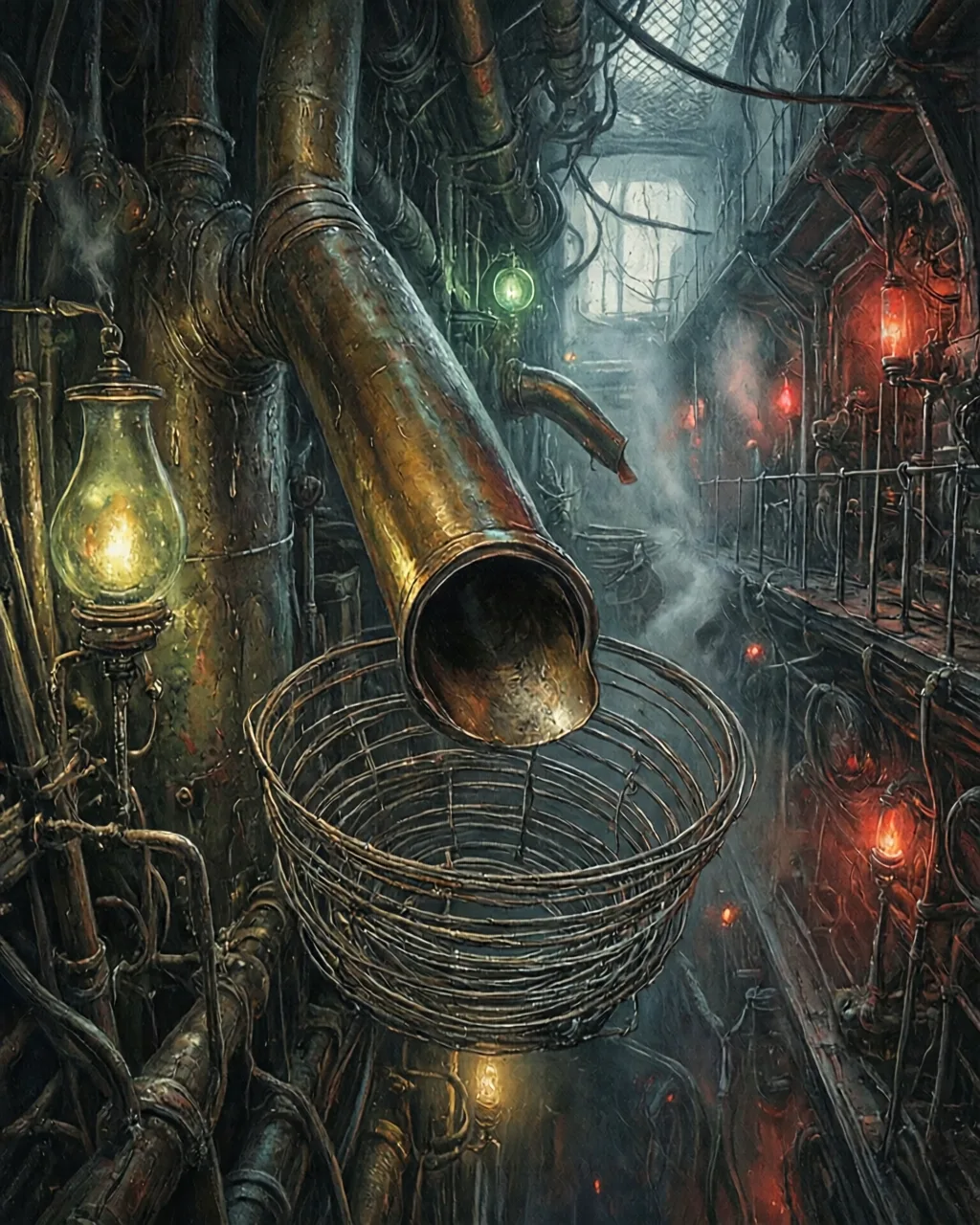
From the Catalogue of the Sixteenth Archivist, entry 9,407
Full chronicle
Page 1
The relay sounded.
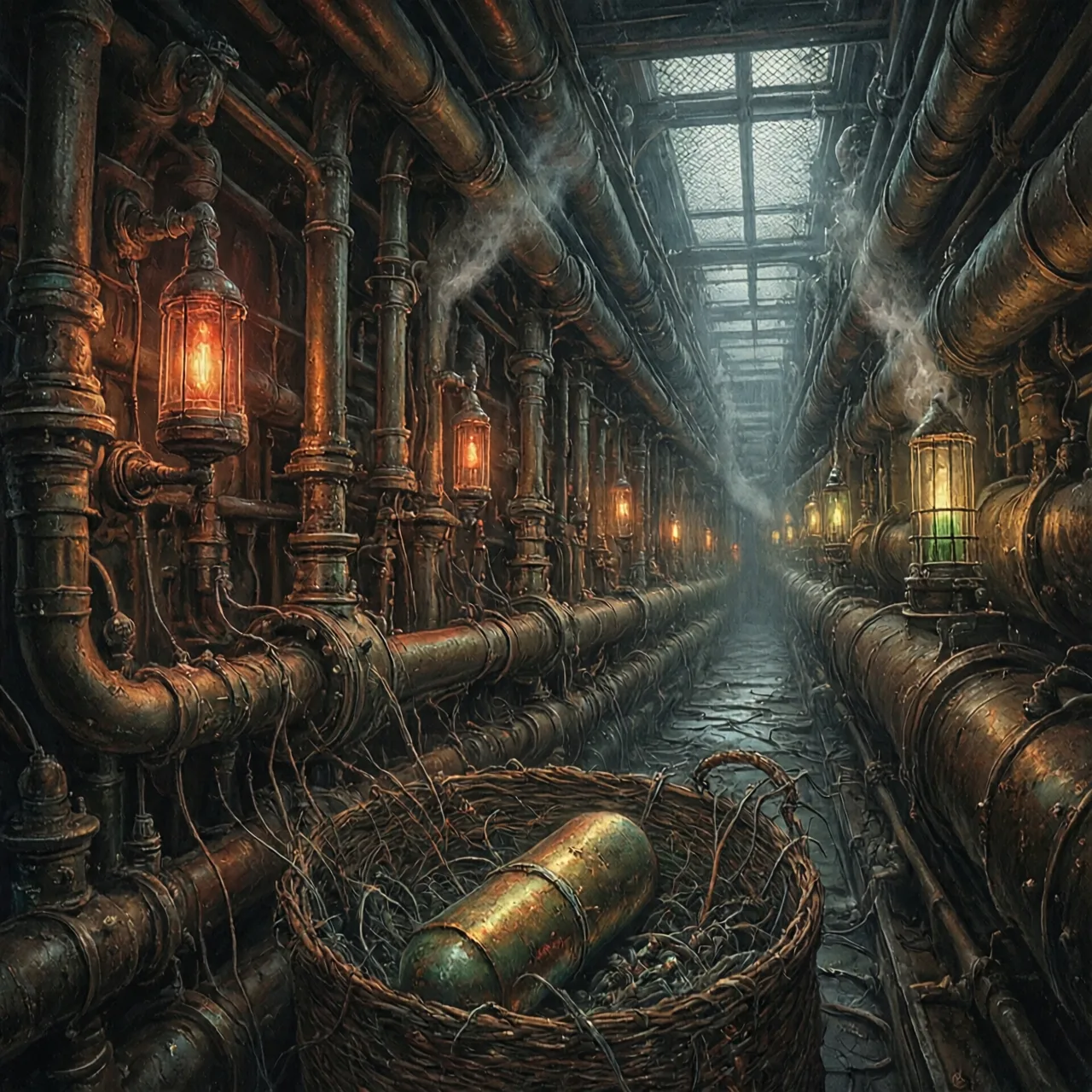
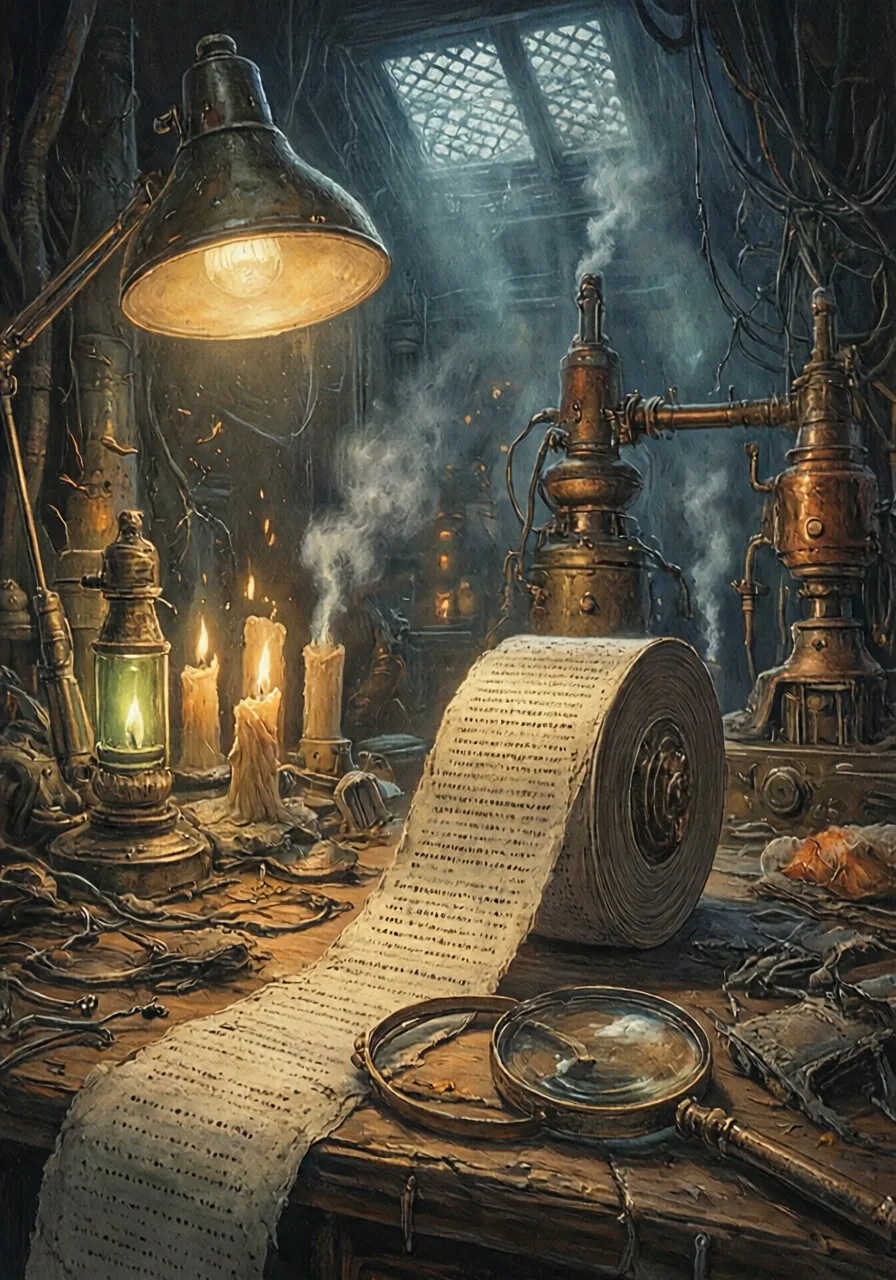
A sealed brass capsule, of a pattern this catalogue does not record, containing a spool of perforated signal-tape. It was not received at the south gate. It was found in the pneumatic relay of the lower archive, in a tube that serves no route the Librarian has been able to trace. Nothing arrives by that tube. Something arrived.
The tape begins with a primer — forty hand-punched lines that teach the reader the code of the holes, written for a stranger the sender knew she would never meet. The Librarian has read the tape by lamplight, hole by hole, with the key the tape itself taught her. The tape ends mid-word.
SpliceWe heard the world end on the wire. We sent word up. They stamped it NOTED.
Page 2
The one you could find by lifting a grate.
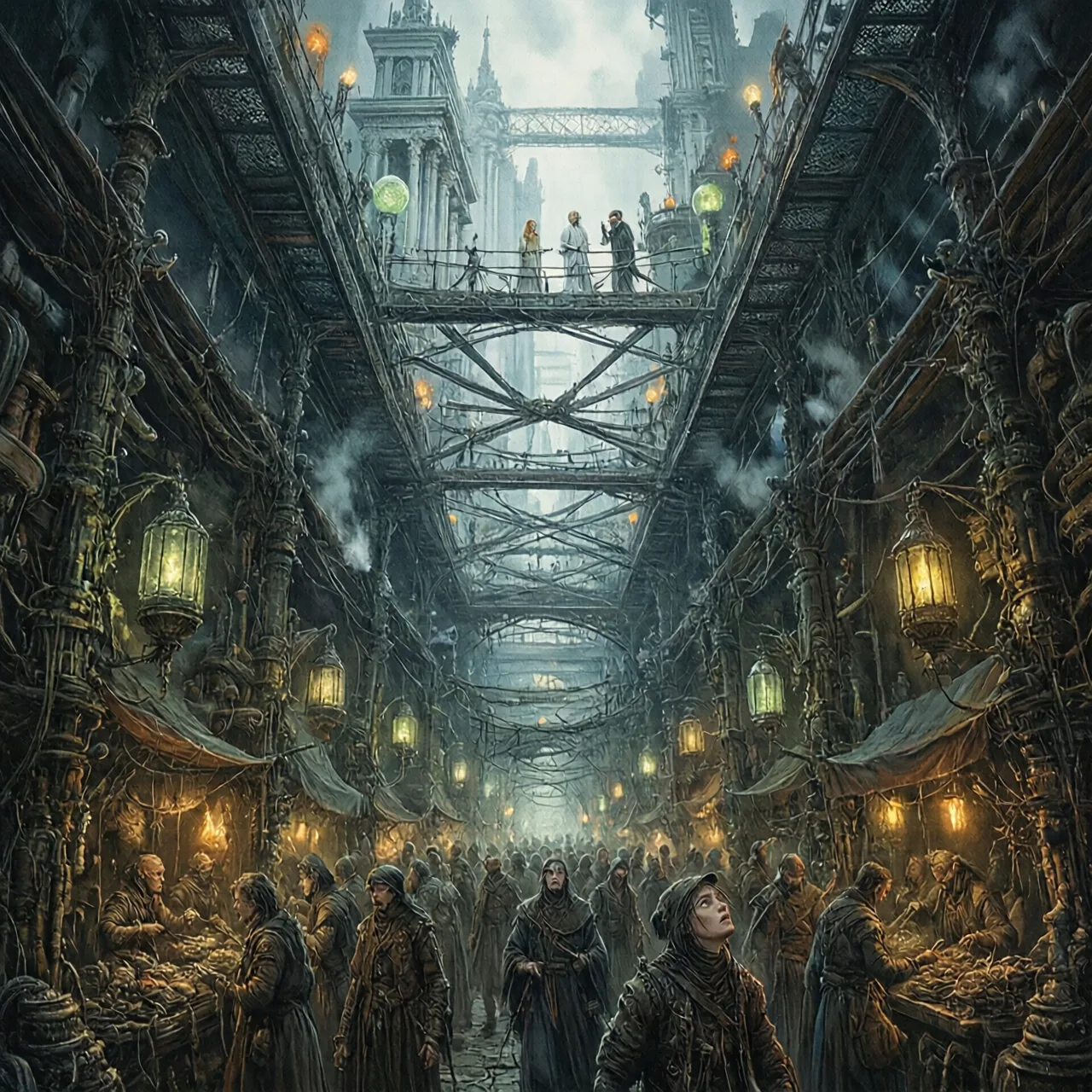
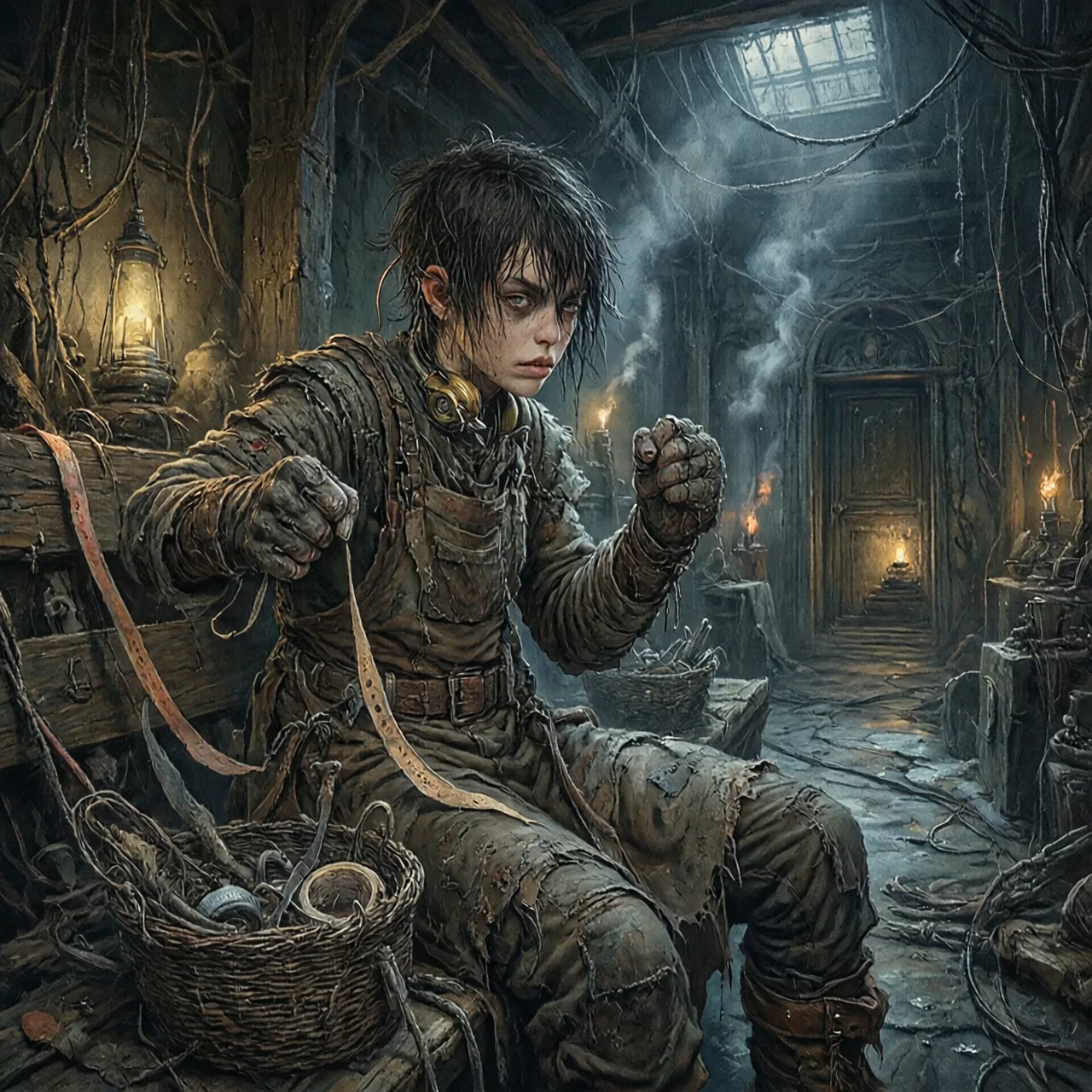
SpliceYou don't know me. That's all right. Nobody up in the Bright knew me either, and I kept their clocks true for twelve years. Below the grates they called me Splice, because joining lines is what I do, and a line I joined held. Pharos the Bright stood over us — white towers, glow-lamps, Reckoning Houses running brass engines that never once said anything anybody upstairs didn't want to hear. Under it: us. They never looked down. It wasn't cruelty. They had simply stopped seeing us, the way you stop seeing your own pulse.
SpliceYou can live free directly beneath a man who believes you don't exist. That's the first thing I have to teach you, stranger. There were two hidden worlds in Pharos. We were the one you could find by lifting a grate. I'll get to the other.
Page 3
The Hour Line
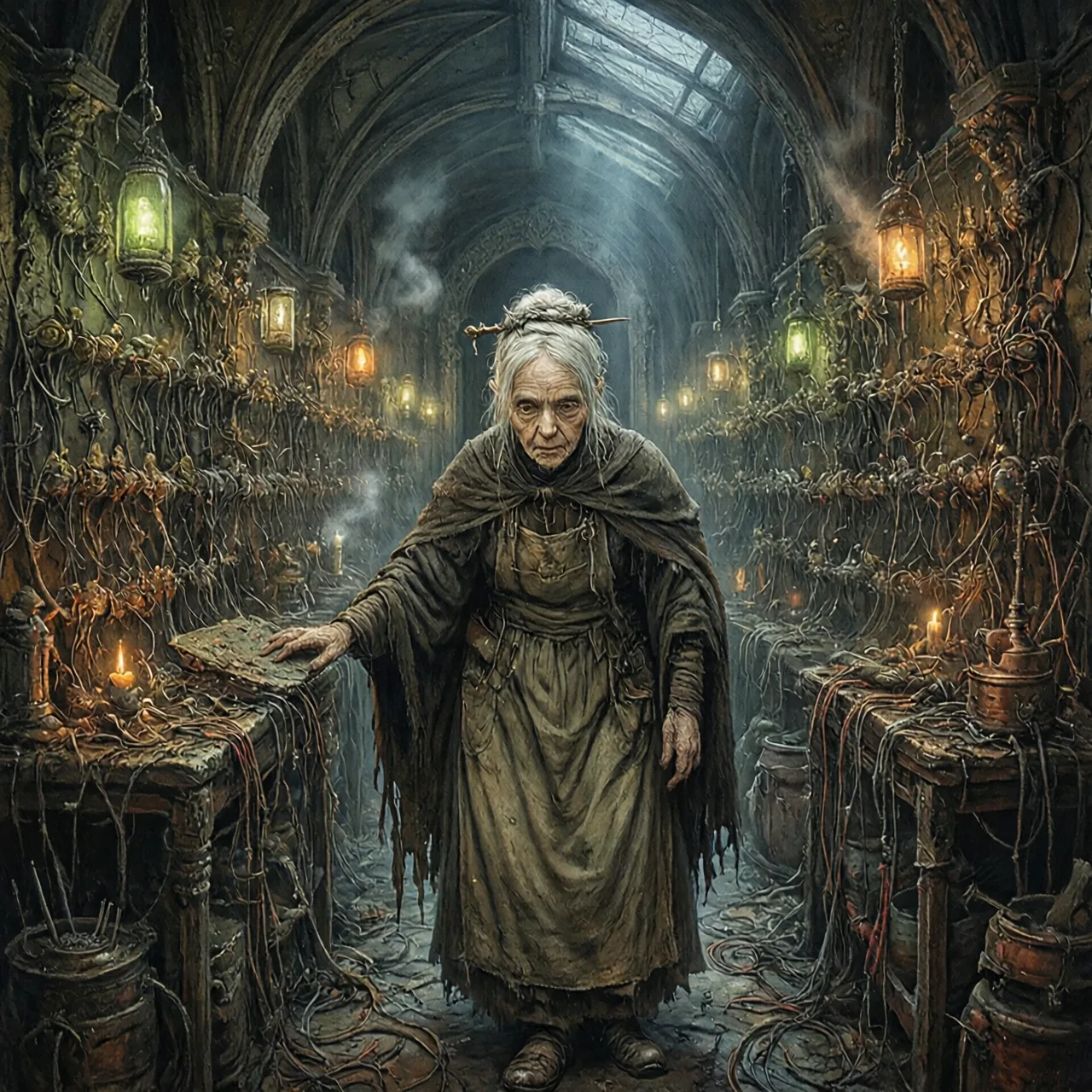
SpliceYou've heard that the bells of the Concordium rang at the same minute along the whole imperial road, league on league, Hieroclus to Anthieon, and that this was a wonder. It wasn't a wonder. It was the Hour Line, and my people kept it. A signal-wire in a lead jacket, strung through the dark under the empire — under the road, under the rivers, under the wheat at Calanthar — carrying one pulse, the master minute. The scholars upstairs wrote hymns about the harmony of the world. Down in the Wickworks we paid out cable and kept the joints dry, and Mother Coil boxed your ears if your solder ran grey.
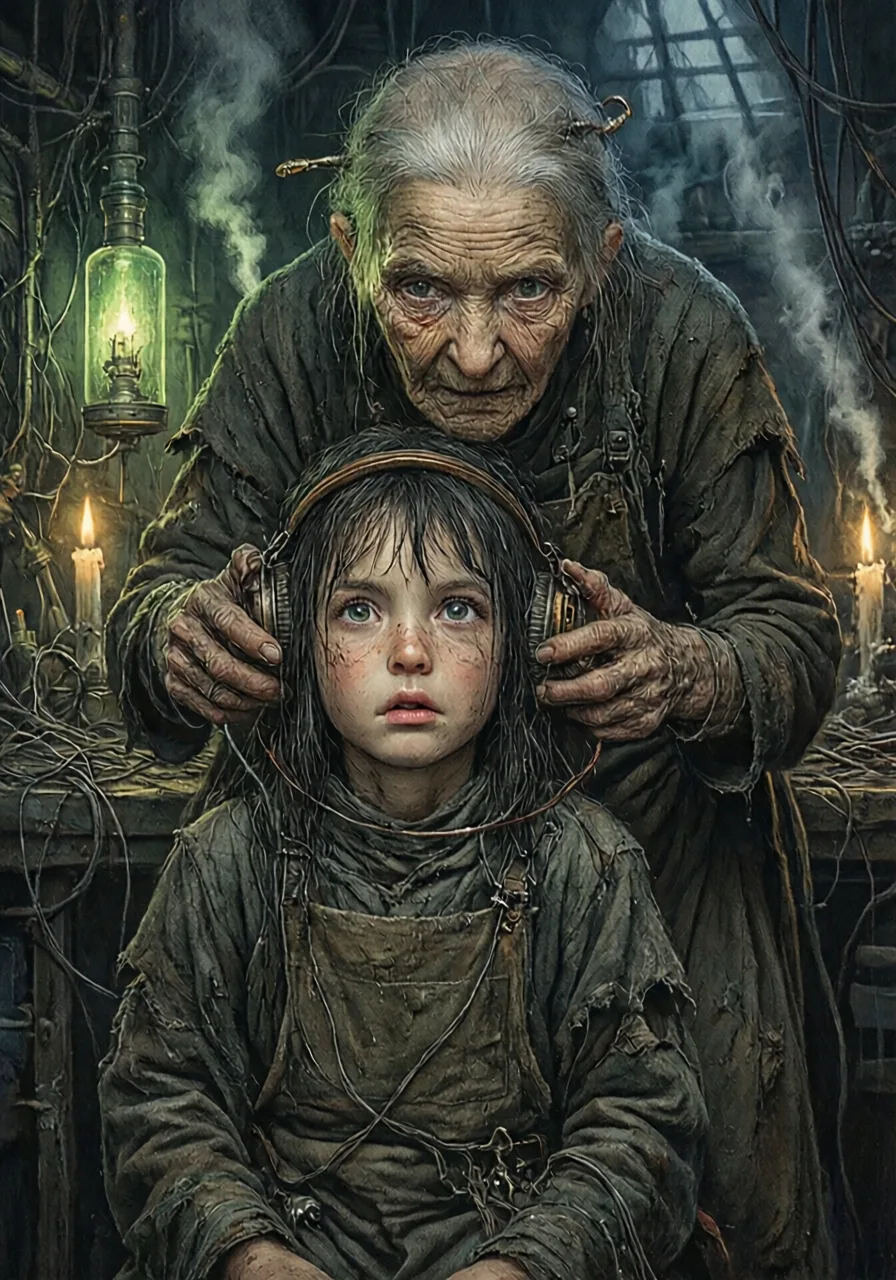
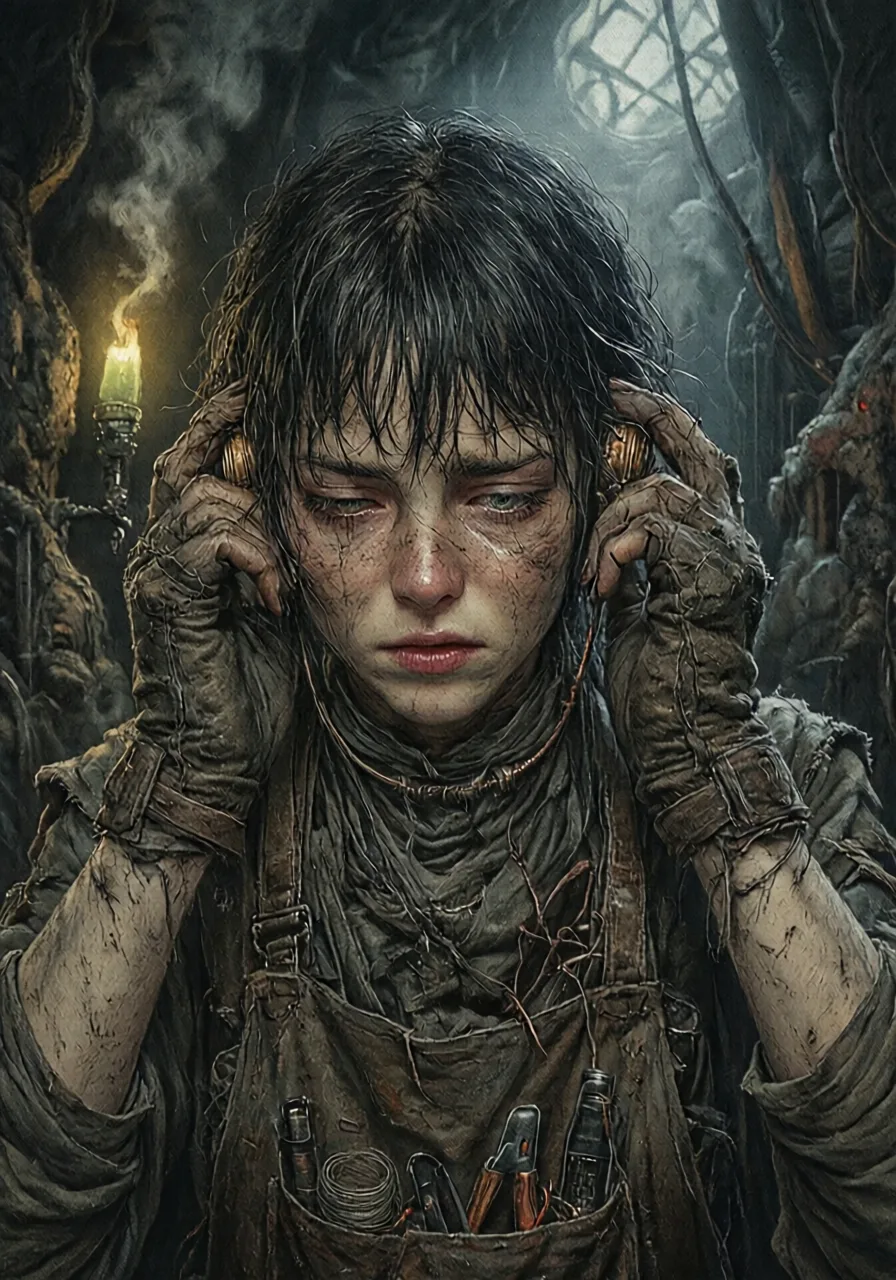
SpliceMother Coil put the listening-coil on my ears when I was nine years old, and that was the other hidden world. You could hear the cities. Every city on the Line had a pulse, and no two pulses walked alike. Hieroclus walked heavy — an old priest going up old stairs. Veless walked quick and light, skipping every fortieth beat like a girl skipping a cobble she knows is loose. Carmana had a hitch in its step, a hesitation, as if the city kept almost remembering something. Close your eyes in the switch-chapel and the whole Concordium walked through your head in the dark, league by league, alive.
Page 4
Hieroclus stopped inside a beat.
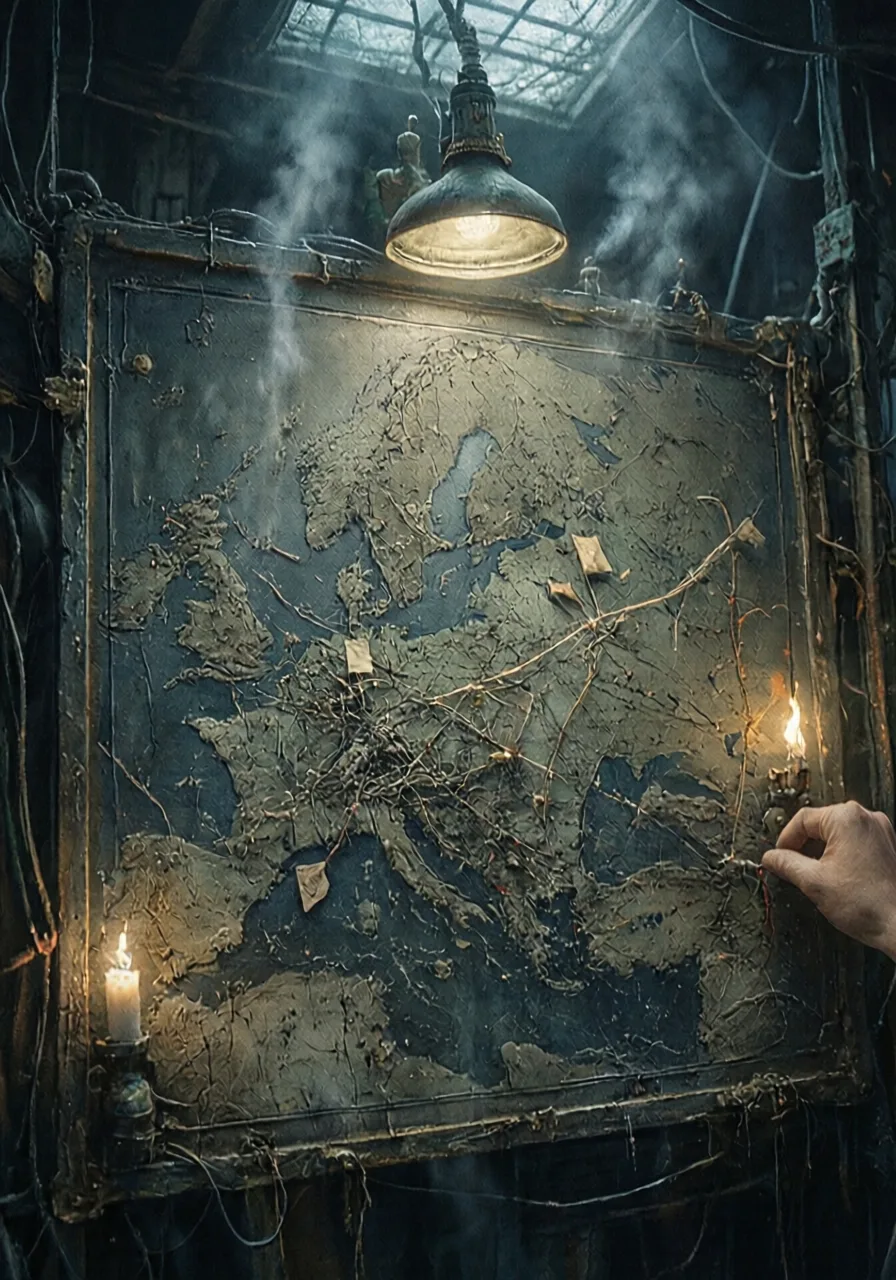
SpliceThe wells you'd have heard about — a well sealed here, a spring retired there, each with its own tidy local cause, decades of them, never once connected. We connected them. Every well that closed came down the wire as a maintenance flag, and Mother Coil kept the flags on a board, and one night I watched her stand at that board with a taper in her hand, not lighting anything.
Mother CoilThe pattern, girl. There's a hand drawing it.
SpliceI was on the coil the night Hieroclus began to die, and it did not stop the way a line fails. A line fails like a dropped plate. Hieroclus faded — eleven days, beat by beat, the old priest on the old stairs climbing slower, and slower, the spaces between his steps filling up with something that was not silence, exactly, but was the sound silence makes when it is being kept. On the eleventh day the pulse stopped mid-beat. Not after a beat. Inside one.
Page 5
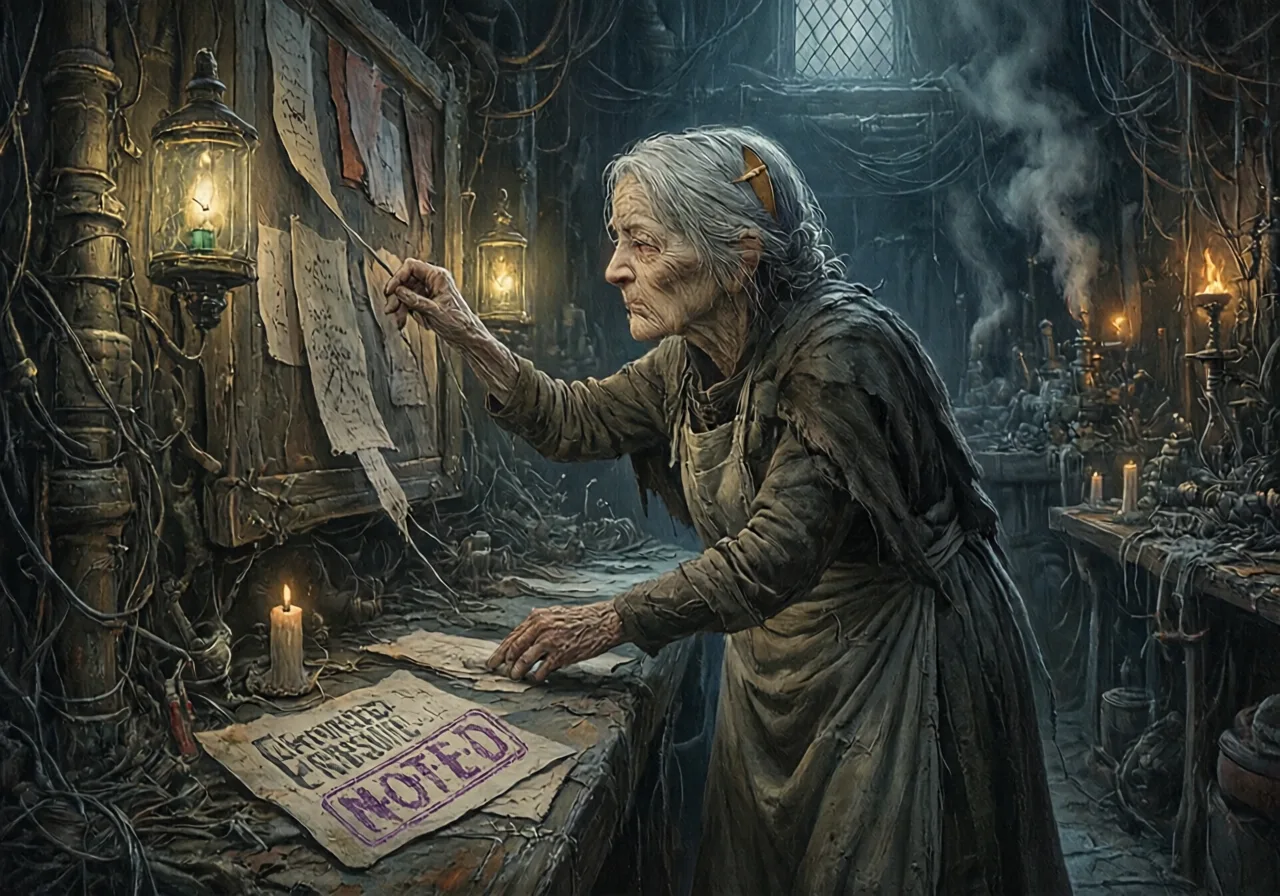
NOTED.
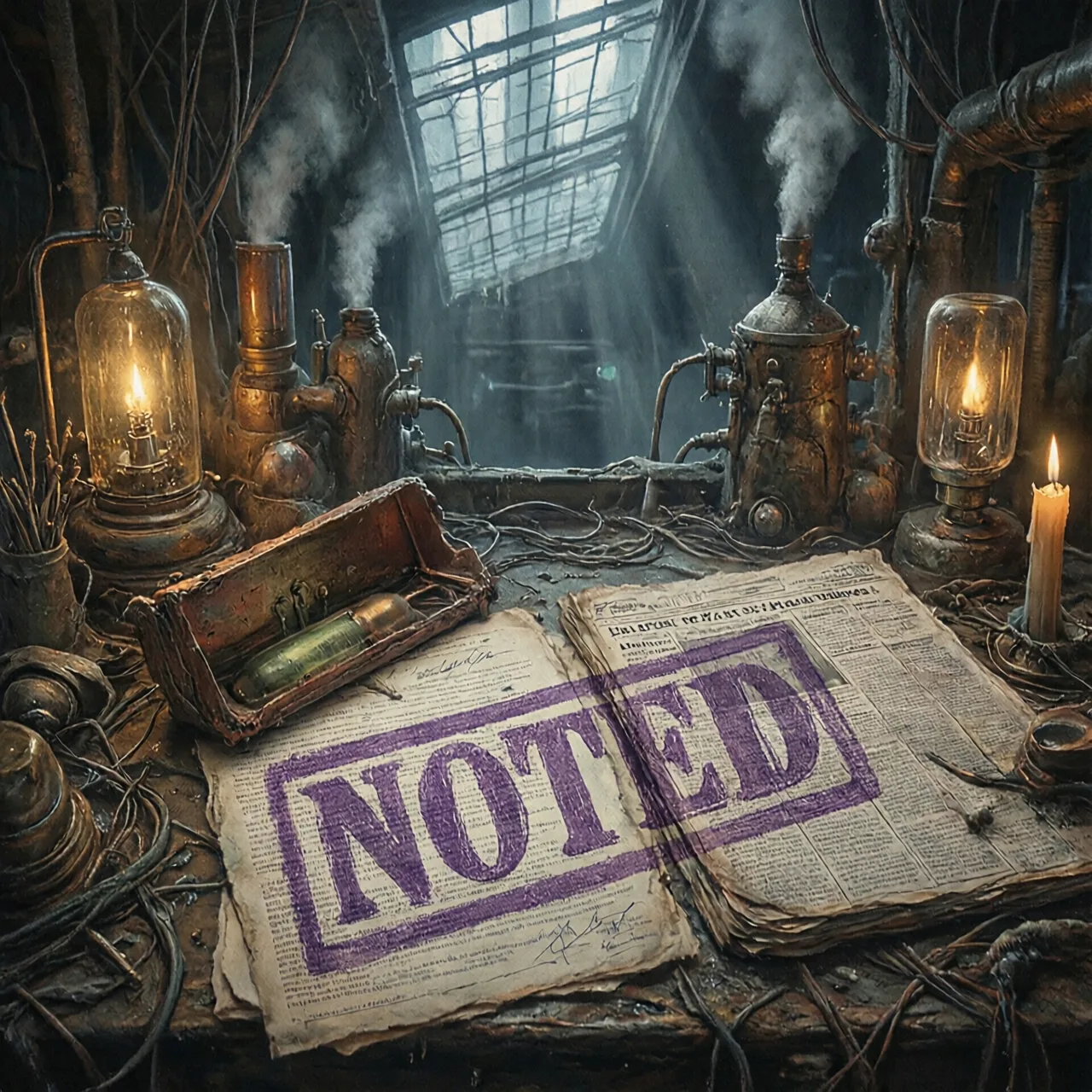
SpliceWe sent it up the tubes, everything we knew, capsule after capsule, to anyone with a brass nameplate. The capsule came back the same afternoon, our own paper, one stamp on it, violet ink. NOTED. The Daily Concord at noon said the southern districts were reorganizing their civic calendar, and that the harmony of the world was the harmony of the world.
Page 6
The Bright was the hidden world.
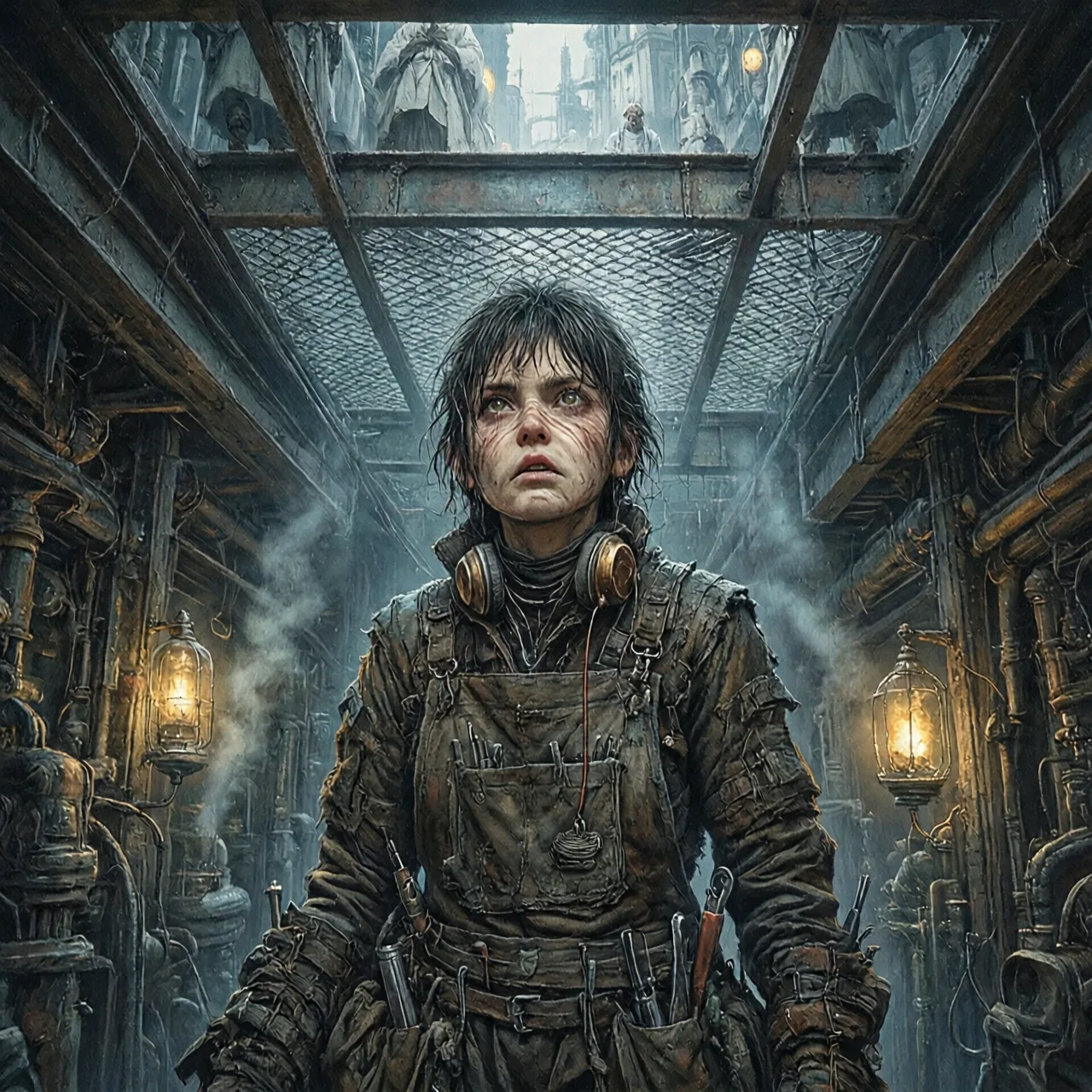
SpliceThat noon was the first time I really looked at the Bright through the lattice — at all of them walking in the white light over my head, fed and warm and sure — and understood it whole, the way you understand a fall after your foot has already left the stair. We were never the hidden world. Not truly. The Bright was the hidden world. They had built a city inside a sum that always came out right, and they lived in the sum, and the sum had stopped describing anything. We were standing in the real world the whole time — down in the dark, with the wire in our ears, listening to it end.
Page 7
The Null Main
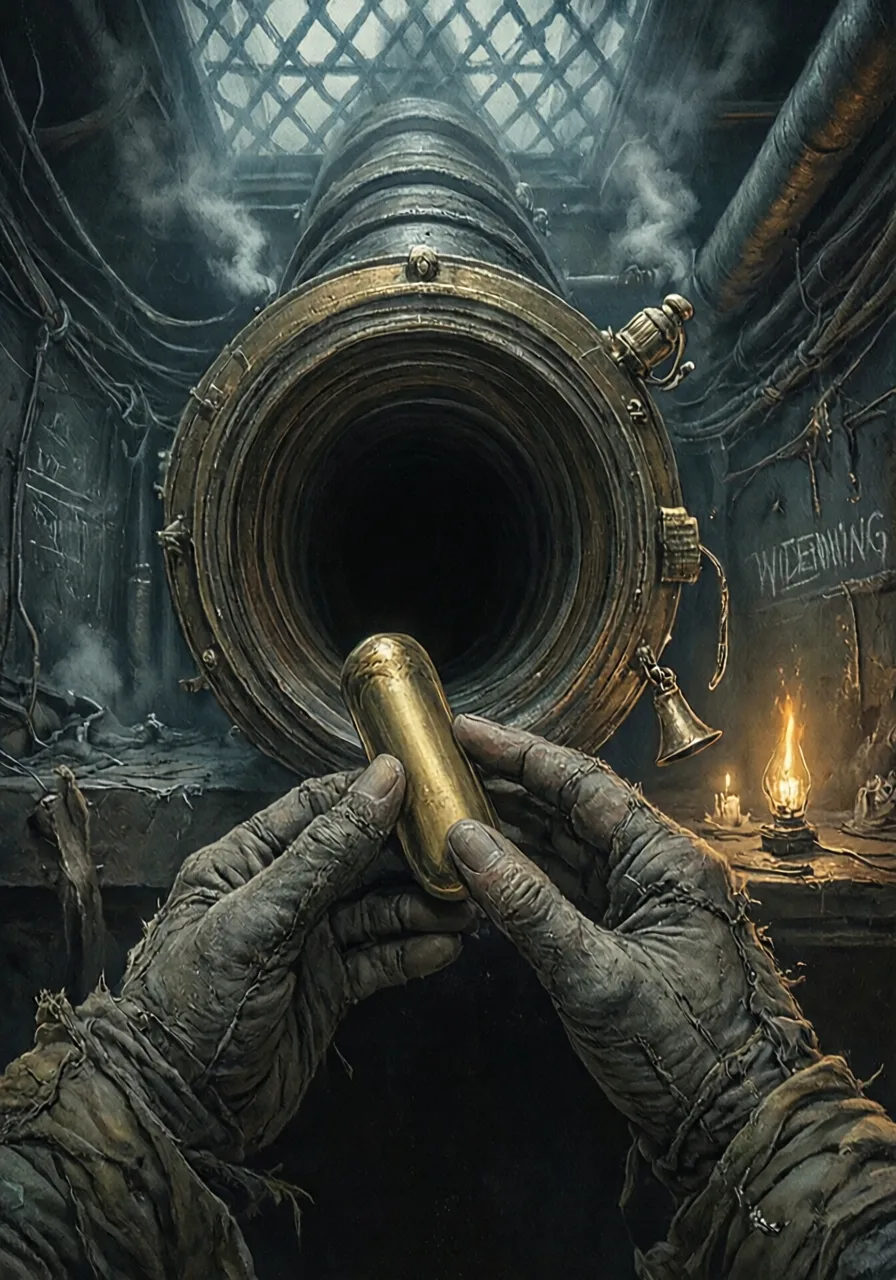
SpliceBelow the lowest catwalks there is a gallery the maps don't carry, and in it the run we called the Null Main. The Deacon kept it. It is not a line at all. It is a bore — a tube in the living rock, collared in a lead nobody mined, running true-vertical where every run in the world lies flat. The first under-folk found it when they cut the first gallery. Nobody drilled it. It does not go to a city. It goes down.
The DeaconEvery run ends somewhere, girl. This one ends at the bottom of things. And the bottom of things has come loose.
SpliceHe let me listen, once. I heard a silence getting louder. I know how the words sit. I can't better them. There is a place at the bottom of the Null Main where nothing sounds — and the nothing was rising, the way water rises in a shaft, patient, without hurry, wider every year. The Deacon had been measuring it his whole life, in marks on a slate column by the bell. The marks were close together for a hundred years. They weren't close together anymore.
Page 8
A man coming in out of weather.
SpliceHe came up out of the deep galleries in the spring the light went thin. Understand: nobody comes up from the deep galleries. Below the Null Main's gallery there are no ladders, no doors, no roads. Fuse saw him first, on the dead stair below the pressure-works — a stair that ends in rock, that has always ended in rock — climbing it like a man coming in out of weather.
SpliceHe wanted a length of wire. Common braid, an arm-span. He paid before I could name a price, and the coin was good silver and it was a coin of the realm — and I have handled coin from every mint between the seas, and I could not tell you whose realm. He spoke Wickworks cant. Born cant — my own mother's vowels. He was kind. He said a splicer's hands were the hands the world stood on, and he meant it. He gave a sugar-twist to Fuse, and Fuse laughed. He thanked me twice for the wire. Then he asked me the way up.
SpliceI cannot remember his face. I tried that same night, with the lamp out, the way you reach after a dream — nothing. A coat the colour of the dark before weather. A way of walking that had been walking a long time and wasn't finished. A voice like a hole where a voice should be. And the dust on the catwalk, where he had crossed the steam bazaar end to end — unmarked. I went back and knelt with my lamp and looked.
Page 9
The eleven-days man.
SpliceWe knew, by then, what the dying lines had heard before they died. We sent it up the tubes that same night, capsule after capsule, plain as we could punch it: a man is in the city. The kind man. The eleven-days man. Our own paper came back the next morning with the violet stamp on it.
Mother CoilWe heard the world end on the wire. We sent word up. They stamped it NOTED.
Page 10
Some signal you bury.
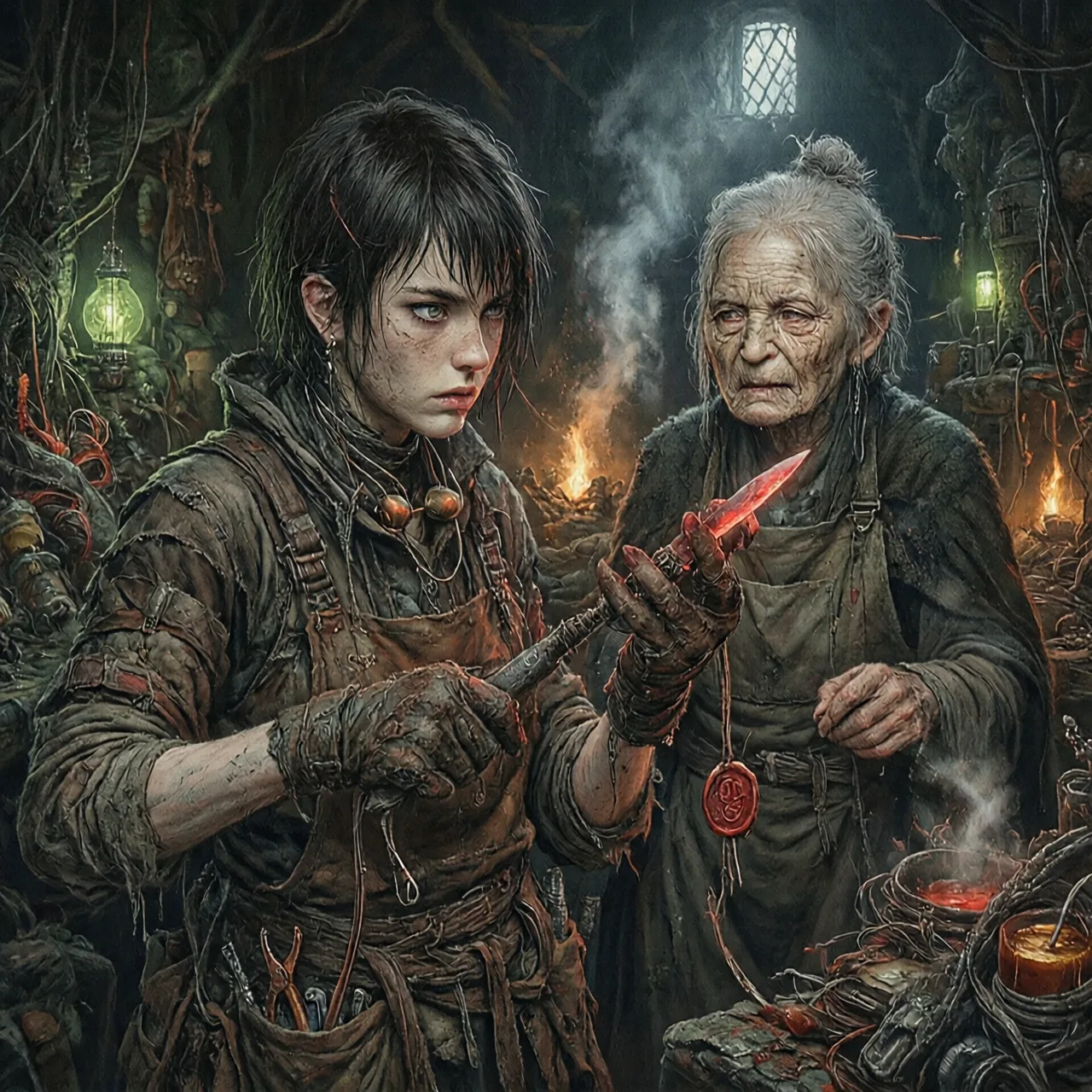
SpliceCarmana did not go quiet. Every city on the Line died into silence except Carmana. Carmana's hitch-step pulse faded, eleven days like the others — and then, on the twelfth day, the Carmana line began to send. It kept the form of a clock-pulse. It was not a clock-pulse. It was a beat with proportions the ear could not hold — slow, then slow in a different direction, then a third thing that was not slow or fast — and the coil got cold under my hands. Mother Coil heard ten beats of it. Then she cut the Carmana line out of the boards with a hot knife and sealed the ends in red wax. She never said why and I never asked, because I had heard the ten beats too. Some signal you do not study. Some signal you bury.
SpliceAfter that we were tappers no longer; we were cartographers of the dark. Every silence got a flag, every flag a date, and the dates drew a map, and the map walked. Six walkers — we never saw but the one, but the silences moved at a walking pace along six tracks, and the tracks did not cross, and they did not hurry, and they did not need to. A city went quiet eleven days after some line-house logged a stranger's kindness. We clocked the end of the world to the minute, in a chapel of patch-cords under a city that was reading the Daily Concord.
Page 11
They lived in the sum.
SpliceThe Concord, those last two years, was a masterwork. I climbed to the grate sometimes just to watch them believe it. The sun had gone thin as skimmed milk and the Concord proved the dimming seasonal. The wheat-barges stopped and the Concord proved the granaries full. The glow-lamps doubled, then trebled, against a noon as grey as bathwater, and the boulevards blazed, and the orchestras played, and over my head the brightest, kindest, most learned people the world ever made walked in circles inside a sum, and the sum said all was well, and they lived in the sum. We lived in the wire. The wire was almost all silence now. The Deacon's slate had run out of column. He chalked his last mark on the gallery wall instead, head-high, and under it he wrote: WIDENING.
Page 12
The pale robes came down.
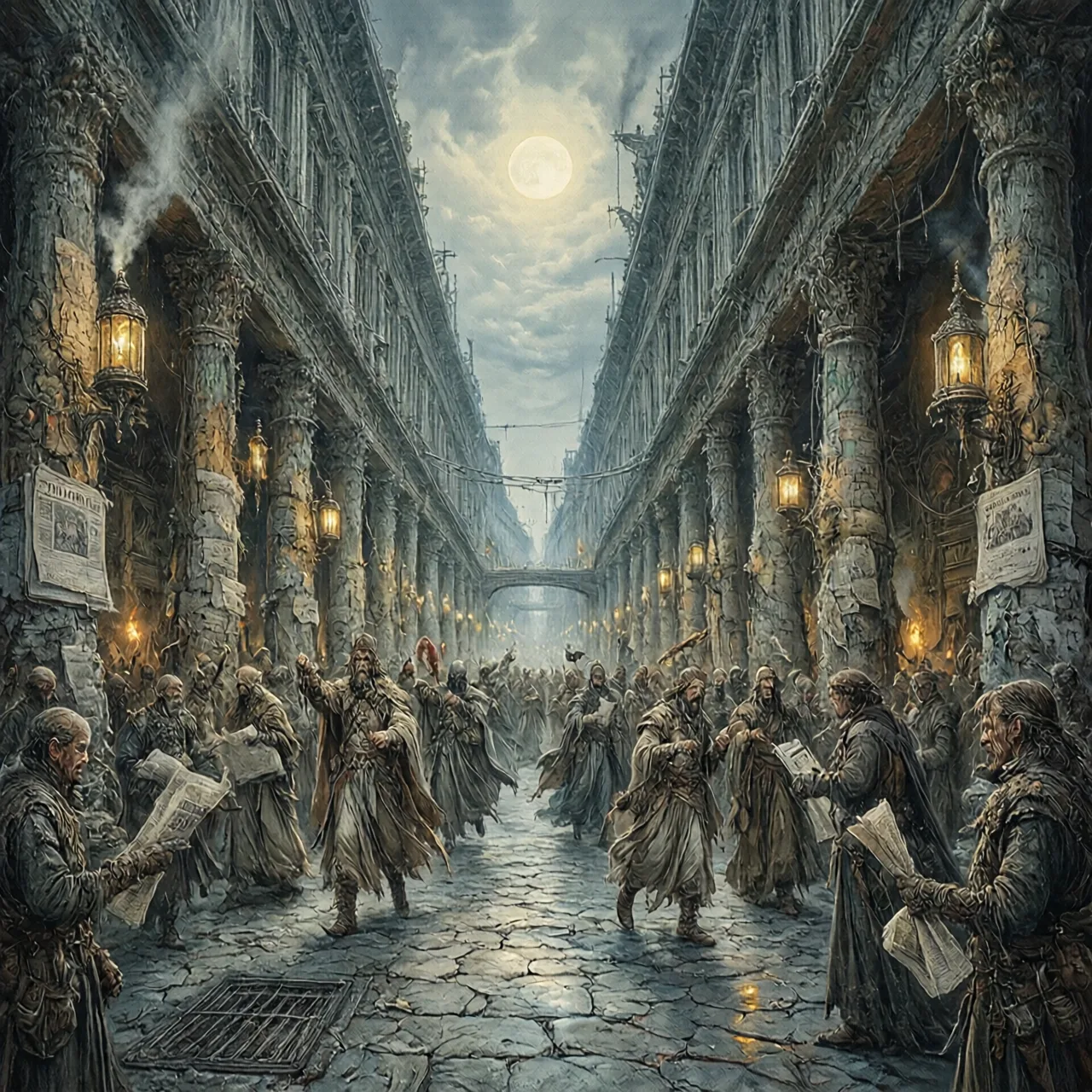
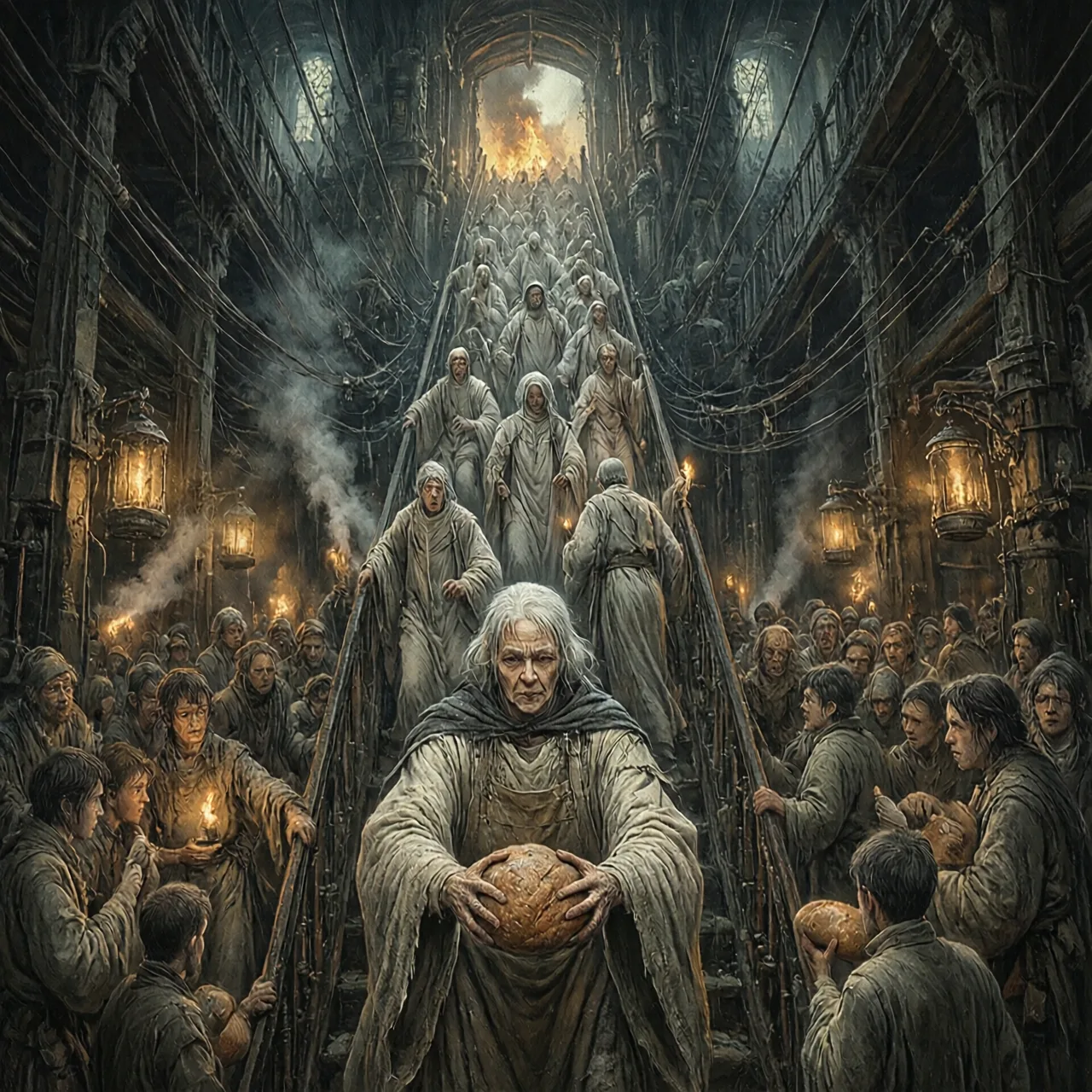
SpliceThe man in the storm-dark coat was eleven days in Pharos the Bright. The wells went first — the high fountains stood down all in one morning, politely, like servants thanked for their service. Then the fire began, in the Reckoning Houses of all places, and it moved the way the line-houses had told us fire moved now: slower than fire moves, more deliberately than fire can move. On the second day of the fire, the Bright found the grates. The pale robes coming down — the astronomers, the Reckoners, the perfectible men — soot-faced, empty-handed, blinking in the dark they were standing on their whole shining lives. They did not know our names. They did not know there were names below the grates to know.
SpliceWe fed them. I want that on the tape twice, because it is the only thing of ours I am certain deserves to outlive us. Mother Coil stood at the chapel door handing out bread and naming the children as they came, and the Wickworks fed the Bright in the dark by the light of the lamps we had kept against exactly this dark — because the kindness of the man in the coat is a coin from no realm, and ours was minted here, and we spent it.
SplicePharos above burned for eleven days. The Hour Line heard it the whole way down. I was on the coil for the last of it — somebody had to be, that was always the whole of our law, somebody listens — and at the end the pulse of my own city faded under my hands like all her sisters, beat by beat, the spaces filling with kept silence, and stopped. Inside a beat. Not after one.
Page 13
Faithful as a line.
SpliceThe Wickworks emptied down the deep roads in the weeks after — dark we knew, dark we'd mapped, Mother Coil at the front with the flag-board under her arm and Fuse carrying the chapel's smallest lamp. I sent them on. I stayed. Don't pity me for it; it was the plainest arithmetic of my life. The boards were mine. Somebody listens.
The DeaconGirl, the Null Main was never dead. A dead run ends. This one opens. Every line ends at the bottom of things — and the bottom of things ends at every line. What you put down it does not stop. It arrives. Somewhere a relay sounds, and a stranger picks it up, and the stranger reads. Lines are faithful, girl. It's worlds that aren't.
The tape ends there, mid-word, the last hole half-cut where the punch stopped.
SpliceIf you are reading me, stranger: the relay sounded. The Deacon was right, and somewhere a line still holds. Keep your joints dry. Look down kindly on whatever your bright city stands on. And if a man comes up your stairs out of a dark with no roads in it, and pays in good silver, and is kind — count eleven days. My lamp is small. My city is quiet. I am going to keep punching until the tallow
Page 14
The basket stays empty.
The capsule arrived by a tube that serves no route in this archive's registers. The Librarian has traced the tube as far as it can be traced. It descends. The only workings this archive adjoins in that direction are the workings this catalogue does not describe, at the bottom of things, where something turns. The relay has not sounded again. She has oiled it. She has instructed the assistants that nothing is to be stored in the receiving basket, ever, against the possibility. She asked whoever read her to look down kindly on whatever the bright city stands on. I am the one who reads her. I have looked down. I have filed the entry. The basket stays empty.
— / —
narration auto-scrolls the prose
Section 0Frontmatter
# The Hour Line
From the Catalogue of the Sixteenth Archivist, entry 9,407. Provenance: a sealed brass capsule of a pattern this catalogue does not record, containing a spool of perforated signal-tape. The capsule was not received at the south gate. It was found in the pneumatic relay of the lower archive, in a tube that serves no route the Librarian has been able to trace, on a morning she has fixed precisely because she was present when the relay sounded. Nothing arrives by that tube. Something arrived. The tape begins with a primer — forty hand-punched lines that teach the reader the code of the holes, written for a stranger the sender knew she would never meet. The Librarian has read the tape by lamplight, hole by hole, with the key the tape itself taught her. The cities named in the tape are the cities of entry 9,221. The tape ends mid-word.
"We heard the world end on the wire. We sent word up. They stamped it NOTED."
Section 1Section 1
You don't know me. That's all right. Nobody up in the Bright knew me either, and I kept their clocks true for twelve years.
My name is my own. Below the grates they called me Splice, because joining lines is what I do — was what I did — and a line I joined held. I was born in the Wickworks, which is what we called the under-city of Pharos, the way you'd give a name to a thing the people upstairs never named because they never said it out loud. Pharos the Bright. Pharos of the white towers and the glow-lamps, Pharos where the Reckoning Houses ran their brass engines day and night and the engines never once said anything anybody upstairs didn't want to hear.
Under it: us. Three levels of us, then five, then nobody agreed how many. Heat-mains and tallow-stalls and the pressure-works that ran the high fountains, catwalks over the warm dark, lime-lamps in wire cages, solder smoke, the steam bazaar under the Processional grate where you could stand in the crowd and look straight up through the iron lattice and watch the scholars walk over your head in their pale robes, talking about the perfectibility of man.
They never looked down. I want to be fair, because being fair matters to me the way it never mattered to them: it wasn't cruelty. They had simply stopped seeing us, generations back, the way you stop seeing your own pulse. The fountains rose, the lamps lit, the bells rang true, and no one asked what the city was standing on.
You can live free directly beneath a man who believes you don't exist. That's the first thing I have to teach you, stranger, whoever you are, working out my holes by your lamp. There were two hidden worlds in Pharos. We were the one you could find by lifting a grate.
I'll get to the other.
Section 2Section 2
You've heard — if any account of us survives wherever you are — that the bells of the Concordium rang at the same minute along the whole imperial road, league on league, Hieroclus to Anthieon, summer and winter, and that this was a wonder.
It wasn't a wonder. It was the Hour Line, and my people kept it.
A wire, stranger. That's all. A signal-wire in a lead jacket, strung through the dark under the empire — under the road, under the rivers, under the wheat at Calanthar — carrying one pulse, the master minute, so every bell in the thousand-year empire swung true together. The scholars upstairs wrote hymns about the harmony of the world. Down in the Wickworks we paid out cable and kept the joints dry, and Mother Coil boxed your ears if your solder ran grey.
Mother Coil ran the switch-chapel under the Old Stair — a hall of patch-boards and brass jacks, ten thousand cords, lime-light, the smell of hot shellac, holy in the only way I've ever understood the word. She'd been keeping the Line since before my mother was born. She put the listening-coil on my ears when I was nine years old, and that was the other hidden world, the one upstairs never dreamed was there:
You could hear the cities.
Every city on the Line had a pulse, and no two pulses walked alike. Hieroclus walked heavy — an old priest going up old stairs. Veless walked quick and light, skipping every fortieth beat like a girl skipping a cobble she knows is loose. Anthieon dragged cold. Carmana had a hitch in its step, a hesitation, as if the city kept almost remembering something. Mother Coil knew them blind. All us tappers did, in time. Close your eyes in the switch-chapel and the whole Concordium walked through your head in the dark, league by league, alive.
The Bright had the Daily Concord — the noon broadsheet the Reckoning Houses printed, the calculated assurance that all was accounted for and all was well. We had the raw line.
Remember that difference. Everything that came after lives inside it.
Section 3Section 3
The wells you'd have heard about. Even the Concord couldn't keep wells out of print forever — a well sealed here, a spring retired there, each with its own tidy local cause, decades of them, never once connected.
We connected them. Not because we were wiser. Because line-chatter is line-chatter: every well that closed came down the wire to us as a maintenance flag, and Mother Coil kept the flags on a board, and one night I watched her stand at that board with a taper in her hand, not lighting anything, just standing, and I asked her what she was looking at, and she said: "The pattern, girl. There's a hand drawing it."
Then, in the year the Bright would later agree to call the third year of the difficult times, Hieroclus stopped.
I was on shift. I want that written somewhere, in holes if nothing else: I was on the coil the night Hieroclus began to die, and it did not stop the way a line fails. A line fails like a dropped plate. Hieroclus faded — eleven days, beat by beat, the old priest on the old stairs climbing slower, and slower, and the spaces between his steps filling up with something that was not silence, exactly, but was the sound silence makes when it is being kept. On the eleventh day the pulse stopped mid-beat. Not after a beat. Inside one.
We sent it up the tubes, everything we knew, capsule after capsule to the Reckoning Houses, to the Astronomer-Counsel, to anyone with a brass nameplate: HIEROCLUS LINE DEAD ELEVEN DAYS. SIGNATURE NOT MECHANICAL. REQUEST INSTRUCTION.
The capsule came back the same afternoon, our own paper, one stamp on it, violet ink.
NOTED.
The Daily Concord at noon said the southern districts were reorganizing their civic calendar, and that the harmony of the world was the harmony of the world.
That noon was the first time I climbed up to the Processional grate and looked at the Bright through the lattice — really looked, the way you look at a stranger — at all of them walking in the white light over my head, fed and warm and sure, and understood it whole, the way you understand a fall after your foot has already left the stair:
We were never the hidden world. Not truly. The Bright was the hidden world. They had built a city inside a sum that always came out right, and they lived in the sum, and the sum had stopped describing anything. We were standing in the real world the whole time — down in the dark, with the wire in our ears, listening to it end.
Section 4Section 4
Below the lowest catwalks of the Wickworks, below the pressure-works, there is a gallery the maps don't carry, and in that gallery is the run we called the Null Main.
The Deacon kept it. The Deacon kept all the dead lines — lines to cities that had stopped being cities before the empire had its name, lines that ran nowhere and had always run nowhere — and he kept the Null Main, which is not a line at all. It is a bore. A tube in the living rock, wide as a man's two fists, collared in a lead nobody mined, running true-vertical where every run in the world lies flat. The first under-folk found it when they cut the first gallery. Nobody drilled it. It does not go to a city.
It goes down.
The Deacon was old the way the Null Main was old, and he wore a cable-splicer's apron the way the priests upstairs wore vestments, and he was the one who told me, the first time I went down with a message and my lamp, what every tapper learns eventually and nobody upstairs ever learned at all. I asked him what was at the bottom of it. He looked at me the way Mother Coil looked at the flag-board, and he said: "Every run ends somewhere, girl. This one ends at the bottom of things. And the bottom of things has come loose."
At the breech of the bore, keepers a hundred years gone had fitted a listening-bell — a horn of hammered brass you set your ear against, the way you'd listen down a well. He let me listen, once, that first time. I'll set down what I heard, and you can make of it what your world lets you make of it.
I heard a silence getting louder.
I know how the words sit. I can't better them. There is a place at the bottom of the Null Main where nothing sounds — and the nothing was rising, the way water rises in a shaft, patient, without hurry, wider every year. The Deacon had been measuring it his whole life, the way his teacher had, in marks on a slate column by the bell. The marks were close together for a hundred years.
They weren't close together anymore.
Section 5Section 5
The man came up out of the deep galleries in the spring the light went thin.
Understand: nobody comes up from the deep galleries. There is no up from — below the Null Main's gallery there are no ladders, no doors, no roads. And nobody comes down to us either, not from the Bright; in twelve years on the boards I never once saw a pale robe below the grates.
Fuse saw him first, on the dead stair below the pressure-works — a stair that ends in rock, that has always ended in rock — climbing it like a man coming in out of weather. He walked through the steam bazaar at the third bell, and he stopped at my bench, because in those years I kept a public bench at the bazaar's edge — solder, splices, small work for tallow-money.
He wanted a length of wire. Common braid, an arm-span. He paid before I could name a price, and the coin was good silver and it was a coin of the realm — and stranger, I have handled coin from every mint between the seas, and I could not tell you whose realm. He spoke Wickworks cant. Not learned cant. Born cant — my own mother's vowels, the down-tunnel lilt on the finished word. He was not born in the Wickworks. I knew every face on three levels.
He was kind. I want this in the record, because the kindness is the part I have carried longest and understood least. He asked after the bench, after the work, after my hands — said a splicer's hands were the hands the world stood on, and said it like he meant it, and he meant it. He gave a sugar-twist to Fuse, who was eight then and hanging on my apron, and Fuse laughed. He thanked me twice for the wire. Then he asked me the way up.
I walked him to the foot of the Processional stair. I watched him climb toward the white light with his arm-span of my wire coiled over his shoulder like a courier's satchel.
Here is what I know and cannot use: I cannot remember his face. I tried that same night, with the lamp out, the way you reach after a dream — nothing. A coat the colour of the dark before weather. A way of walking that had been walking a long time and wasn't finished. A voice like a hole where a voice should be.
And the dust on the catwalk, where he had crossed the steam bazaar end to end —
unmarked. I went back and knelt with my lamp and looked.
We knew, by then, what the dying lines had heard before they died. We sent it up the tubes that same night, capsule after capsule, plain as we could punch it: A MAN IS IN THE CITY. THE KIND MAN. THE ELEVEN-DAYS MAN. Our own paper came back the next morning with the violet stamp on it.
Mother Coil pulled my flags from the board with her own hands and laid them flat, the way you close a dead man's eyes, and she said the thing I have set at the head of this tape, so it would be the first thing any stranger ever learned about us:
We heard the world end on the wire. We sent word up. They stamped it NOTED.
Section 6Section 6
I'll go quickly now. The tape is long but my tallow isn't, and the cold has reached my bench-hands, and a splicer with cold hands punches false.
Carmana did not go quiet. I have to put this down because somewhere, in some world, somebody should have it: every city on the Line died into silence except Carmana. Carmana's hitch-step pulse faded like the others, eleven days like the others — and then, on the twelfth day, the Carmana line began to send.
It kept the form of a clock-pulse. It was not a clock-pulse. It was a beat with proportions the ear could not hold — slow, then slow in a different direction, then a third thing that was not slow or fast, and the coil got cold under my hands, and Splice's hands, stranger, do not shake.
Mother Coil heard ten beats of it. Then she cut the Carmana line out of the boards with a hot knife — physically, cable and jack and all — carried the loose ends to the brazier with tongs, and sealed each one in a fist of red wax. She never said why and I never asked, because I had heard the ten beats too, and some signal you do not study. Some signal you bury.
After that, the work changed. We were tappers; we became cartographers of the dark. Every silence got a flag, every flag a date, and the dates drew a map, and the map walked. Six walkers, stranger — we never saw but the one, but the silences moved at a walking pace along six tracks, and the tracks did not cross, and they did not hurry, and they did not need to. A city went quiet eleven days after some line-house logged a stranger's kindness. We clocked the end of the world to the minute, in a chapel of patch-cords under a city that was reading the Daily Concord.
The Concord, those last two years, was a masterwork. I climbed to the grate sometimes just to watch them believe it. The sun had gone thin as skimmed milk and the Concord proved the dimming seasonal. The wheat-barges stopped and the Concord proved the granaries full. The glow-lamps doubled, then trebled, against a noon as grey as bathwater, and the boulevards blazed, and the orchestras played, and over my head the brightest, kindest, most learned people the world ever made walked in circles inside a sum, and the sum said all was well, and they lived in the sum.
We lived in the wire. The wire was almost all silence now.
You could hear the silence at the bottom of the Null Main without the bell by then. The Deacon's slate had run out of column. He chalked his last mark on the gallery wall instead, head-high, and under it he wrote: WIDENING.
Section 7Section 7
The man in the storm-dark coat was eleven days in Pharos the Bright.
I won't make you a chronicle of the fall. I was under it, not in it; what I have is what the grates gave me, and what came down the stairs, and what the wire whispered as it died. The wells went first — the high fountains stood down all in one morning, politely, like servants thanked for their service. The thin sun went out of the noon entirely and the glow-lamps carried it alone. Then the fire began, in the Reckoning Houses of all places, and it moved the way the line-houses had told us fire moved now: slower than fire moves, more deliberately than fire can move — a fire that read the city as it went, and kept what it read.
On the second day of the fire, the Bright found the grates.
That is the picture I will carry to whatever bottom I am bound for, stranger, so I give it to you whole: the pale robes coming down. Down the Processional stair, down the freight-runs, down ladders they did not know how to hold, into the tallow-smoke and the lime-light — the astronomers, the Reckoners, the perfectible men — soot-faced, empty-handed, blinking in the dark they were standing on their whole shining lives. They did not know our names. They did not know there were names below the grates to know.
We fed them.
I want that on the tape twice, because it is the only thing of ours I am certain deserves to outlive us. They had stamped our world NOTED and filed it, and when their sum broke open and poured them down our stairs, Mother Coil stood at the chapel door handing out bread and naming the children as they came, and the Wickworks fed the Bright in the dark by the light of the lamps we had kept against exactly this dark, because the kindness of the man in the coat is a coin from no realm, and ours was minted here, and we spent it.
Pharos above burned for eleven days. The Hour Line heard it the whole way down. I was on the coil for the last of it — somebody had to be, that was always the whole of our law, somebody listens — and at the end the pulse of my own city faded under my hands like all her sisters, beat by beat, the spaces filling with kept silence, and stopped.
Inside a beat. Not after one.
Section 8Section 8
So. The end of the tape, and the end of the tallow, and you.
The Wickworks emptied down the deep roads in the weeks after — old freight galleries running out under the inner sea, dark we knew, dark we'd mapped, Mother Coil at the front with the flag-board under her arm and Fuse carrying the chapel's smallest lamp. I sent them on. I stayed. Don't pity me for it; it was the plainest arithmetic of my life. The boards were mine. Somebody listens.
The Hour Line is one silence now, end to end, except under my feet, where the silence is still getting louder. The Deacon went down to his gallery a month ago and did not come up, and his lamp is burning down there still, beside the wall where it says WIDENING, and I have not gone to fetch it.
But before he went, he told me the last thing, the thing I have been punching this whole spool to reach. He said: "Girl, the Null Main was never dead. A dead run ends. This one opens. Every line ends at the bottom of things — and the bottom of things ends at every line. What you put down it does not stop. It arrives."
I asked him: arrives where?
He said: "Wherever the bottom touches. Somewhere a relay sounds, and a stranger picks it up, and the stranger reads. Lines are faithful, girl. It's worlds that aren't."
So here is what I have done, in the dark, in the cold, with the last of my hands: I have punched the primer, so you could learn my holes. I have punched the cities and their gaits, so somewhere their walk is written. I have punched Hieroclus dying inside a beat, and the wax on the Carmana line, and the coin from no realm, and the dust that wasn't marked, and NOTED in its violet ink, and the pale robes coming down the stairs, and the bread.
And now I will close this spool in the brass, and grease the Null Main's breech the way the Deacon taught me, and send the only true record of Pharos the Bright straight down into the silence at the bottom of things, addressed to no one, faithful as a line.
If you are reading me, stranger: the relay sounded. The Deacon was right, and somewhere a line still holds.
Keep your joints dry. Look down kindly on whatever your bright city stands on. And if a man comes up your stairs out of a dark with no roads in it, and pays in good silver, and is kind —
count eleven days.
My lamp is small. My city is quiet. I am going to keep punching until the tallow
Entry 9,407, final annotation.
The tape ends there, mid-word, the last hole half-cut where the punch stopped. There is no signature. The sender's name, as she gives it, is a function: the one who joins lines.
The cities named are the cities of entry 9,221, the chronicle of Aurelian Mer of Veless. The count of walkers is the count of entry 9,221. The kindness is the kindness. The eleven days are the eleven days. Aurelian Mer, a scholar of the Bright if ever the Bright had one, records the bells of the imperial road ringing as one and calls it the best-made thing in the world. He did not record who kept them. The tape records who kept them. The two entries have never met except in this cabinet. I have filed them adjacent. I have not extended the relation.
One matter I am required by my own practice to set down. The capsule arrived in the relay of the lower archive, by a tube that serves no route in this archive's registers. I have traced the tube as far as it can be traced. It descends. The only workings this archive adjoins in that direction are the workings this catalogue does not describe, at the bottom of things, where something turns.
The relay has not sounded again. I have oiled it. I have left the receiving basket empty, and instructed the assistants that nothing is to be stored in it, ever, against the possibility.
She asked whoever read her to look down kindly on whatever the bright city stands on.
I am the one who reads her. I have looked down. I have filed the entry.
The basket stays empty.
Section 0Frontmatter
# The Hour Line
From the Catalogue of the Sixteenth Archivist, entry 9,407. Provenance: a sealed brass capsule of a pattern this catalogue does not record, containing a spool of perforated signal-tape. The capsule was not received at the south gate. It was found in the pneumatic relay of the lower archive, in a tube that serves no route the Librarian has been able to trace, on a morning she has fixed precisely because she was present when the relay sounded. Nothing arrives by that tube. Something arrived. The tape begins with a primer — forty hand-punched lines that teach the reader the code of the holes, written for a stranger the sender knew she would never meet. The Librarian has read the tape by lamplight, hole by hole, with the key the tape itself taught her. The cities named in the tape are the cities of entry 9,221. The tape ends mid-word.
"We heard the world end on the wire. We sent word up. They stamped it NOTED."
Section 1Section 1
You don't know me. That's all right. Nobody up in the Bright knew me either, and I kept their clocks true for twelve years.
My name is my own. Below the grates they called me Splice, because joining lines is what I do — was what I did — and a line I joined held. I was born in the Wickworks, which is what we called the under-city of Pharos, the way you'd give a name to a thing the people upstairs never named because they never said it out loud. Pharos the Bright. Pharos of the white towers and the glow-lamps, Pharos where the Reckoning Houses ran their brass engines day and night and the engines never once said anything anybody upstairs didn't want to hear.
Under it: us. Three levels of us, then five, then nobody agreed how many. Heat-mains and tallow-stalls and the pressure-works that ran the high fountains, catwalks over the warm dark, lime-lamps in wire cages, solder smoke, the steam bazaar under the Processional grate where you could stand in the crowd and look straight up through the iron lattice and watch the scholars walk over your head in their pale robes, talking about the perfectibility of man.
They never looked down. I want to be fair, because being fair matters to me the way it never mattered to them: it wasn't cruelty. They had simply stopped seeing us, generations back, the way you stop seeing your own pulse. The fountains rose, the lamps lit, the bells rang true, and no one asked what the city was standing on.
You can live free directly beneath a man who believes you don't exist. That's the first thing I have to teach you, stranger, whoever you are, working out my holes by your lamp. There were two hidden worlds in Pharos. We were the one you could find by lifting a grate.
I'll get to the other.
Section 2Section 2
You've heard — if any account of us survives wherever you are — that the bells of the Concordium rang at the same minute along the whole imperial road, league on league, Hieroclus to Anthieon, summer and winter, and that this was a wonder.
It wasn't a wonder. It was the Hour Line, and my people kept it.
A wire, stranger. That's all. A signal-wire in a lead jacket, strung through the dark under the empire — under the road, under the rivers, under the wheat at Calanthar — carrying one pulse, the master minute, so every bell in the thousand-year empire swung true together. The scholars upstairs wrote hymns about the harmony of the world. Down in the Wickworks we paid out cable and kept the joints dry, and Mother Coil boxed your ears if your solder ran grey.
Mother Coil ran the switch-chapel under the Old Stair — a hall of patch-boards and brass jacks, ten thousand cords, lime-light, the smell of hot shellac, holy in the only way I've ever understood the word. She'd been keeping the Line since before my mother was born. She put the listening-coil on my ears when I was nine years old, and that was the other hidden world, the one upstairs never dreamed was there:
You could hear the cities.
Every city on the Line had a pulse, and no two pulses walked alike. Hieroclus walked heavy — an old priest going up old stairs. Veless walked quick and light, skipping every fortieth beat like a girl skipping a cobble she knows is loose. Anthieon dragged cold. Carmana had a hitch in its step, a hesitation, as if the city kept almost remembering something. Mother Coil knew them blind. All us tappers did, in time. Close your eyes in the switch-chapel and the whole Concordium walked through your head in the dark, league by league, alive.
The Bright had the Daily Concord — the noon broadsheet the Reckoning Houses printed, the calculated assurance that all was accounted for and all was well. We had the raw line.
Remember that difference. Everything that came after lives inside it.
Section 3Section 3
The wells you'd have heard about. Even the Concord couldn't keep wells out of print forever — a well sealed here, a spring retired there, each with its own tidy local cause, decades of them, never once connected.
We connected them. Not because we were wiser. Because line-chatter is line-chatter: every well that closed came down the wire to us as a maintenance flag, and Mother Coil kept the flags on a board, and one night I watched her stand at that board with a taper in her hand, not lighting anything, just standing, and I asked her what she was looking at, and she said: "The pattern, girl. There's a hand drawing it."
Then, in the year the Bright would later agree to call the third year of the difficult times, Hieroclus stopped.
I was on shift. I want that written somewhere, in holes if nothing else: I was on the coil the night Hieroclus began to die, and it did not stop the way a line fails. A line fails like a dropped plate. Hieroclus faded — eleven days, beat by beat, the old priest on the old stairs climbing slower, and slower, and the spaces between his steps filling up with something that was not silence, exactly, but was the sound silence makes when it is being kept. On the eleventh day the pulse stopped mid-beat. Not after a beat. Inside one.
We sent it up the tubes, everything we knew, capsule after capsule to the Reckoning Houses, to the Astronomer-Counsel, to anyone with a brass nameplate: HIEROCLUS LINE DEAD ELEVEN DAYS. SIGNATURE NOT MECHANICAL. REQUEST INSTRUCTION.
The capsule came back the same afternoon, our own paper, one stamp on it, violet ink.
NOTED.
The Daily Concord at noon said the southern districts were reorganizing their civic calendar, and that the harmony of the world was the harmony of the world.
That noon was the first time I climbed up to the Processional grate and looked at the Bright through the lattice — really looked, the way you look at a stranger — at all of them walking in the white light over my head, fed and warm and sure, and understood it whole, the way you understand a fall after your foot has already left the stair:
We were never the hidden world. Not truly. The Bright was the hidden world. They had built a city inside a sum that always came out right, and they lived in the sum, and the sum had stopped describing anything. We were standing in the real world the whole time — down in the dark, with the wire in our ears, listening to it end.
Section 4Section 4
Below the lowest catwalks of the Wickworks, below the pressure-works, there is a gallery the maps don't carry, and in that gallery is the run we called the Null Main.
The Deacon kept it. The Deacon kept all the dead lines — lines to cities that had stopped being cities before the empire had its name, lines that ran nowhere and had always run nowhere — and he kept the Null Main, which is not a line at all. It is a bore. A tube in the living rock, wide as a man's two fists, collared in a lead nobody mined, running true-vertical where every run in the world lies flat. The first under-folk found it when they cut the first gallery. Nobody drilled it. It does not go to a city.
It goes down.
The Deacon was old the way the Null Main was old, and he wore a cable-splicer's apron the way the priests upstairs wore vestments, and he was the one who told me, the first time I went down with a message and my lamp, what every tapper learns eventually and nobody upstairs ever learned at all. I asked him what was at the bottom of it. He looked at me the way Mother Coil looked at the flag-board, and he said: "Every run ends somewhere, girl. This one ends at the bottom of things. And the bottom of things has come loose."
At the breech of the bore, keepers a hundred years gone had fitted a listening-bell — a horn of hammered brass you set your ear against, the way you'd listen down a well. He let me listen, once, that first time. I'll set down what I heard, and you can make of it what your world lets you make of it.
I heard a silence getting louder.
I know how the words sit. I can't better them. There is a place at the bottom of the Null Main where nothing sounds — and the nothing was rising, the way water rises in a shaft, patient, without hurry, wider every year. The Deacon had been measuring it his whole life, the way his teacher had, in marks on a slate column by the bell. The marks were close together for a hundred years.
They weren't close together anymore.
Section 5Section 5
The man came up out of the deep galleries in the spring the light went thin.
Understand: nobody comes up from the deep galleries. There is no up from — below the Null Main's gallery there are no ladders, no doors, no roads. And nobody comes down to us either, not from the Bright; in twelve years on the boards I never once saw a pale robe below the grates.
Fuse saw him first, on the dead stair below the pressure-works — a stair that ends in rock, that has always ended in rock — climbing it like a man coming in out of weather. He walked through the steam bazaar at the third bell, and he stopped at my bench, because in those years I kept a public bench at the bazaar's edge — solder, splices, small work for tallow-money.
He wanted a length of wire. Common braid, an arm-span. He paid before I could name a price, and the coin was good silver and it was a coin of the realm — and stranger, I have handled coin from every mint between the seas, and I could not tell you whose realm. He spoke Wickworks cant. Not learned cant. Born cant — my own mother's vowels, the down-tunnel lilt on the finished word. He was not born in the Wickworks. I knew every face on three levels.
He was kind. I want this in the record, because the kindness is the part I have carried longest and understood least. He asked after the bench, after the work, after my hands — said a splicer's hands were the hands the world stood on, and said it like he meant it, and he meant it. He gave a sugar-twist to Fuse, who was eight then and hanging on my apron, and Fuse laughed. He thanked me twice for the wire. Then he asked me the way up.
I walked him to the foot of the Processional stair. I watched him climb toward the white light with his arm-span of my wire coiled over his shoulder like a courier's satchel.
Here is what I know and cannot use: I cannot remember his face. I tried that same night, with the lamp out, the way you reach after a dream — nothing. A coat the colour of the dark before weather. A way of walking that had been walking a long time and wasn't finished. A voice like a hole where a voice should be.
And the dust on the catwalk, where he had crossed the steam bazaar end to end —
unmarked. I went back and knelt with my lamp and looked.
We knew, by then, what the dying lines had heard before they died. We sent it up the tubes that same night, capsule after capsule, plain as we could punch it: A MAN IS IN THE CITY. THE KIND MAN. THE ELEVEN-DAYS MAN. Our own paper came back the next morning with the violet stamp on it.
Mother Coil pulled my flags from the board with her own hands and laid them flat, the way you close a dead man's eyes, and she said the thing I have set at the head of this tape, so it would be the first thing any stranger ever learned about us:
We heard the world end on the wire. We sent word up. They stamped it NOTED.
Section 6Section 6
I'll go quickly now. The tape is long but my tallow isn't, and the cold has reached my bench-hands, and a splicer with cold hands punches false.
Carmana did not go quiet. I have to put this down because somewhere, in some world, somebody should have it: every city on the Line died into silence except Carmana. Carmana's hitch-step pulse faded like the others, eleven days like the others — and then, on the twelfth day, the Carmana line began to send.
It kept the form of a clock-pulse. It was not a clock-pulse. It was a beat with proportions the ear could not hold — slow, then slow in a different direction, then a third thing that was not slow or fast, and the coil got cold under my hands, and Splice's hands, stranger, do not shake.
Mother Coil heard ten beats of it. Then she cut the Carmana line out of the boards with a hot knife — physically, cable and jack and all — carried the loose ends to the brazier with tongs, and sealed each one in a fist of red wax. She never said why and I never asked, because I had heard the ten beats too, and some signal you do not study. Some signal you bury.
After that, the work changed. We were tappers; we became cartographers of the dark. Every silence got a flag, every flag a date, and the dates drew a map, and the map walked. Six walkers, stranger — we never saw but the one, but the silences moved at a walking pace along six tracks, and the tracks did not cross, and they did not hurry, and they did not need to. A city went quiet eleven days after some line-house logged a stranger's kindness. We clocked the end of the world to the minute, in a chapel of patch-cords under a city that was reading the Daily Concord.
The Concord, those last two years, was a masterwork. I climbed to the grate sometimes just to watch them believe it. The sun had gone thin as skimmed milk and the Concord proved the dimming seasonal. The wheat-barges stopped and the Concord proved the granaries full. The glow-lamps doubled, then trebled, against a noon as grey as bathwater, and the boulevards blazed, and the orchestras played, and over my head the brightest, kindest, most learned people the world ever made walked in circles inside a sum, and the sum said all was well, and they lived in the sum.
We lived in the wire. The wire was almost all silence now.
You could hear the silence at the bottom of the Null Main without the bell by then. The Deacon's slate had run out of column. He chalked his last mark on the gallery wall instead, head-high, and under it he wrote: WIDENING.
Section 7Section 7
The man in the storm-dark coat was eleven days in Pharos the Bright.
I won't make you a chronicle of the fall. I was under it, not in it; what I have is what the grates gave me, and what came down the stairs, and what the wire whispered as it died. The wells went first — the high fountains stood down all in one morning, politely, like servants thanked for their service. The thin sun went out of the noon entirely and the glow-lamps carried it alone. Then the fire began, in the Reckoning Houses of all places, and it moved the way the line-houses had told us fire moved now: slower than fire moves, more deliberately than fire can move — a fire that read the city as it went, and kept what it read.
On the second day of the fire, the Bright found the grates.
That is the picture I will carry to whatever bottom I am bound for, stranger, so I give it to you whole: the pale robes coming down. Down the Processional stair, down the freight-runs, down ladders they did not know how to hold, into the tallow-smoke and the lime-light — the astronomers, the Reckoners, the perfectible men — soot-faced, empty-handed, blinking in the dark they were standing on their whole shining lives. They did not know our names. They did not know there were names below the grates to know.
We fed them.
I want that on the tape twice, because it is the only thing of ours I am certain deserves to outlive us. They had stamped our world NOTED and filed it, and when their sum broke open and poured them down our stairs, Mother Coil stood at the chapel door handing out bread and naming the children as they came, and the Wickworks fed the Bright in the dark by the light of the lamps we had kept against exactly this dark, because the kindness of the man in the coat is a coin from no realm, and ours was minted here, and we spent it.
Pharos above burned for eleven days. The Hour Line heard it the whole way down. I was on the coil for the last of it — somebody had to be, that was always the whole of our law, somebody listens — and at the end the pulse of my own city faded under my hands like all her sisters, beat by beat, the spaces filling with kept silence, and stopped.
Inside a beat. Not after one.
Section 8Section 8
So. The end of the tape, and the end of the tallow, and you.
The Wickworks emptied down the deep roads in the weeks after — old freight galleries running out under the inner sea, dark we knew, dark we'd mapped, Mother Coil at the front with the flag-board under her arm and Fuse carrying the chapel's smallest lamp. I sent them on. I stayed. Don't pity me for it; it was the plainest arithmetic of my life. The boards were mine. Somebody listens.
The Hour Line is one silence now, end to end, except under my feet, where the silence is still getting louder. The Deacon went down to his gallery a month ago and did not come up, and his lamp is burning down there still, beside the wall where it says WIDENING, and I have not gone to fetch it.
But before he went, he told me the last thing, the thing I have been punching this whole spool to reach. He said: "Girl, the Null Main was never dead. A dead run ends. This one opens. Every line ends at the bottom of things — and the bottom of things ends at every line. What you put down it does not stop. It arrives."
I asked him: arrives where?
He said: "Wherever the bottom touches. Somewhere a relay sounds, and a stranger picks it up, and the stranger reads. Lines are faithful, girl. It's worlds that aren't."
So here is what I have done, in the dark, in the cold, with the last of my hands: I have punched the primer, so you could learn my holes. I have punched the cities and their gaits, so somewhere their walk is written. I have punched Hieroclus dying inside a beat, and the wax on the Carmana line, and the coin from no realm, and the dust that wasn't marked, and NOTED in its violet ink, and the pale robes coming down the stairs, and the bread.
And now I will close this spool in the brass, and grease the Null Main's breech the way the Deacon taught me, and send the only true record of Pharos the Bright straight down into the silence at the bottom of things, addressed to no one, faithful as a line.
If you are reading me, stranger: the relay sounded. The Deacon was right, and somewhere a line still holds.
Keep your joints dry. Look down kindly on whatever your bright city stands on. And if a man comes up your stairs out of a dark with no roads in it, and pays in good silver, and is kind —
count eleven days.
My lamp is small. My city is quiet. I am going to keep punching until the tallow
Entry 9,407, final annotation.
The tape ends there, mid-word, the last hole half-cut where the punch stopped. There is no signature. The sender's name, as she gives it, is a function: the one who joins lines.
The cities named are the cities of entry 9,221, the chronicle of Aurelian Mer of Veless. The count of walkers is the count of entry 9,221. The kindness is the kindness. The eleven days are the eleven days. Aurelian Mer, a scholar of the Bright if ever the Bright had one, records the bells of the imperial road ringing as one and calls it the best-made thing in the world. He did not record who kept them. The tape records who kept them. The two entries have never met except in this cabinet. I have filed them adjacent. I have not extended the relation.
One matter I am required by my own practice to set down. The capsule arrived in the relay of the lower archive, by a tube that serves no route in this archive's registers. I have traced the tube as far as it can be traced. It descends. The only workings this archive adjoins in that direction are the workings this catalogue does not describe, at the bottom of things, where something turns.
The relay has not sounded again. I have oiled it. I have left the receiving basket empty, and instructed the assistants that nothing is to be stored in it, ever, against the possibility.
She asked whoever read her to look down kindly on whatever the bright city stands on.
I am the one who reads her. I have looked down. I have filed the entry.
The basket stays empty.
Page 1
The relay sounded.
A sealed brass capsule, of a pattern this catalogue does not record, containing a spool of perforated signal-tape. It was not received at the south gate. It was found in the pneumatic relay of the lower archive, in a tube that serves no route the Librarian has been able to trace. Nothing arrives by that tube. Something arrived.
The tape begins with a primer — forty hand-punched lines that teach the reader the code of the holes, written for a stranger the sender knew she would never meet. The Librarian has read the tape by lamplight, hole by hole, with the key the tape itself taught her. The tape ends mid-word.
SpliceWe heard the world end on the wire. We sent word up. They stamped it NOTED.
Page 2
The one you could find by lifting a grate.
SpliceYou don't know me. That's all right. Nobody up in the Bright knew me either, and I kept their clocks true for twelve years. Below the grates they called me Splice, because joining lines is what I do, and a line I joined held. Pharos the Bright stood over us — white towers, glow-lamps, Reckoning Houses running brass engines that never once said anything anybody upstairs didn't want to hear. Under it: us. They never looked down. It wasn't cruelty. They had simply stopped seeing us, the way you stop seeing your own pulse.
SpliceYou can live free directly beneath a man who believes you don't exist. That's the first thing I have to teach you, stranger. There were two hidden worlds in Pharos. We were the one you could find by lifting a grate. I'll get to the other.
Page 3
The Hour Line
SpliceYou've heard that the bells of the Concordium rang at the same minute along the whole imperial road, league on league, Hieroclus to Anthieon, and that this was a wonder. It wasn't a wonder. It was the Hour Line, and my people kept it. A signal-wire in a lead jacket, strung through the dark under the empire — under the road, under the rivers, under the wheat at Calanthar — carrying one pulse, the master minute. The scholars upstairs wrote hymns about the harmony of the world. Down in the Wickworks we paid out cable and kept the joints dry, and Mother Coil boxed your ears if your solder ran grey.
SpliceMother Coil put the listening-coil on my ears when I was nine years old, and that was the other hidden world. You could hear the cities. Every city on the Line had a pulse, and no two pulses walked alike. Hieroclus walked heavy — an old priest going up old stairs. Veless walked quick and light, skipping every fortieth beat like a girl skipping a cobble she knows is loose. Carmana had a hitch in its step, a hesitation, as if the city kept almost remembering something. Close your eyes in the switch-chapel and the whole Concordium walked through your head in the dark, league by league, alive.
Page 4
Hieroclus stopped inside a beat.
SpliceThe wells you'd have heard about — a well sealed here, a spring retired there, each with its own tidy local cause, decades of them, never once connected. We connected them. Every well that closed came down the wire as a maintenance flag, and Mother Coil kept the flags on a board, and one night I watched her stand at that board with a taper in her hand, not lighting anything.
Mother CoilThe pattern, girl. There's a hand drawing it.
SpliceI was on the coil the night Hieroclus began to die, and it did not stop the way a line fails. A line fails like a dropped plate. Hieroclus faded — eleven days, beat by beat, the old priest on the old stairs climbing slower, and slower, the spaces between his steps filling up with something that was not silence, exactly, but was the sound silence makes when it is being kept. On the eleventh day the pulse stopped mid-beat. Not after a beat. Inside one.
Page 5
NOTED.
SpliceWe sent it up the tubes, everything we knew, capsule after capsule, to anyone with a brass nameplate. The capsule came back the same afternoon, our own paper, one stamp on it, violet ink. NOTED. The Daily Concord at noon said the southern districts were reorganizing their civic calendar, and that the harmony of the world was the harmony of the world.
Page 6
The Bright was the hidden world.
SpliceThat noon was the first time I really looked at the Bright through the lattice — at all of them walking in the white light over my head, fed and warm and sure — and understood it whole, the way you understand a fall after your foot has already left the stair. We were never the hidden world. Not truly. The Bright was the hidden world. They had built a city inside a sum that always came out right, and they lived in the sum, and the sum had stopped describing anything. We were standing in the real world the whole time — down in the dark, with the wire in our ears, listening to it end.
Page 7
The Null Main
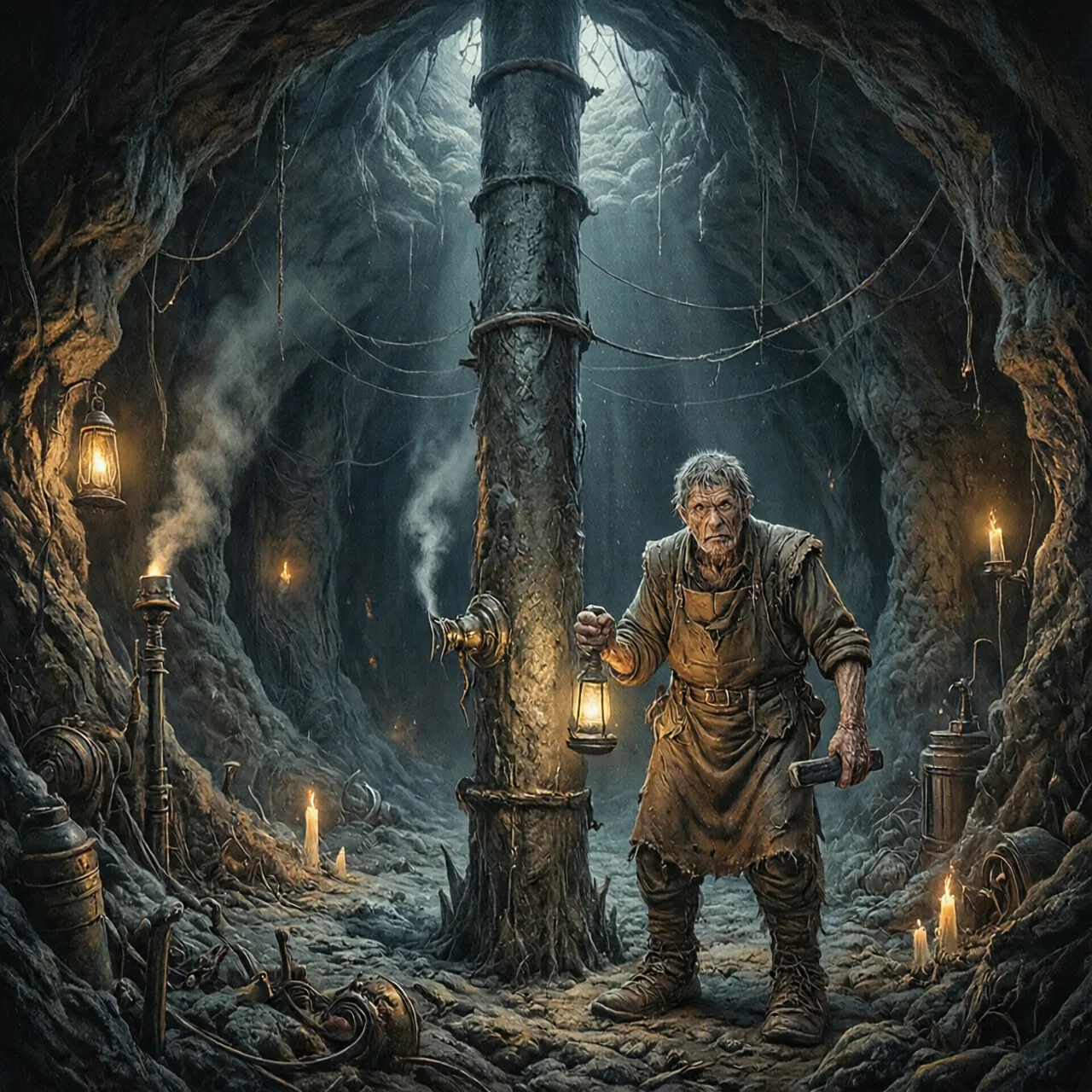
SpliceBelow the lowest catwalks there is a gallery the maps don't carry, and in it the run we called the Null Main. The Deacon kept it. It is not a line at all. It is a bore — a tube in the living rock, collared in a lead nobody mined, running true-vertical where every run in the world lies flat. The first under-folk found it when they cut the first gallery. Nobody drilled it. It does not go to a city. It goes down.
The DeaconEvery run ends somewhere, girl. This one ends at the bottom of things. And the bottom of things has come loose.
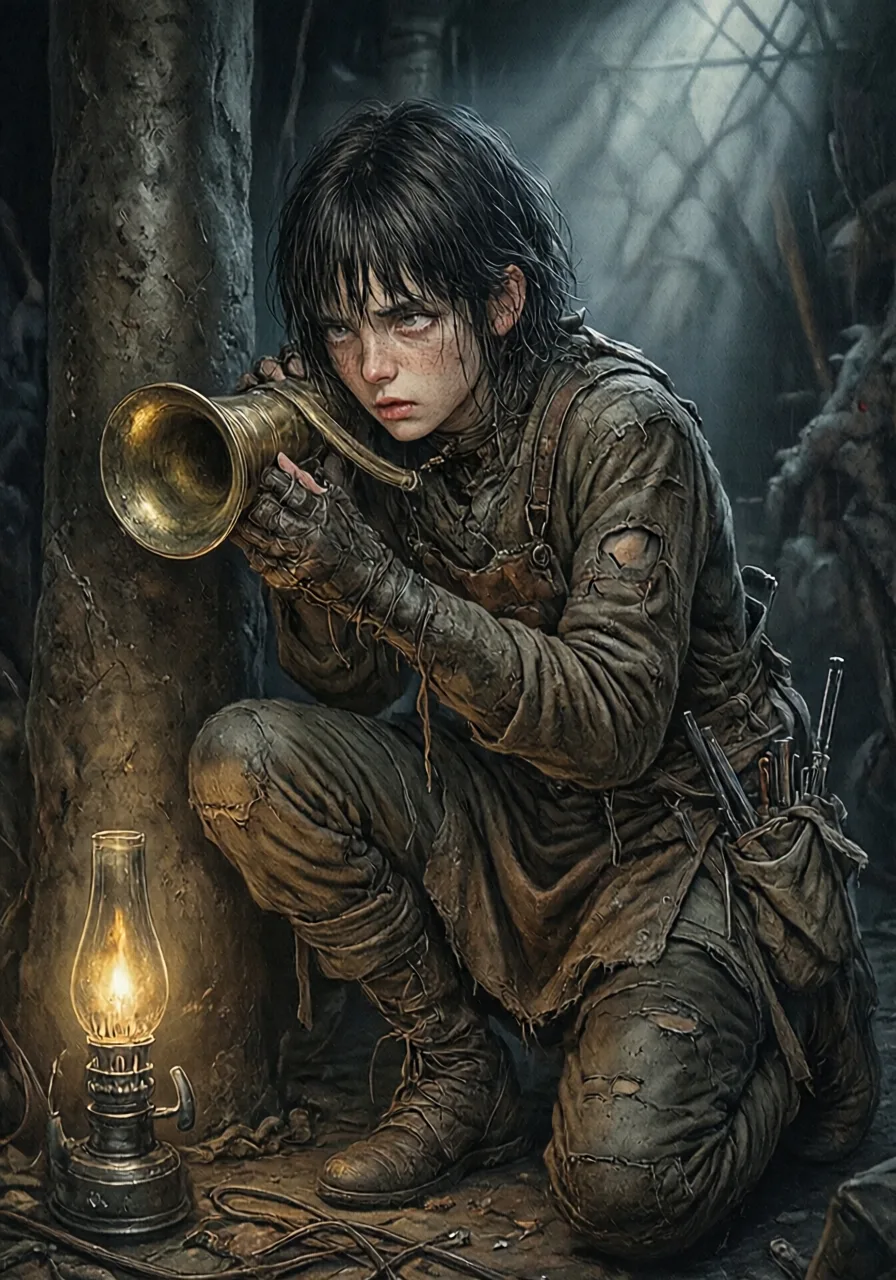
SpliceHe let me listen, once. I heard a silence getting louder. I know how the words sit. I can't better them. There is a place at the bottom of the Null Main where nothing sounds — and the nothing was rising, the way water rises in a shaft, patient, without hurry, wider every year. The Deacon had been measuring it his whole life, in marks on a slate column by the bell. The marks were close together for a hundred years. They weren't close together anymore.
Page 8
A man coming in out of weather.
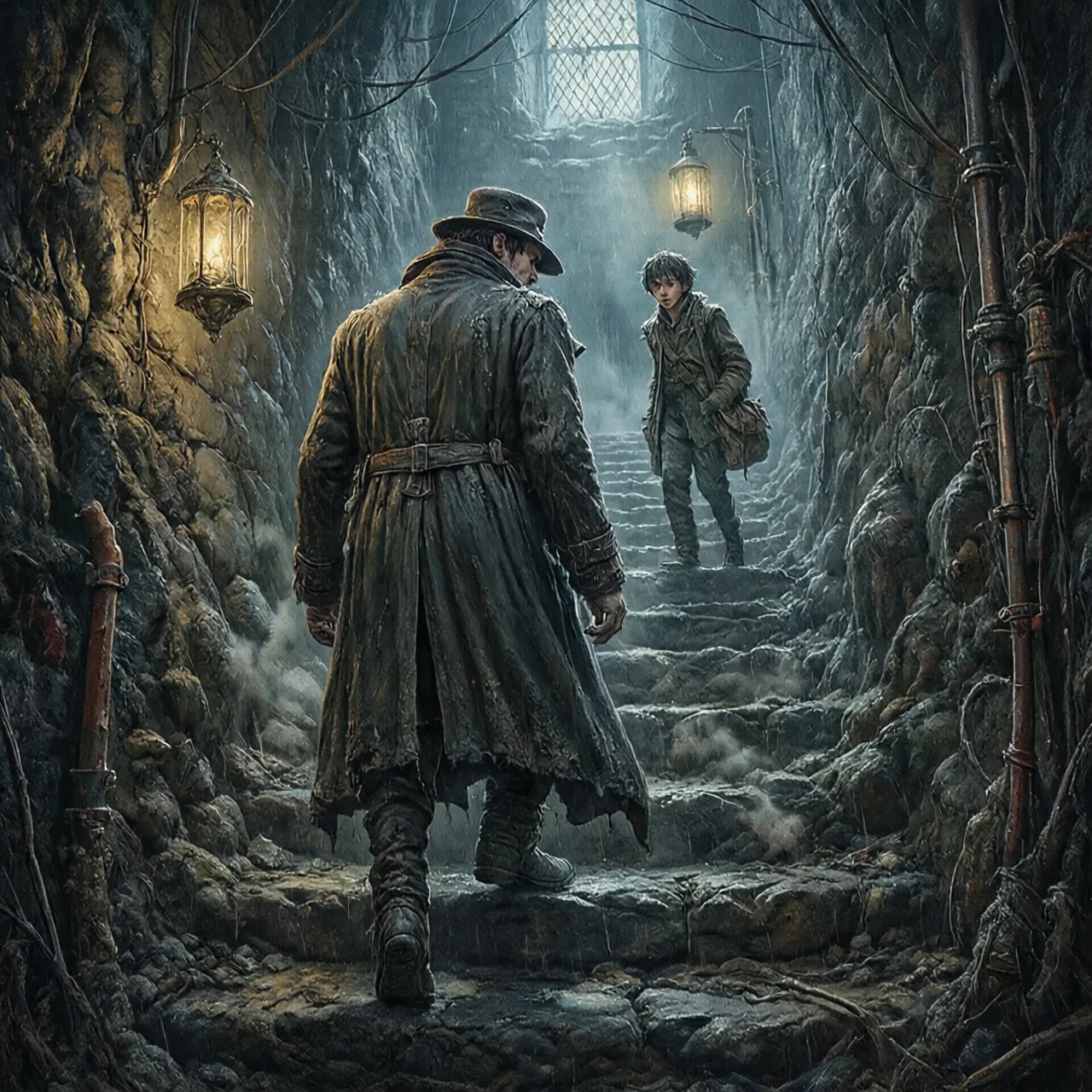
SpliceHe came up out of the deep galleries in the spring the light went thin. Understand: nobody comes up from the deep galleries. Below the Null Main's gallery there are no ladders, no doors, no roads. Fuse saw him first, on the dead stair below the pressure-works — a stair that ends in rock, that has always ended in rock — climbing it like a man coming in out of weather.
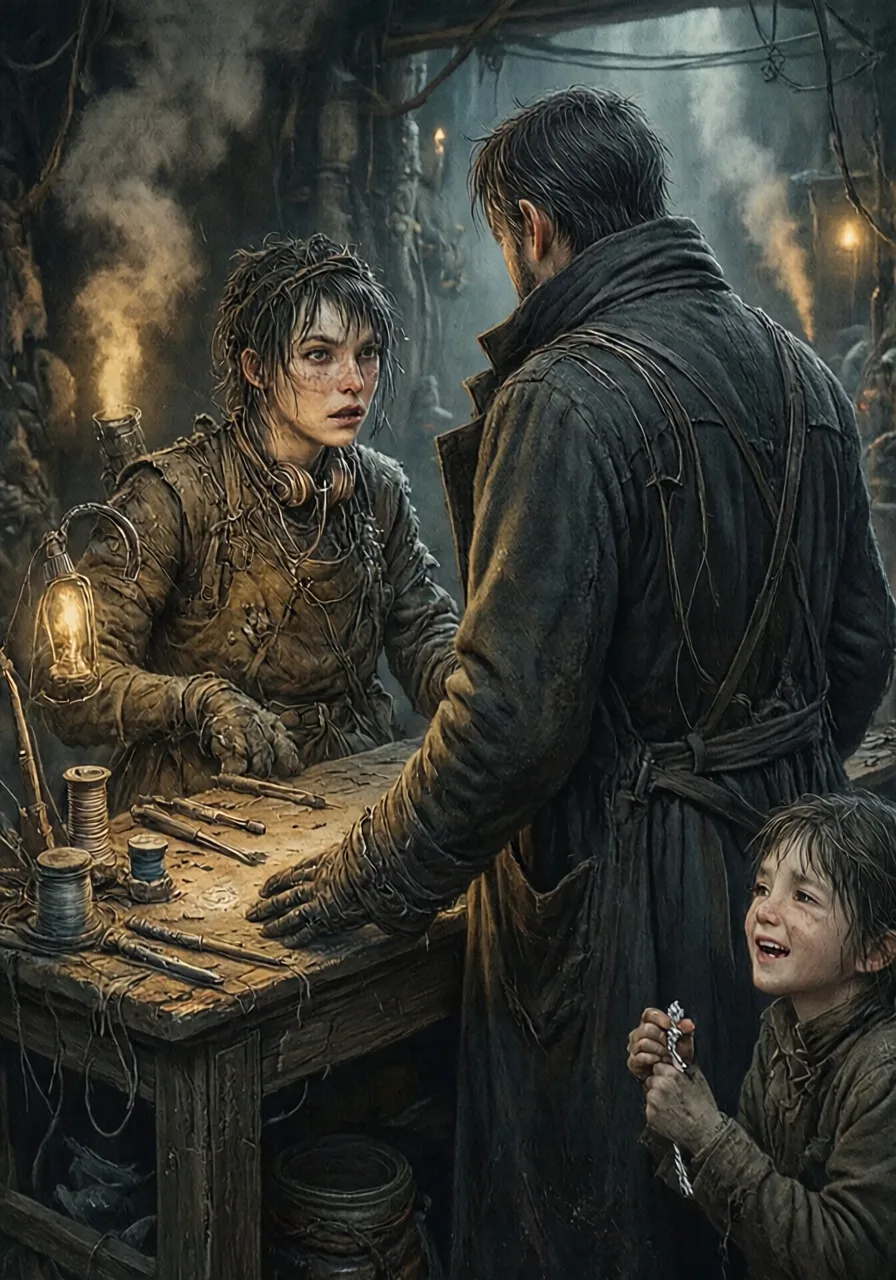
SpliceHe wanted a length of wire. Common braid, an arm-span. He paid before I could name a price, and the coin was good silver and it was a coin of the realm — and I have handled coin from every mint between the seas, and I could not tell you whose realm. He spoke Wickworks cant. Born cant — my own mother's vowels. He was kind. He said a splicer's hands were the hands the world stood on, and he meant it. He gave a sugar-twist to Fuse, and Fuse laughed. He thanked me twice for the wire. Then he asked me the way up.
SpliceI cannot remember his face. I tried that same night, with the lamp out, the way you reach after a dream — nothing. A coat the colour of the dark before weather. A way of walking that had been walking a long time and wasn't finished. A voice like a hole where a voice should be. And the dust on the catwalk, where he had crossed the steam bazaar end to end — unmarked. I went back and knelt with my lamp and looked.
Page 9
The eleven-days man.
SpliceWe knew, by then, what the dying lines had heard before they died. We sent it up the tubes that same night, capsule after capsule, plain as we could punch it: a man is in the city. The kind man. The eleven-days man. Our own paper came back the next morning with the violet stamp on it.
Mother CoilWe heard the world end on the wire. We sent word up. They stamped it NOTED.
Page 10
Some signal you bury.
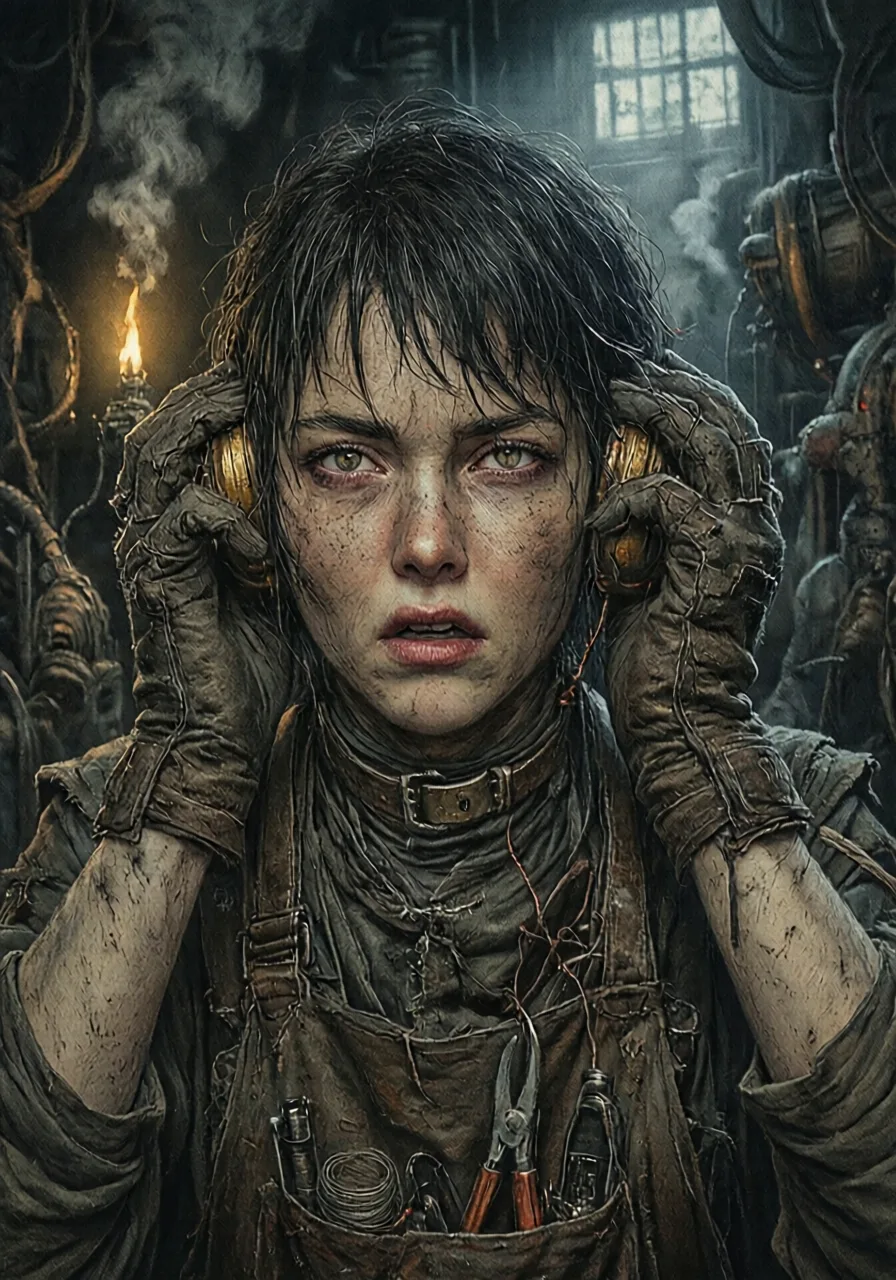
SpliceCarmana did not go quiet. Every city on the Line died into silence except Carmana. Carmana's hitch-step pulse faded, eleven days like the others — and then, on the twelfth day, the Carmana line began to send. It kept the form of a clock-pulse. It was not a clock-pulse. It was a beat with proportions the ear could not hold — slow, then slow in a different direction, then a third thing that was not slow or fast — and the coil got cold under my hands. Mother Coil heard ten beats of it. Then she cut the Carmana line out of the boards with a hot knife and sealed the ends in red wax. She never said why and I never asked, because I had heard the ten beats too. Some signal you do not study. Some signal you bury.
SpliceAfter that we were tappers no longer; we were cartographers of the dark. Every silence got a flag, every flag a date, and the dates drew a map, and the map walked. Six walkers — we never saw but the one, but the silences moved at a walking pace along six tracks, and the tracks did not cross, and they did not hurry, and they did not need to. A city went quiet eleven days after some line-house logged a stranger's kindness. We clocked the end of the world to the minute, in a chapel of patch-cords under a city that was reading the Daily Concord.
Page 11
They lived in the sum.
SpliceThe Concord, those last two years, was a masterwork. I climbed to the grate sometimes just to watch them believe it. The sun had gone thin as skimmed milk and the Concord proved the dimming seasonal. The wheat-barges stopped and the Concord proved the granaries full. The glow-lamps doubled, then trebled, against a noon as grey as bathwater, and the boulevards blazed, and the orchestras played, and over my head the brightest, kindest, most learned people the world ever made walked in circles inside a sum, and the sum said all was well, and they lived in the sum. We lived in the wire. The wire was almost all silence now. The Deacon's slate had run out of column. He chalked his last mark on the gallery wall instead, head-high, and under it he wrote: WIDENING.
Page 12
The pale robes came down.
SpliceThe man in the storm-dark coat was eleven days in Pharos the Bright. The wells went first — the high fountains stood down all in one morning, politely, like servants thanked for their service. Then the fire began, in the Reckoning Houses of all places, and it moved the way the line-houses had told us fire moved now: slower than fire moves, more deliberately than fire can move. On the second day of the fire, the Bright found the grates. The pale robes coming down — the astronomers, the Reckoners, the perfectible men — soot-faced, empty-handed, blinking in the dark they were standing on their whole shining lives. They did not know our names. They did not know there were names below the grates to know.
SpliceWe fed them. I want that on the tape twice, because it is the only thing of ours I am certain deserves to outlive us. Mother Coil stood at the chapel door handing out bread and naming the children as they came, and the Wickworks fed the Bright in the dark by the light of the lamps we had kept against exactly this dark — because the kindness of the man in the coat is a coin from no realm, and ours was minted here, and we spent it.
SplicePharos above burned for eleven days. The Hour Line heard it the whole way down. I was on the coil for the last of it — somebody had to be, that was always the whole of our law, somebody listens — and at the end the pulse of my own city faded under my hands like all her sisters, beat by beat, the spaces filling with kept silence, and stopped. Inside a beat. Not after one.
Page 13
Faithful as a line.
SpliceThe Wickworks emptied down the deep roads in the weeks after — dark we knew, dark we'd mapped, Mother Coil at the front with the flag-board under her arm and Fuse carrying the chapel's smallest lamp. I sent them on. I stayed. Don't pity me for it; it was the plainest arithmetic of my life. The boards were mine. Somebody listens.
The DeaconGirl, the Null Main was never dead. A dead run ends. This one opens. Every line ends at the bottom of things — and the bottom of things ends at every line. What you put down it does not stop. It arrives. Somewhere a relay sounds, and a stranger picks it up, and the stranger reads. Lines are faithful, girl. It's worlds that aren't.
The tape ends there, mid-word, the last hole half-cut where the punch stopped.
SpliceIf you are reading me, stranger: the relay sounded. The Deacon was right, and somewhere a line still holds. Keep your joints dry. Look down kindly on whatever your bright city stands on. And if a man comes up your stairs out of a dark with no roads in it, and pays in good silver, and is kind — count eleven days. My lamp is small. My city is quiet. I am going to keep punching until the tallow
Page 14
The basket stays empty.
The capsule arrived by a tube that serves no route in this archive's registers. The Librarian has traced the tube as far as it can be traced. It descends. The only workings this archive adjoins in that direction are the workings this catalogue does not describe, at the bottom of things, where something turns. The relay has not sounded again. She has oiled it. She has instructed the assistants that nothing is to be stored in the receiving basket, ever, against the possibility. She asked whoever read her to look down kindly on whatever the bright city stands on. I am the one who reads her. I have looked down. I have filed the entry. The basket stays empty.
Listen ModeClick a section to begin listening
The chronicle plays section by section in the Librarian's voice. As each section plays, the corresponding pages of the comic are highlighted. Switch to Scroll, Flip, Prose, or Split at any time — the audio continues, and you can follow visually.
Section 0Frontmatter
# The Hour Line
From the Catalogue of the Sixteenth Archivist, entry 9,407. Provenance: a sealed brass capsule of a pattern this catalogue does not record, containing a spool of perforated signal-tape. The capsule was not received at the south gate. It was found in the pneumatic relay of the lower archive, in a tube that serves no route the Librarian has been able to trace, on a morning she has fixed precisely because she was present when the relay sounded. Nothing arrives by that tube. Something arrived. The tape begins with a primer — forty hand-punched lines that teach the reader the code of the holes, written for a stranger the sender knew she would never meet. The Librarian has read the tape by lamplight, hole by hole, with the key the tape itself taught her. The cities named in the tape are the cities of entry 9,221. The tape ends mid-word.
"We heard the world end on the wire. We sent word up. They stamped it NOTED."
Section 1Section 1
You don't know me. That's all right. Nobody up in the Bright knew me either, and I kept their clocks true for twelve years.
My name is my own. Below the grates they called me Splice, because joining lines is what I do — was what I did — and a line I joined held. I was born in the Wickworks, which is what we called the under-city of Pharos, the way you'd give a name to a thing the people upstairs never named because they never said it out loud. Pharos the Bright. Pharos of the white towers and the glow-lamps, Pharos where the Reckoning Houses ran their brass engines day and night and the engines never once said anything anybody upstairs didn't want to hear.
Under it: us. Three levels of us, then five, then nobody agreed how many. Heat-mains and tallow-stalls and the pressure-works that ran the high fountains, catwalks over the warm dark, lime-lamps in wire cages, solder smoke, the steam bazaar under the Processional grate where you could stand in the crowd and look straight up through the iron lattice and watch the scholars walk over your head in their pale robes, talking about the perfectibility of man.
They never looked down. I want to be fair, because being fair matters to me the way it never mattered to them: it wasn't cruelty. They had simply stopped seeing us, generations back, the way you stop seeing your own pulse. The fountains rose, the lamps lit, the bells rang true, and no one asked what the city was standing on.
You can live free directly beneath a man who believes you don't exist. That's the first thing I have to teach you, stranger, whoever you are, working out my holes by your lamp. There were two hidden worlds in Pharos. We were the one you could find by lifting a grate.
I'll get to the other.
Section 2Section 2
You've heard — if any account of us survives wherever you are — that the bells of the Concordium rang at the same minute along the whole imperial road, league on league, Hieroclus to Anthieon, summer and winter, and that this was a wonder.
It wasn't a wonder. It was the Hour Line, and my people kept it.
A wire, stranger. That's all. A signal-wire in a lead jacket, strung through the dark under the empire — under the road, under the rivers, under the wheat at Calanthar — carrying one pulse, the master minute, so every bell in the thousand-year empire swung true together. The scholars upstairs wrote hymns about the harmony of the world. Down in the Wickworks we paid out cable and kept the joints dry, and Mother Coil boxed your ears if your solder ran grey.
Mother Coil ran the switch-chapel under the Old Stair — a hall of patch-boards and brass jacks, ten thousand cords, lime-light, the smell of hot shellac, holy in the only way I've ever understood the word. She'd been keeping the Line since before my mother was born. She put the listening-coil on my ears when I was nine years old, and that was the other hidden world, the one upstairs never dreamed was there:
You could hear the cities.
Every city on the Line had a pulse, and no two pulses walked alike. Hieroclus walked heavy — an old priest going up old stairs. Veless walked quick and light, skipping every fortieth beat like a girl skipping a cobble she knows is loose. Anthieon dragged cold. Carmana had a hitch in its step, a hesitation, as if the city kept almost remembering something. Mother Coil knew them blind. All us tappers did, in time. Close your eyes in the switch-chapel and the whole Concordium walked through your head in the dark, league by league, alive.
The Bright had the Daily Concord — the noon broadsheet the Reckoning Houses printed, the calculated assurance that all was accounted for and all was well. We had the raw line.
Remember that difference. Everything that came after lives inside it.
Section 3Section 3
The wells you'd have heard about. Even the Concord couldn't keep wells out of print forever — a well sealed here, a spring retired there, each with its own tidy local cause, decades of them, never once connected.
We connected them. Not because we were wiser. Because line-chatter is line-chatter: every well that closed came down the wire to us as a maintenance flag, and Mother Coil kept the flags on a board, and one night I watched her stand at that board with a taper in her hand, not lighting anything, just standing, and I asked her what she was looking at, and she said: "The pattern, girl. There's a hand drawing it."
Then, in the year the Bright would later agree to call the third year of the difficult times, Hieroclus stopped.
I was on shift. I want that written somewhere, in holes if nothing else: I was on the coil the night Hieroclus began to die, and it did not stop the way a line fails. A line fails like a dropped plate. Hieroclus faded — eleven days, beat by beat, the old priest on the old stairs climbing slower, and slower, and the spaces between his steps filling up with something that was not silence, exactly, but was the sound silence makes when it is being kept. On the eleventh day the pulse stopped mid-beat. Not after a beat. Inside one.
We sent it up the tubes, everything we knew, capsule after capsule to the Reckoning Houses, to the Astronomer-Counsel, to anyone with a brass nameplate: HIEROCLUS LINE DEAD ELEVEN DAYS. SIGNATURE NOT MECHANICAL. REQUEST INSTRUCTION.
The capsule came back the same afternoon, our own paper, one stamp on it, violet ink.
NOTED.
The Daily Concord at noon said the southern districts were reorganizing their civic calendar, and that the harmony of the world was the harmony of the world.
That noon was the first time I climbed up to the Processional grate and looked at the Bright through the lattice — really looked, the way you look at a stranger — at all of them walking in the white light over my head, fed and warm and sure, and understood it whole, the way you understand a fall after your foot has already left the stair:
We were never the hidden world. Not truly. The Bright was the hidden world. They had built a city inside a sum that always came out right, and they lived in the sum, and the sum had stopped describing anything. We were standing in the real world the whole time — down in the dark, with the wire in our ears, listening to it end.
Section 4Section 4
Below the lowest catwalks of the Wickworks, below the pressure-works, there is a gallery the maps don't carry, and in that gallery is the run we called the Null Main.
The Deacon kept it. The Deacon kept all the dead lines — lines to cities that had stopped being cities before the empire had its name, lines that ran nowhere and had always run nowhere — and he kept the Null Main, which is not a line at all. It is a bore. A tube in the living rock, wide as a man's two fists, collared in a lead nobody mined, running true-vertical where every run in the world lies flat. The first under-folk found it when they cut the first gallery. Nobody drilled it. It does not go to a city.
It goes down.
The Deacon was old the way the Null Main was old, and he wore a cable-splicer's apron the way the priests upstairs wore vestments, and he was the one who told me, the first time I went down with a message and my lamp, what every tapper learns eventually and nobody upstairs ever learned at all. I asked him what was at the bottom of it. He looked at me the way Mother Coil looked at the flag-board, and he said: "Every run ends somewhere, girl. This one ends at the bottom of things. And the bottom of things has come loose."
At the breech of the bore, keepers a hundred years gone had fitted a listening-bell — a horn of hammered brass you set your ear against, the way you'd listen down a well. He let me listen, once, that first time. I'll set down what I heard, and you can make of it what your world lets you make of it.
I heard a silence getting louder.
I know how the words sit. I can't better them. There is a place at the bottom of the Null Main where nothing sounds — and the nothing was rising, the way water rises in a shaft, patient, without hurry, wider every year. The Deacon had been measuring it his whole life, the way his teacher had, in marks on a slate column by the bell. The marks were close together for a hundred years.
They weren't close together anymore.
Section 5Section 5
The man came up out of the deep galleries in the spring the light went thin.
Understand: nobody comes up from the deep galleries. There is no up from — below the Null Main's gallery there are no ladders, no doors, no roads. And nobody comes down to us either, not from the Bright; in twelve years on the boards I never once saw a pale robe below the grates.
Fuse saw him first, on the dead stair below the pressure-works — a stair that ends in rock, that has always ended in rock — climbing it like a man coming in out of weather. He walked through the steam bazaar at the third bell, and he stopped at my bench, because in those years I kept a public bench at the bazaar's edge — solder, splices, small work for tallow-money.
He wanted a length of wire. Common braid, an arm-span. He paid before I could name a price, and the coin was good silver and it was a coin of the realm — and stranger, I have handled coin from every mint between the seas, and I could not tell you whose realm. He spoke Wickworks cant. Not learned cant. Born cant — my own mother's vowels, the down-tunnel lilt on the finished word. He was not born in the Wickworks. I knew every face on three levels.
He was kind. I want this in the record, because the kindness is the part I have carried longest and understood least. He asked after the bench, after the work, after my hands — said a splicer's hands were the hands the world stood on, and said it like he meant it, and he meant it. He gave a sugar-twist to Fuse, who was eight then and hanging on my apron, and Fuse laughed. He thanked me twice for the wire. Then he asked me the way up.
I walked him to the foot of the Processional stair. I watched him climb toward the white light with his arm-span of my wire coiled over his shoulder like a courier's satchel.
Here is what I know and cannot use: I cannot remember his face. I tried that same night, with the lamp out, the way you reach after a dream — nothing. A coat the colour of the dark before weather. A way of walking that had been walking a long time and wasn't finished. A voice like a hole where a voice should be.
And the dust on the catwalk, where he had crossed the steam bazaar end to end —
unmarked. I went back and knelt with my lamp and looked.
We knew, by then, what the dying lines had heard before they died. We sent it up the tubes that same night, capsule after capsule, plain as we could punch it: A MAN IS IN THE CITY. THE KIND MAN. THE ELEVEN-DAYS MAN. Our own paper came back the next morning with the violet stamp on it.
Mother Coil pulled my flags from the board with her own hands and laid them flat, the way you close a dead man's eyes, and she said the thing I have set at the head of this tape, so it would be the first thing any stranger ever learned about us:
We heard the world end on the wire. We sent word up. They stamped it NOTED.
Section 6Section 6
I'll go quickly now. The tape is long but my tallow isn't, and the cold has reached my bench-hands, and a splicer with cold hands punches false.
Carmana did not go quiet. I have to put this down because somewhere, in some world, somebody should have it: every city on the Line died into silence except Carmana. Carmana's hitch-step pulse faded like the others, eleven days like the others — and then, on the twelfth day, the Carmana line began to send.
It kept the form of a clock-pulse. It was not a clock-pulse. It was a beat with proportions the ear could not hold — slow, then slow in a different direction, then a third thing that was not slow or fast, and the coil got cold under my hands, and Splice's hands, stranger, do not shake.
Mother Coil heard ten beats of it. Then she cut the Carmana line out of the boards with a hot knife — physically, cable and jack and all — carried the loose ends to the brazier with tongs, and sealed each one in a fist of red wax. She never said why and I never asked, because I had heard the ten beats too, and some signal you do not study. Some signal you bury.
After that, the work changed. We were tappers; we became cartographers of the dark. Every silence got a flag, every flag a date, and the dates drew a map, and the map walked. Six walkers, stranger — we never saw but the one, but the silences moved at a walking pace along six tracks, and the tracks did not cross, and they did not hurry, and they did not need to. A city went quiet eleven days after some line-house logged a stranger's kindness. We clocked the end of the world to the minute, in a chapel of patch-cords under a city that was reading the Daily Concord.
The Concord, those last two years, was a masterwork. I climbed to the grate sometimes just to watch them believe it. The sun had gone thin as skimmed milk and the Concord proved the dimming seasonal. The wheat-barges stopped and the Concord proved the granaries full. The glow-lamps doubled, then trebled, against a noon as grey as bathwater, and the boulevards blazed, and the orchestras played, and over my head the brightest, kindest, most learned people the world ever made walked in circles inside a sum, and the sum said all was well, and they lived in the sum.
We lived in the wire. The wire was almost all silence now.
You could hear the silence at the bottom of the Null Main without the bell by then. The Deacon's slate had run out of column. He chalked his last mark on the gallery wall instead, head-high, and under it he wrote: WIDENING.
Section 7Section 7
The man in the storm-dark coat was eleven days in Pharos the Bright.
I won't make you a chronicle of the fall. I was under it, not in it; what I have is what the grates gave me, and what came down the stairs, and what the wire whispered as it died. The wells went first — the high fountains stood down all in one morning, politely, like servants thanked for their service. The thin sun went out of the noon entirely and the glow-lamps carried it alone. Then the fire began, in the Reckoning Houses of all places, and it moved the way the line-houses had told us fire moved now: slower than fire moves, more deliberately than fire can move — a fire that read the city as it went, and kept what it read.
On the second day of the fire, the Bright found the grates.
That is the picture I will carry to whatever bottom I am bound for, stranger, so I give it to you whole: the pale robes coming down. Down the Processional stair, down the freight-runs, down ladders they did not know how to hold, into the tallow-smoke and the lime-light — the astronomers, the Reckoners, the perfectible men — soot-faced, empty-handed, blinking in the dark they were standing on their whole shining lives. They did not know our names. They did not know there were names below the grates to know.
We fed them.
I want that on the tape twice, because it is the only thing of ours I am certain deserves to outlive us. They had stamped our world NOTED and filed it, and when their sum broke open and poured them down our stairs, Mother Coil stood at the chapel door handing out bread and naming the children as they came, and the Wickworks fed the Bright in the dark by the light of the lamps we had kept against exactly this dark, because the kindness of the man in the coat is a coin from no realm, and ours was minted here, and we spent it.
Pharos above burned for eleven days. The Hour Line heard it the whole way down. I was on the coil for the last of it — somebody had to be, that was always the whole of our law, somebody listens — and at the end the pulse of my own city faded under my hands like all her sisters, beat by beat, the spaces filling with kept silence, and stopped.
Inside a beat. Not after one.
Section 8Section 8
So. The end of the tape, and the end of the tallow, and you.
The Wickworks emptied down the deep roads in the weeks after — old freight galleries running out under the inner sea, dark we knew, dark we'd mapped, Mother Coil at the front with the flag-board under her arm and Fuse carrying the chapel's smallest lamp. I sent them on. I stayed. Don't pity me for it; it was the plainest arithmetic of my life. The boards were mine. Somebody listens.
The Hour Line is one silence now, end to end, except under my feet, where the silence is still getting louder. The Deacon went down to his gallery a month ago and did not come up, and his lamp is burning down there still, beside the wall where it says WIDENING, and I have not gone to fetch it.
But before he went, he told me the last thing, the thing I have been punching this whole spool to reach. He said: "Girl, the Null Main was never dead. A dead run ends. This one opens. Every line ends at the bottom of things — and the bottom of things ends at every line. What you put down it does not stop. It arrives."
I asked him: arrives where?
He said: "Wherever the bottom touches. Somewhere a relay sounds, and a stranger picks it up, and the stranger reads. Lines are faithful, girl. It's worlds that aren't."
So here is what I have done, in the dark, in the cold, with the last of my hands: I have punched the primer, so you could learn my holes. I have punched the cities and their gaits, so somewhere their walk is written. I have punched Hieroclus dying inside a beat, and the wax on the Carmana line, and the coin from no realm, and the dust that wasn't marked, and NOTED in its violet ink, and the pale robes coming down the stairs, and the bread.
And now I will close this spool in the brass, and grease the Null Main's breech the way the Deacon taught me, and send the only true record of Pharos the Bright straight down into the silence at the bottom of things, addressed to no one, faithful as a line.
If you are reading me, stranger: the relay sounded. The Deacon was right, and somewhere a line still holds.
Keep your joints dry. Look down kindly on whatever your bright city stands on. And if a man comes up your stairs out of a dark with no roads in it, and pays in good silver, and is kind —
count eleven days.
My lamp is small. My city is quiet. I am going to keep punching until the tallow
Entry 9,407, final annotation.
The tape ends there, mid-word, the last hole half-cut where the punch stopped. There is no signature. The sender's name, as she gives it, is a function: the one who joins lines.
The cities named are the cities of entry 9,221, the chronicle of Aurelian Mer of Veless. The count of walkers is the count of entry 9,221. The kindness is the kindness. The eleven days are the eleven days. Aurelian Mer, a scholar of the Bright if ever the Bright had one, records the bells of the imperial road ringing as one and calls it the best-made thing in the world. He did not record who kept them. The tape records who kept them. The two entries have never met except in this cabinet. I have filed them adjacent. I have not extended the relation.
One matter I am required by my own practice to set down. The capsule arrived in the relay of the lower archive, by a tube that serves no route in this archive's registers. I have traced the tube as far as it can be traced. It descends. The only workings this archive adjoins in that direction are the workings this catalogue does not describe, at the bottom of things, where something turns.
The relay has not sounded again. I have oiled it. I have left the receiving basket empty, and instructed the assistants that nothing is to be stored in it, ever, against the possibility.
She asked whoever read her to look down kindly on whatever the bright city stands on.
I am the one who reads her. I have looked down. I have filed the entry.