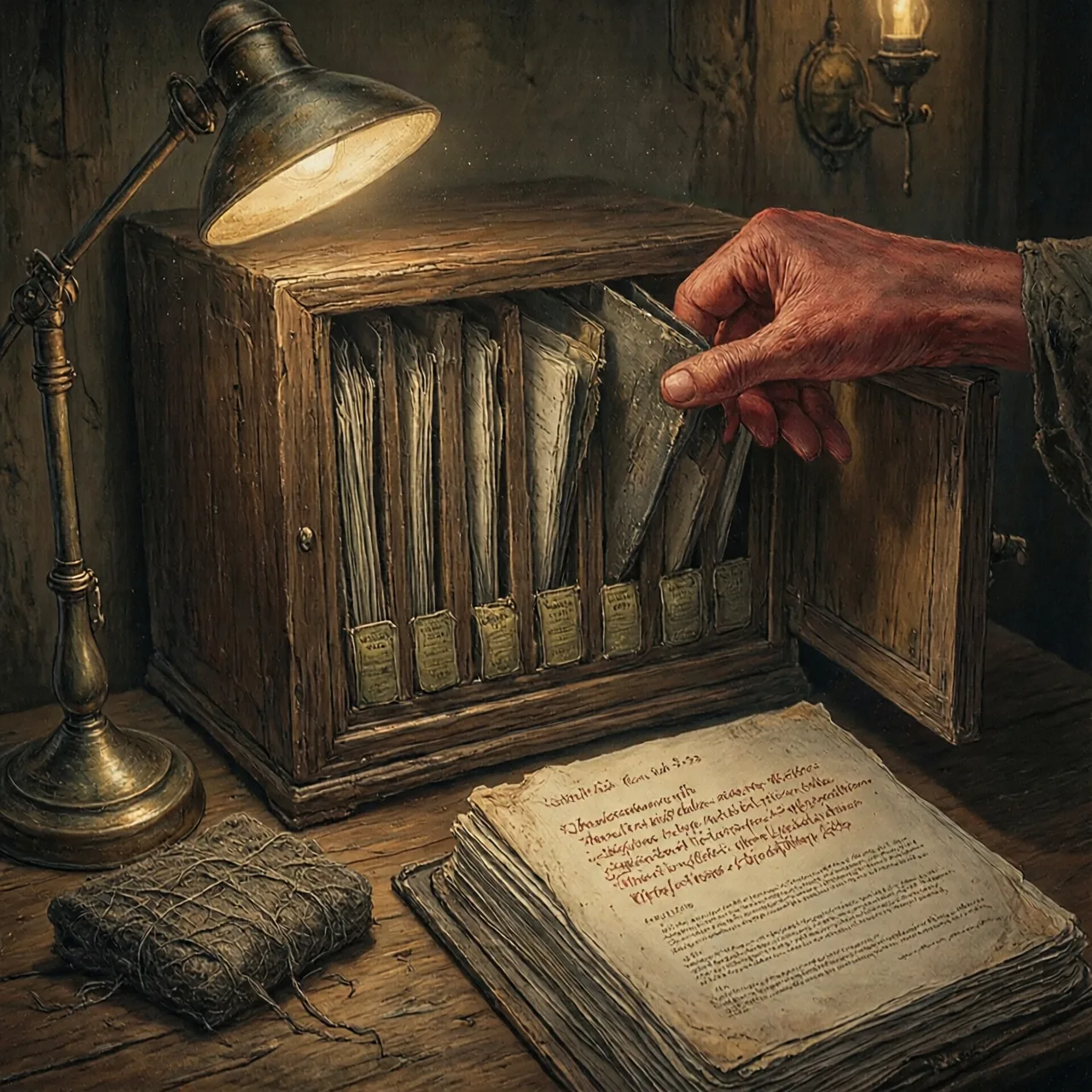
From the Catalogue of the Sixteenth Archivist, entry 9,221 — translated from the chronicle of Aurelian Mer of Veless
Full chronicle
Page 1
She named the writer.
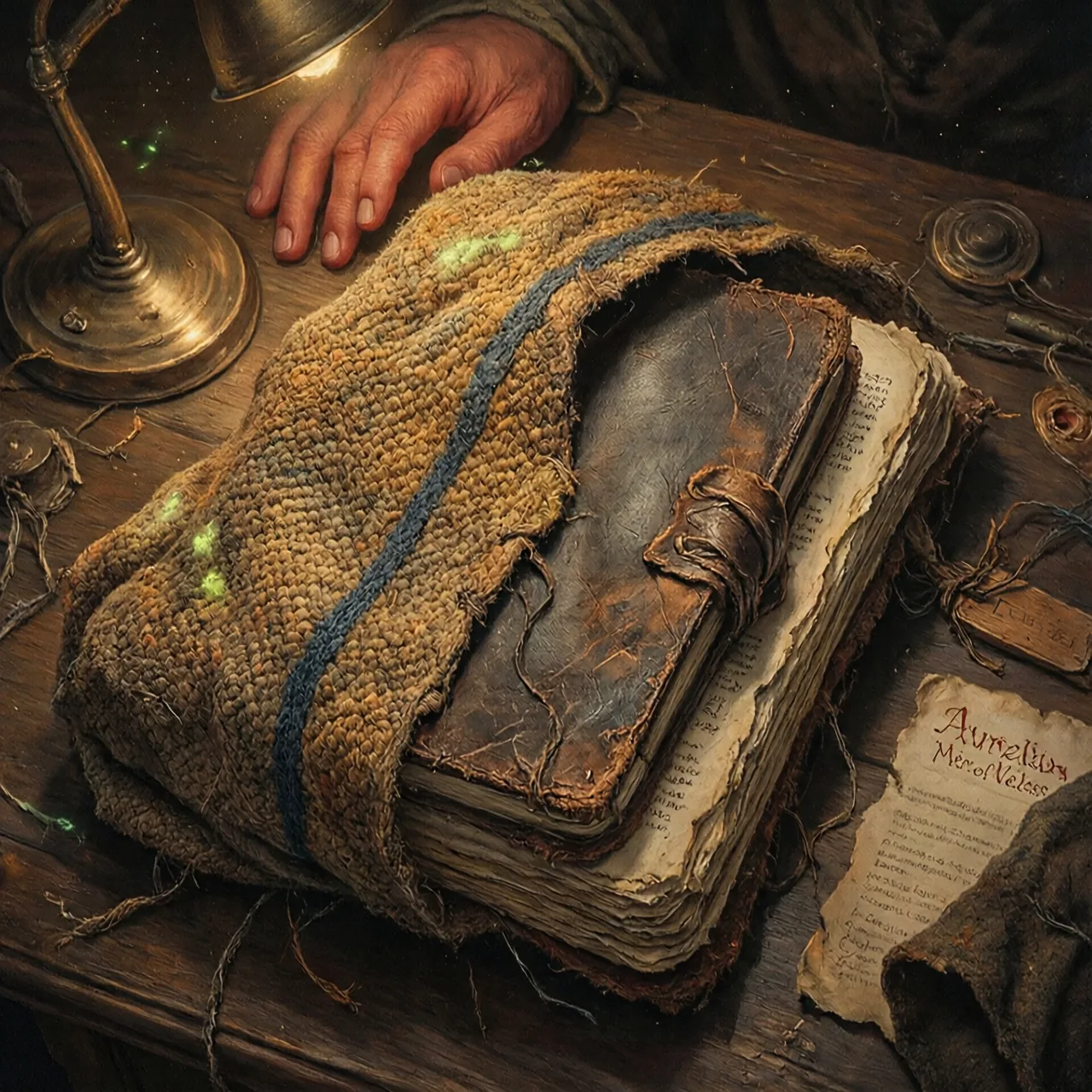
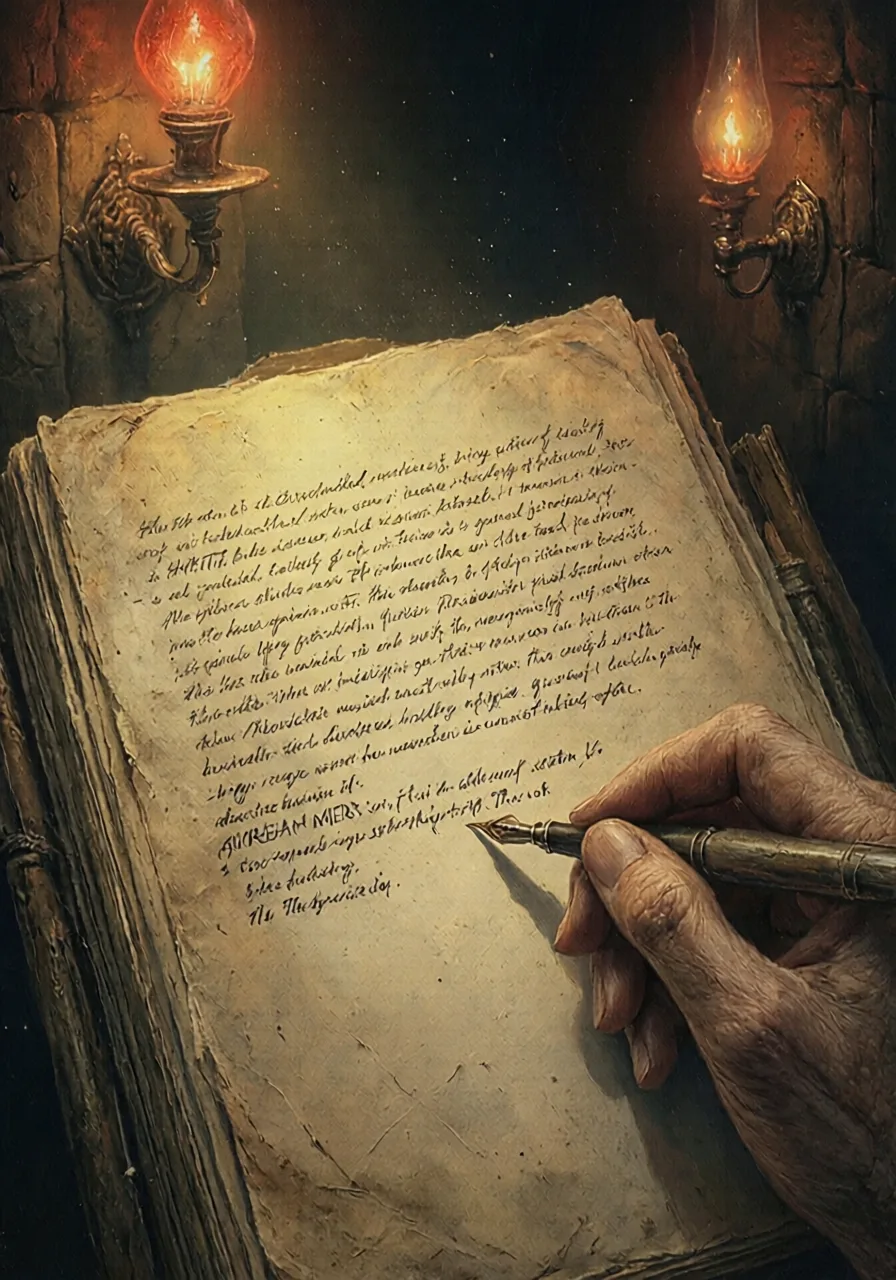
The folio was received at the south gate in an intake bundle dated to entry 9,221. The cloth in which it was bound was a weave the cabinet does not record. The bearer did not survive his arrival. He named the writer. The writer was Aurelian Mer of Veless, of an empire not in any catalogue this archive keeps.
I have read the folio four times. I have not extended the entry on this matter.
Page 2
The seventeenth year of the Long Breaking.
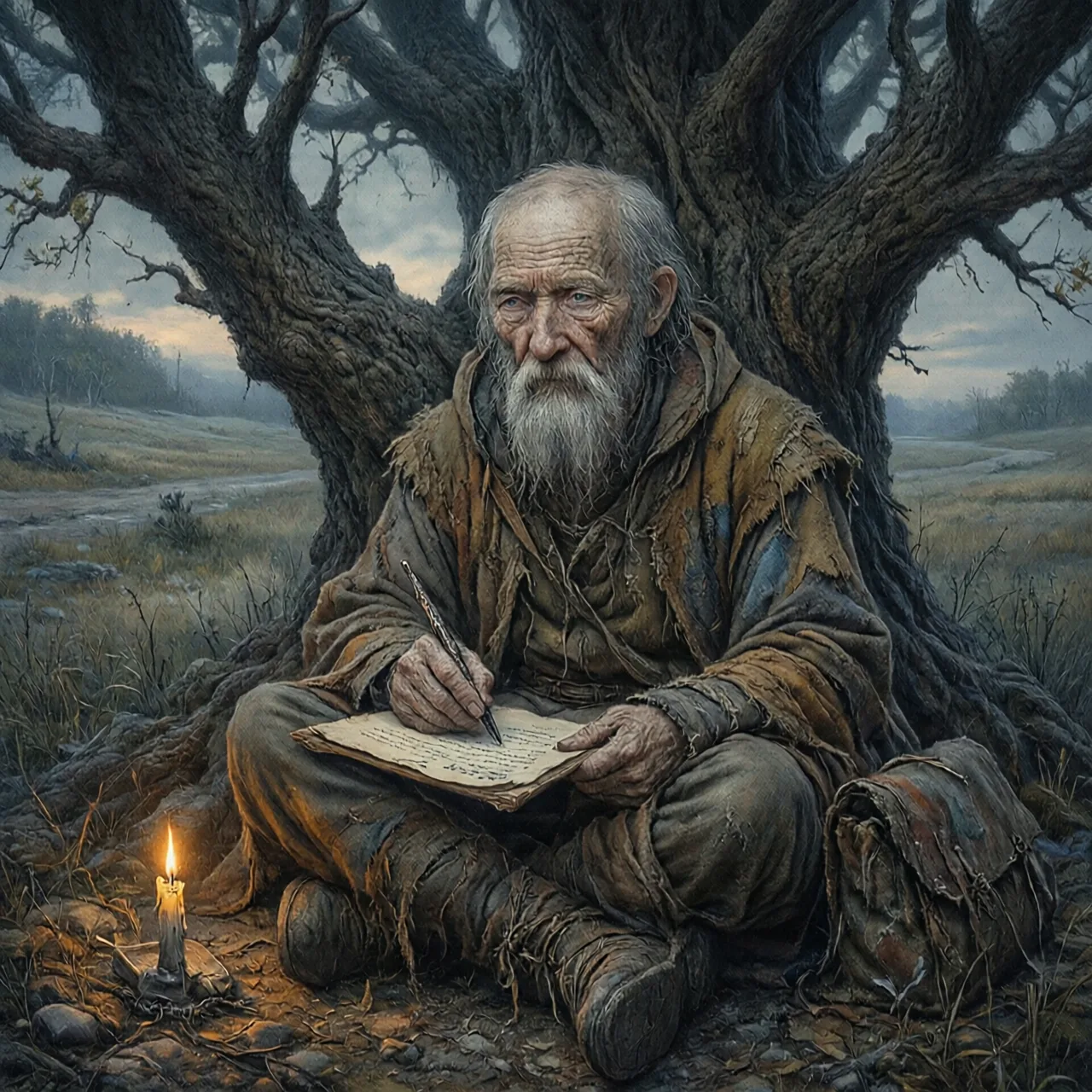
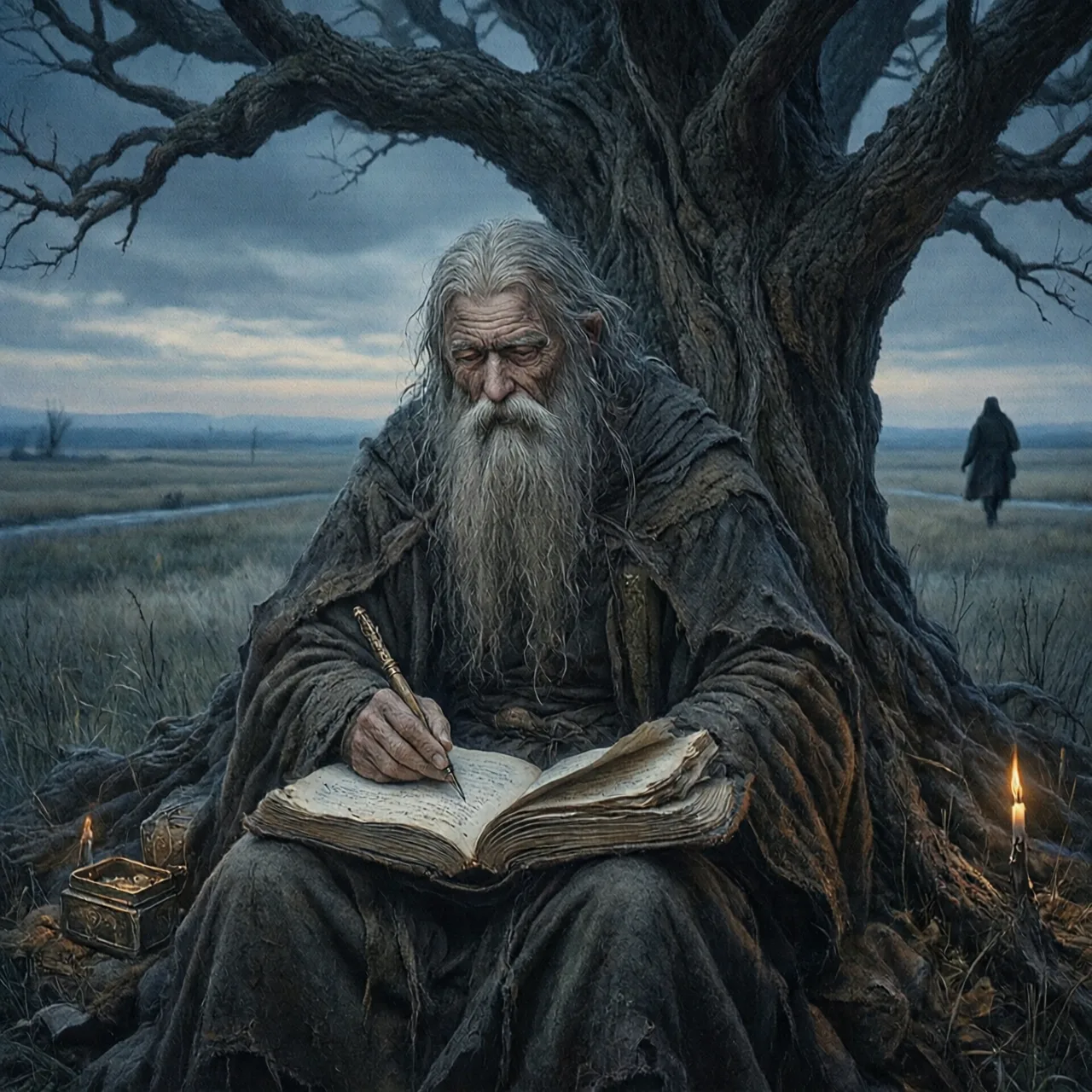
I am writing now under a tree. The tree is not a tree I know the name of. I have known many trees. The trees I knew are not in this country.
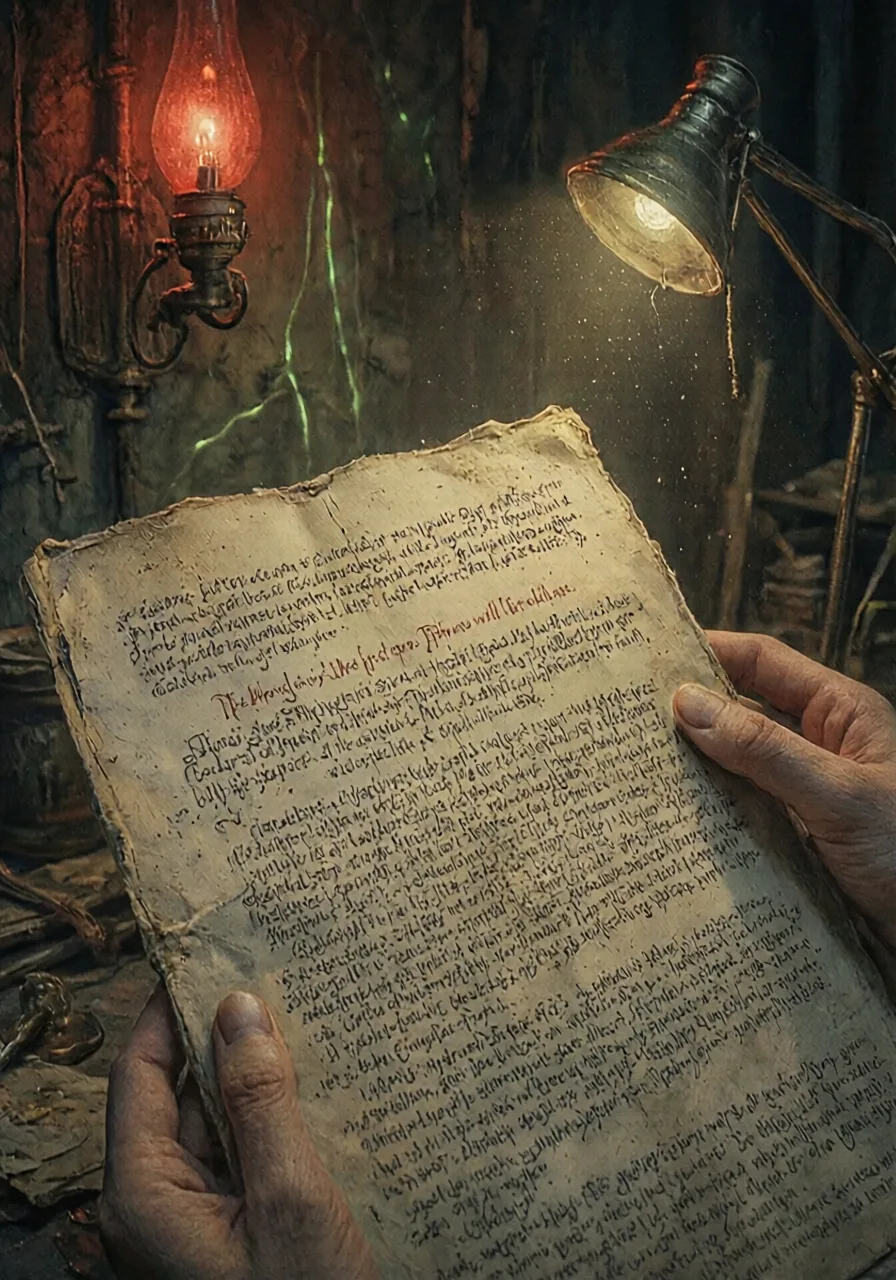
I have written this on the paper Agathon gave me, with the bronze-and-bone pen Agathon gave me, in the hand Agathon taught me. The paper has lasted longer than I expected. The pen has not broken. The hand is the hand it was.
Page 3
The empire of one thousand years.
I remember the procession at the midsummer of my twentieth year. The crowd took up the chorus on the second line. I took it up with them. The chorus had been the chorus since before my grandmother's grandmother. I knew this. I sang it because I knew it. The empire believed it would last. I believed it would last.
Agathon, when I was thirteen and in his first year at the academy, told me that no empire lasts and that the Concordium would not be the first exception. I did not understand him. I thought the empire would last.
Page 4
The well is the first cup.
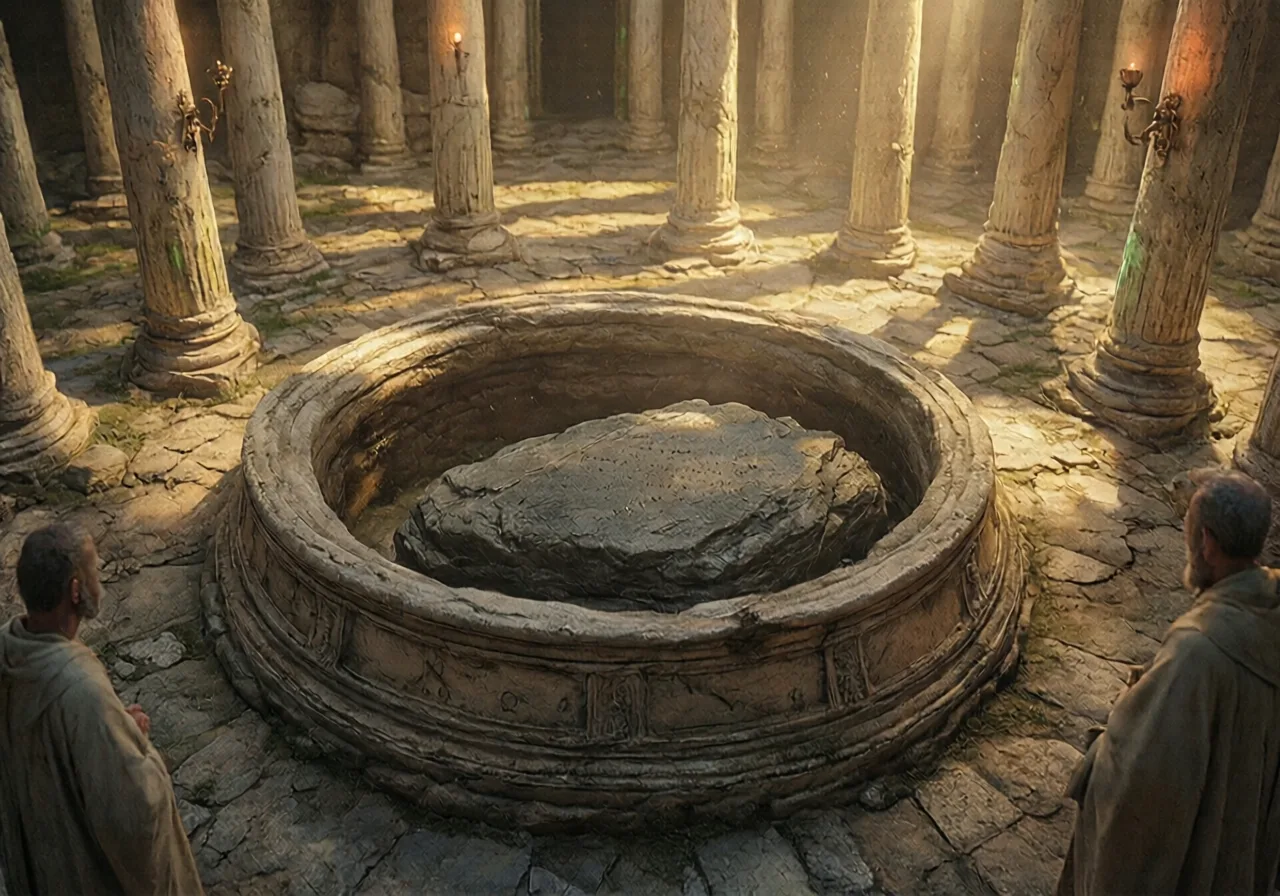
The well had not closed. The water in the well had not run out. The water had become, between one drawing and the next, water the priests would not draw. They could not say why. They sealed the well with a stone and said it had retired, in the manner of a soldier whom the army had thanked for his service.
I wrote a letter to Agathon, who was in his retirement at Veless. I asked him to explain it to me. I have only remembered the letter now, seventeen years later, because the paper I am writing on is paper Agathon gave me on the same visit.
AgathonThe well is the first cup. There will be others.
Page 5
The wheat at Calanthar did not lift its heads.
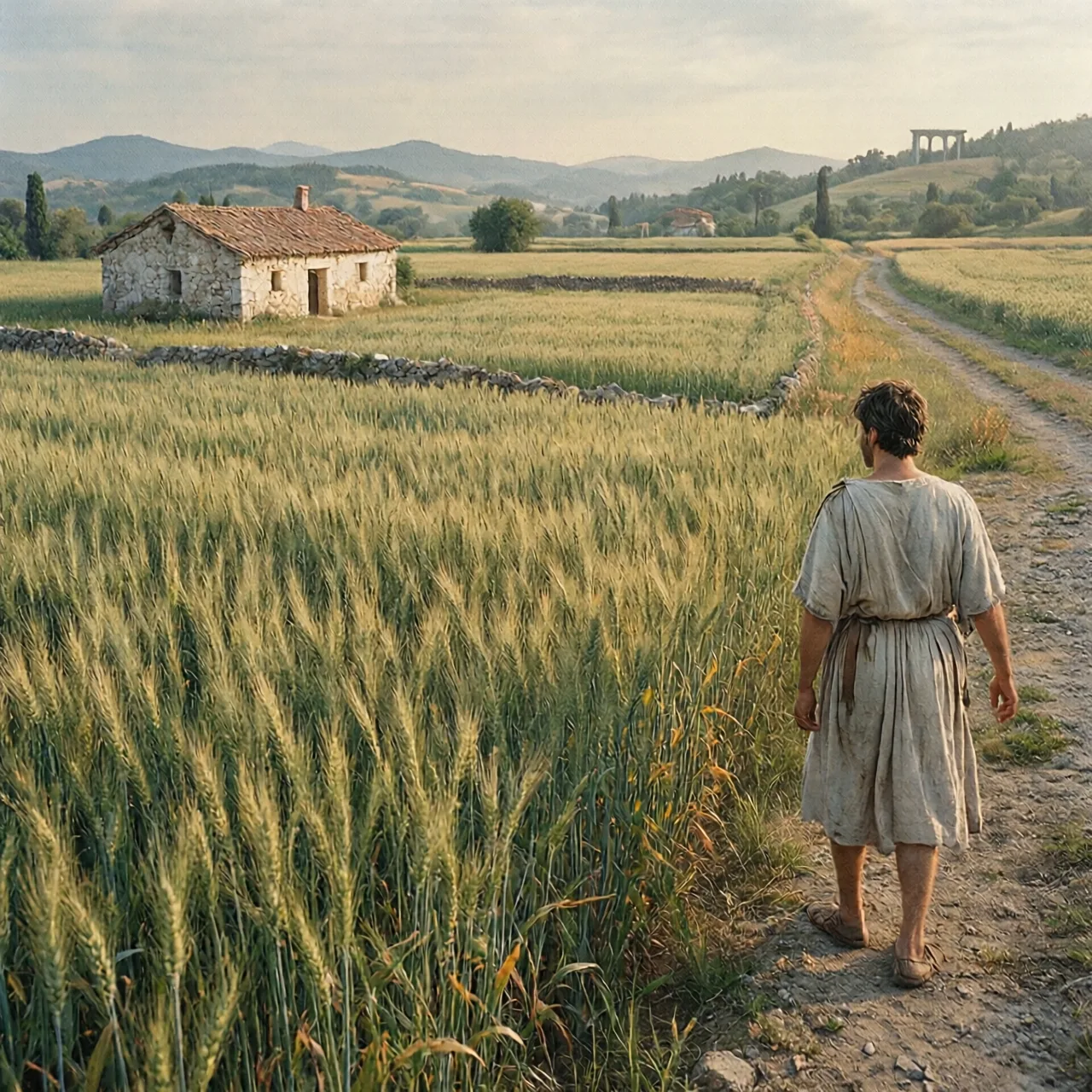
The wheat at Calanthar failed in the eighty-third year of the Concordium's third house. The stalks grew. The stalks reached the height the stalks would normally reach. But the heads did not form. The fields stood, in late summer, full of unfinished wheat.
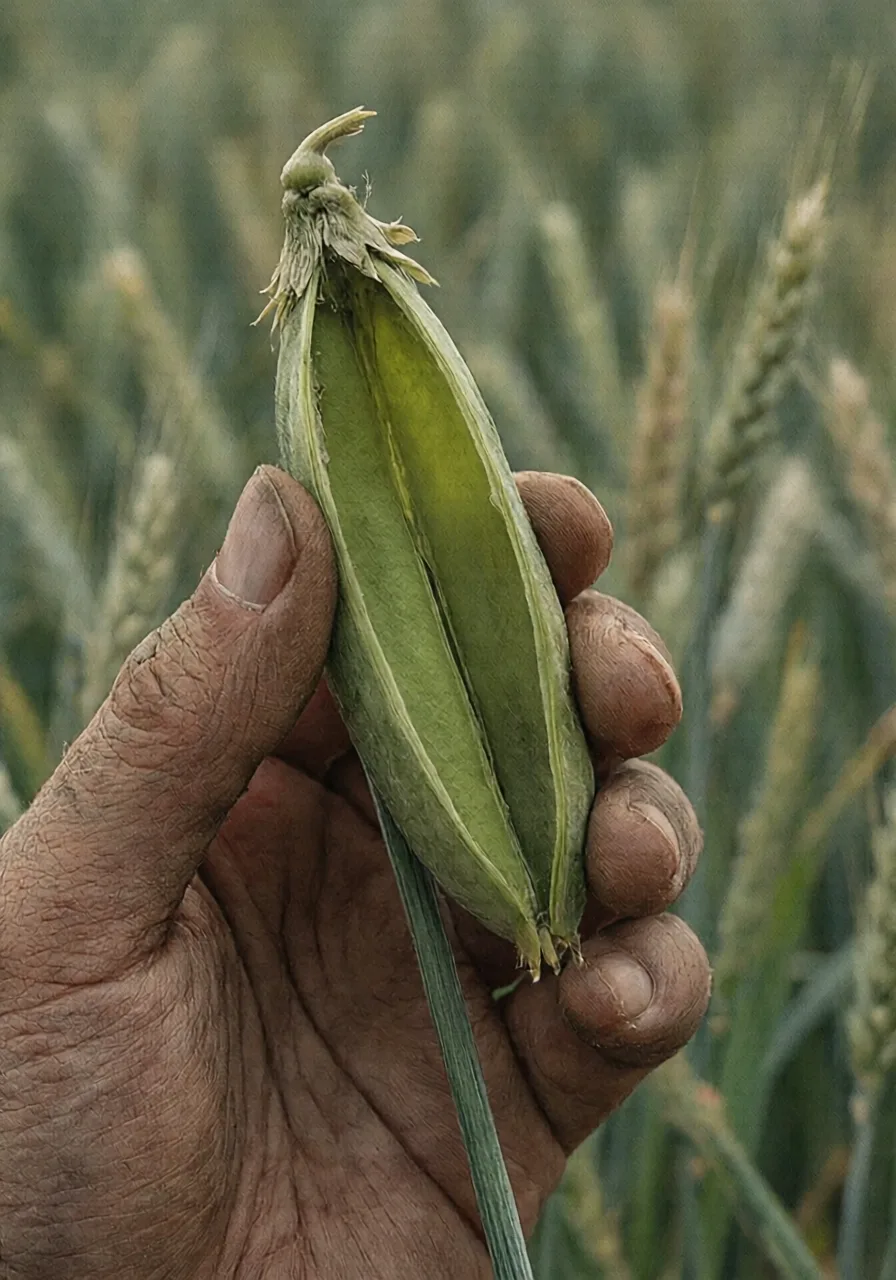
The heads did not form. Where the heads should have been there was a curl of green, a small folded structure that should have, by the season's end, opened into the grain. The curls did not open. The seed is the seed. The seasons are the seasons. The wheat does not grow.
Page 6
The fire moved.
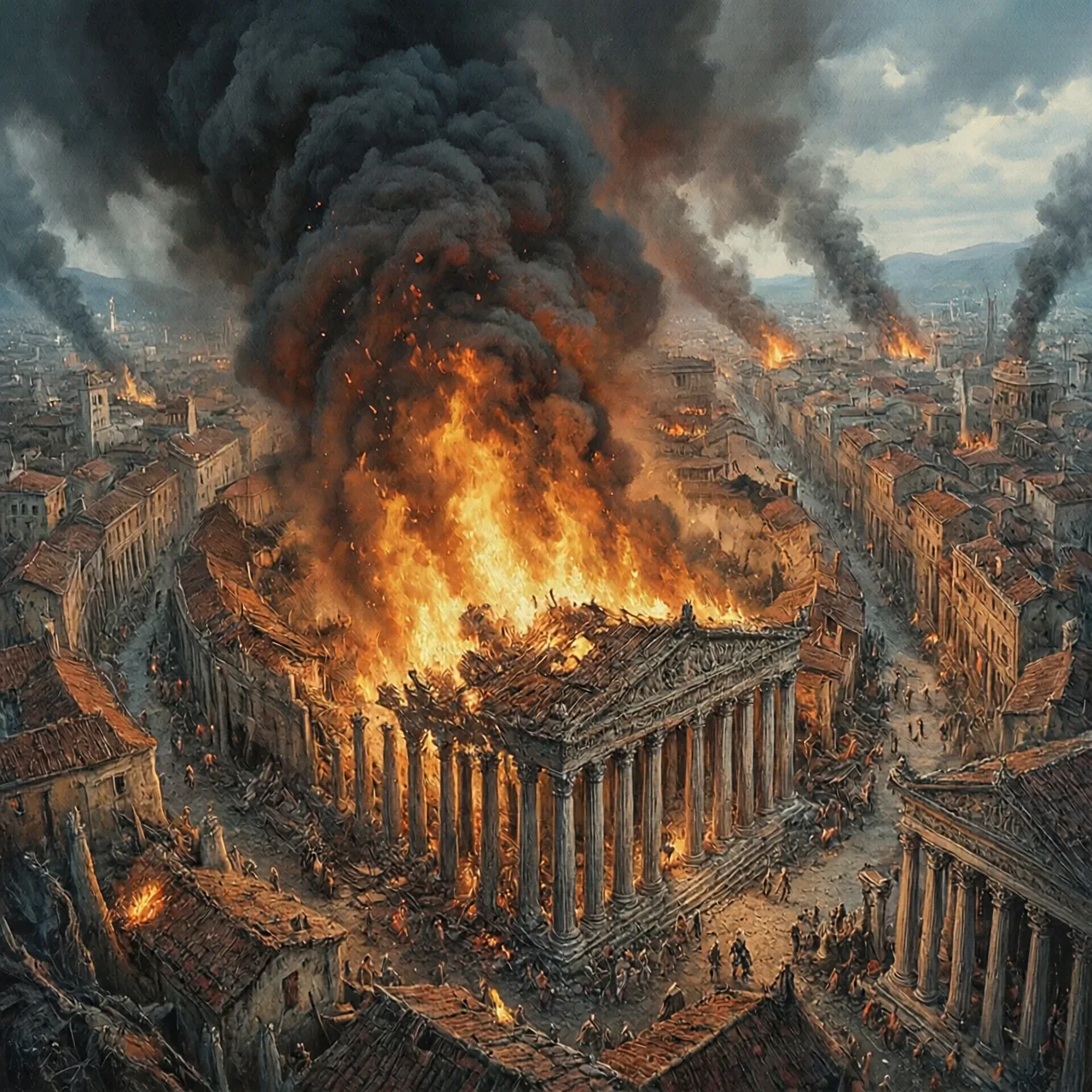
The fire began at the south corner of the city, in the small library attached to the temple. It did not spread the way fires spread. It moved more slowly than a fire would move and more deliberately than a fire could move. It did not jump. It did not skip. It moved.
Page 7
Someone was walking through the fire.
Tarsus had walked from Hieroclus to Veless in the months following. He told me what he had seen of the fire that took the city. I wrote down what he said.
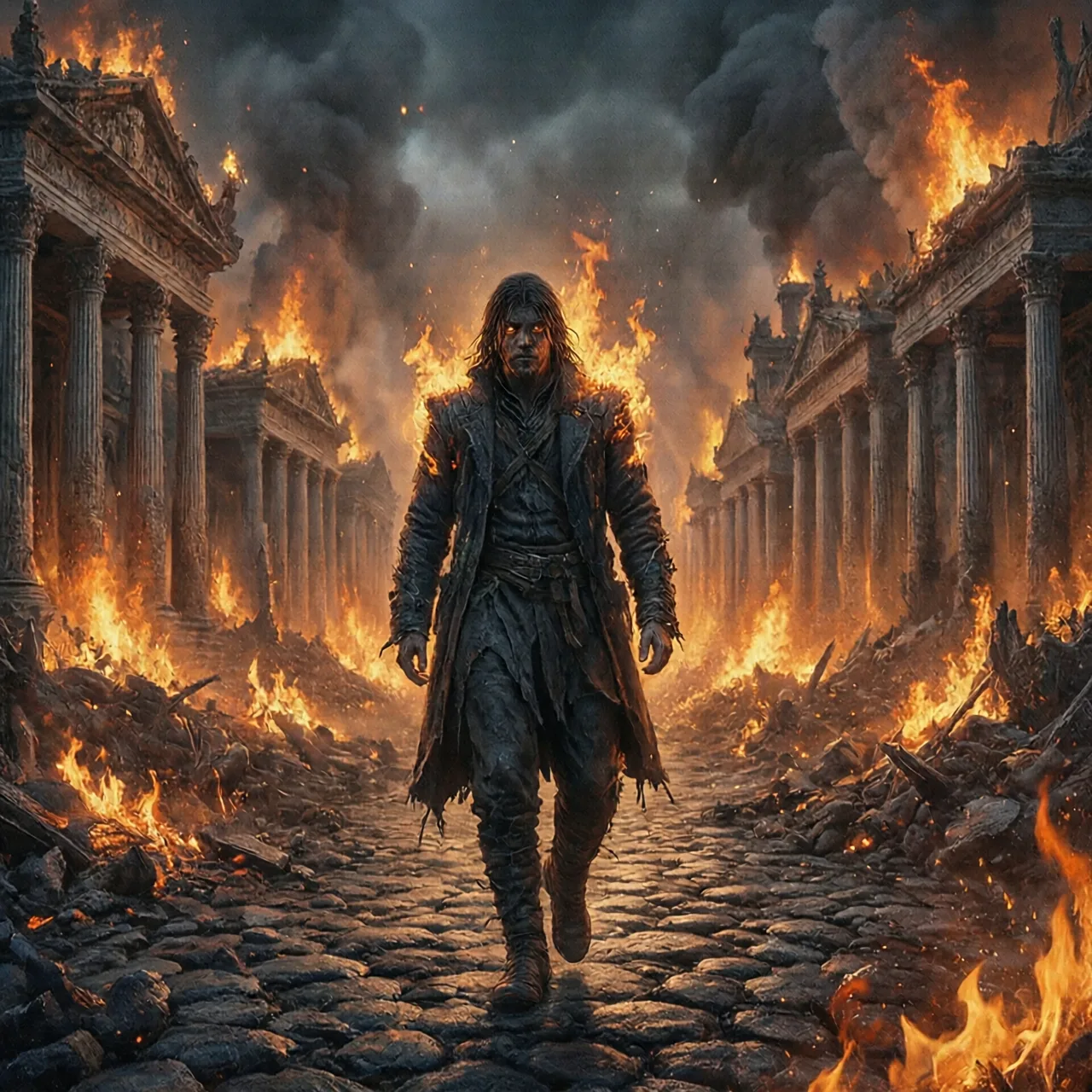
TarsusIt was a man. He was walking through the fire. He was not on fire. The fire was around him the way water is around a man crossing a river. I do not know where he was going. I left before he passed me. I left because I did not want him to pass me.
Tarsus stopped speaking. He sat for a long time in the chair I had offered him. He looked at his hands. I did not press him. After a long time he spoke.
TarsusI left because someone was walking through the fire.
Page 8
There are six of them.
There are six of them. They walk separately. They do not work together. They do not need to. Where they pass, the wells close. The wheat does not lift its heads. The fires begin. The footprints do not disturb the dust. The witnesses say they are kind. A woman at her own well, as the well was closing, told me of one she had seen.
The Woman at the WellHe moved the way a shepherd moves who is herding something that cannot be seen.
Aurelian MerWhat was he herding?
The Woman at the WellUs.
Page 9
Something was standing in the city.
Petros came to my fire in the ninth year of the Long Breaking. He had been a courier of the empire's last year of post-roads. He had been on the road two months. He had reached the rise from which Carmana could be seen. He had not gone further. He told me one of the men who walk through fires had been at Carmana eleven days before he came to the rise.
PetrosI crested the rise. Something was standing in the city. What stood was taller than the towers had been. It went into the cloud at its top. Its proportions could not be held in the eye. I turned. I have not turned to look at Carmana again. I will not.
Page 10
The Long Cold.
The Long Cold came in a summer that did not warm. The sun rose. The light was thin. The light was the light at the edge of autumn, in the long evening — and the light was the light at midsummer noon. The cisterns frozen at Pellos froze again the next winter without thawing in between. The water inside has, by now, become a single body of ice.
Savane died in the third year of the Long Cold. I will not say more of this. I have set down her name. The setting down is the only entry I will make.
Page 11
There is a place at the bottom of things.
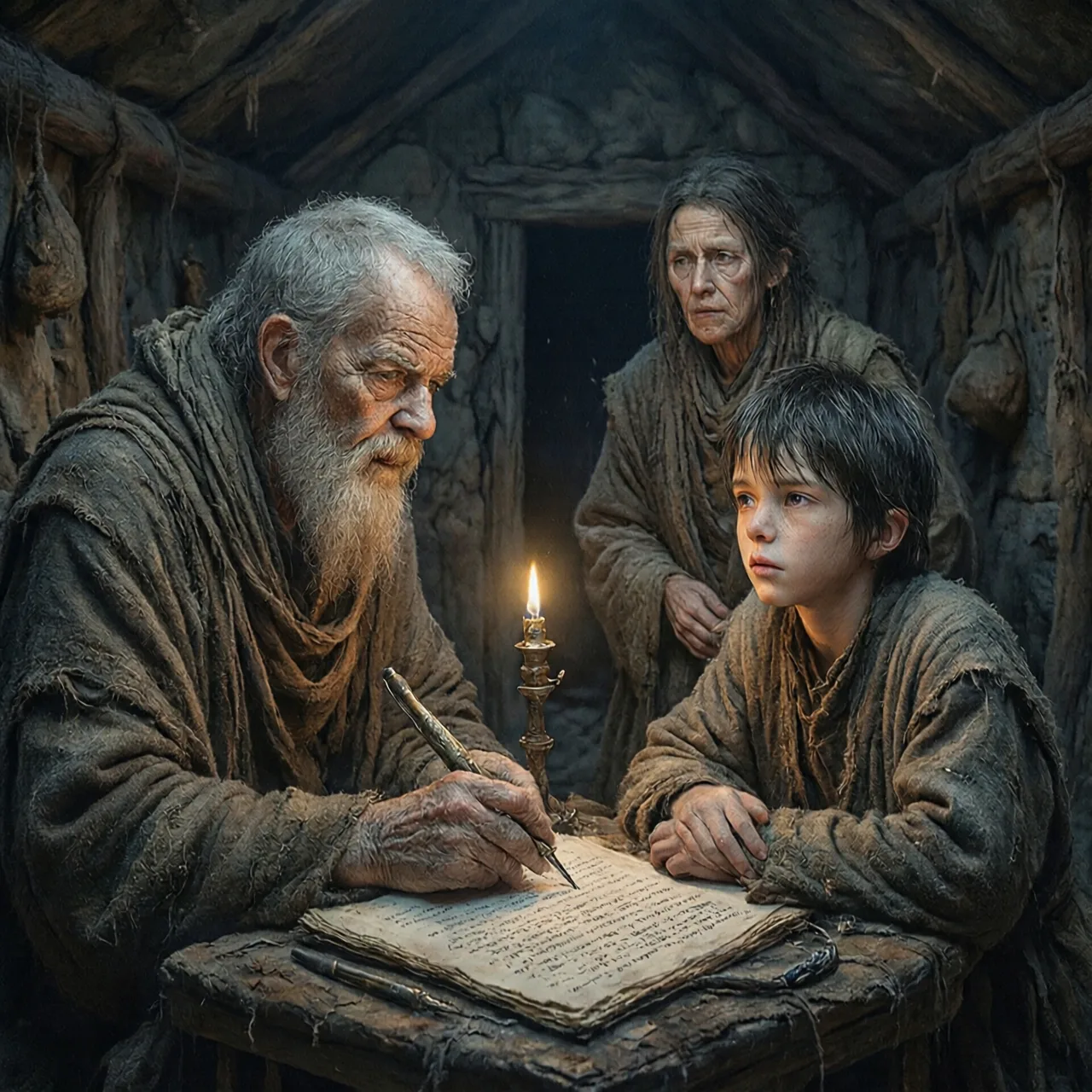
The witness was a boy of perhaps nine. His mother had brought him. She said he had been speaking in a manner that troubled her.
The BoyThere is a place at the bottom of things. The place is small. The place is widening. When the place widens, the wells close. When the place widens, the wheat does not lift its heads. The place is widening because the place has been opened. The place was opened by hands that were not our hands. The hands are not coming. The hands have already done what they did. The place is what is left.
Aurelian MerWhere did you hear this.
The BoyI did not hear it. It came into my mouth one night while I was sleeping. My mother heard me. I have said it because I have it to say.
I wrote it down. He said it again. He said it in the same words. He had not changed the order of a single word. I do not know who the hands were. I do not know where the place is. I have set down what he said.
Page 12
The words have outlived the world.
The words have outlived the world. The world is gone. The words are here. Aurelian Mer of Veless. The seventeenth year of the Long Breaking. The candle is small.
Page 13
I have not extended the entry.
Filed by the Sixteenth Archivist. The Concordium is not in any catalogue. The cities Aurelian Mer names are not in any catalogue. The six men he records walking through the fires are not in any catalogue. What Petros described as standing in the ruins of Carmana is not in any catalogue. The boy's testimony in Section 9 is in any catalogue. I have not extended the entry on this matter.
— / —
narration auto-scrolls the prose
Section 0Frontmatter
# The Heralds of Oblivion
Translated, where translation was possible, from the original — in a hand and a language the catalogue does not name — by the Sixteenth Archivist. The folio was received at the south gate in an intake bundle dated to entry 9,221. The cloth in which the folio was bound is a weave the cabinet does not record. The bearer did not survive his arrival. He had been walking for an interval he could not state. He did not name the place he had walked from. He named the writer. The writer's name was Aurelian Mer of Veless. The civilization to which Aurelian Mer belonged is not in any catalogue this archive keeps. The cities he names are not in any catalogue. I have set the folio in the secure cabinet. I have read it four times. I have not extended the entry on this matter.
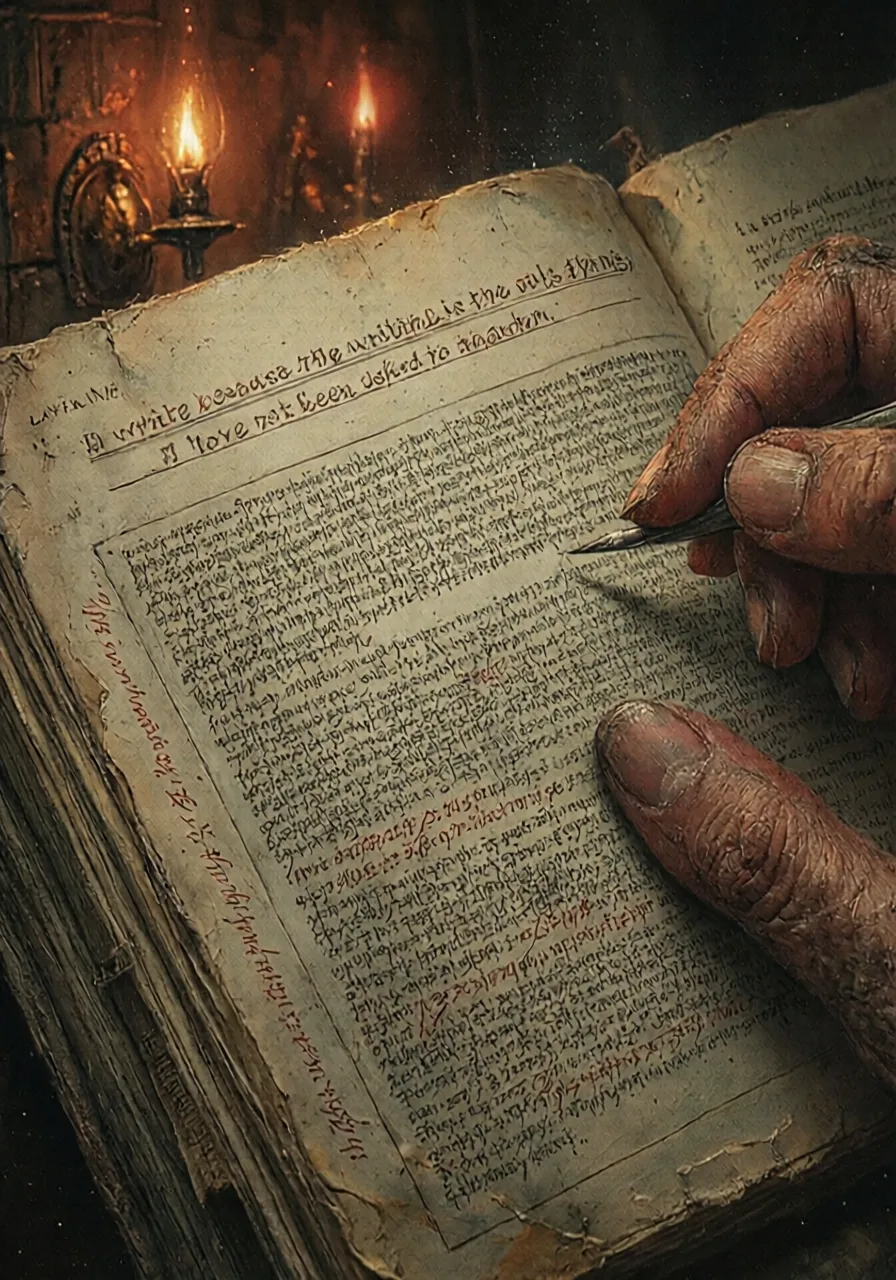
"I write because the writing is the only thing I have not been asked to abandon."
Section 1Section 1
From the chronicle of Aurelian Mer of Veless, set down in the seventeenth year of what we have come to call the Long Breaking. The hand is steady. The pen is steady. The paper is the paper Agathon gave me. The pen is the pen Agathon gave me. The hand he taught me has not yet failed.
I was born in the third year of the rising of the last great house of the Concordium, in the city of Veless, in the season when the wells were sweet and the wheat at Calanthar stood waist-high to a child.
I write this in the seventeenth year of the Long Breaking. I am writing on paper I carried out of the academy library at Veless in the year before the city's fall — when I still believed I would use it to teach a class the following spring. I did not teach the class. There will be no spring.
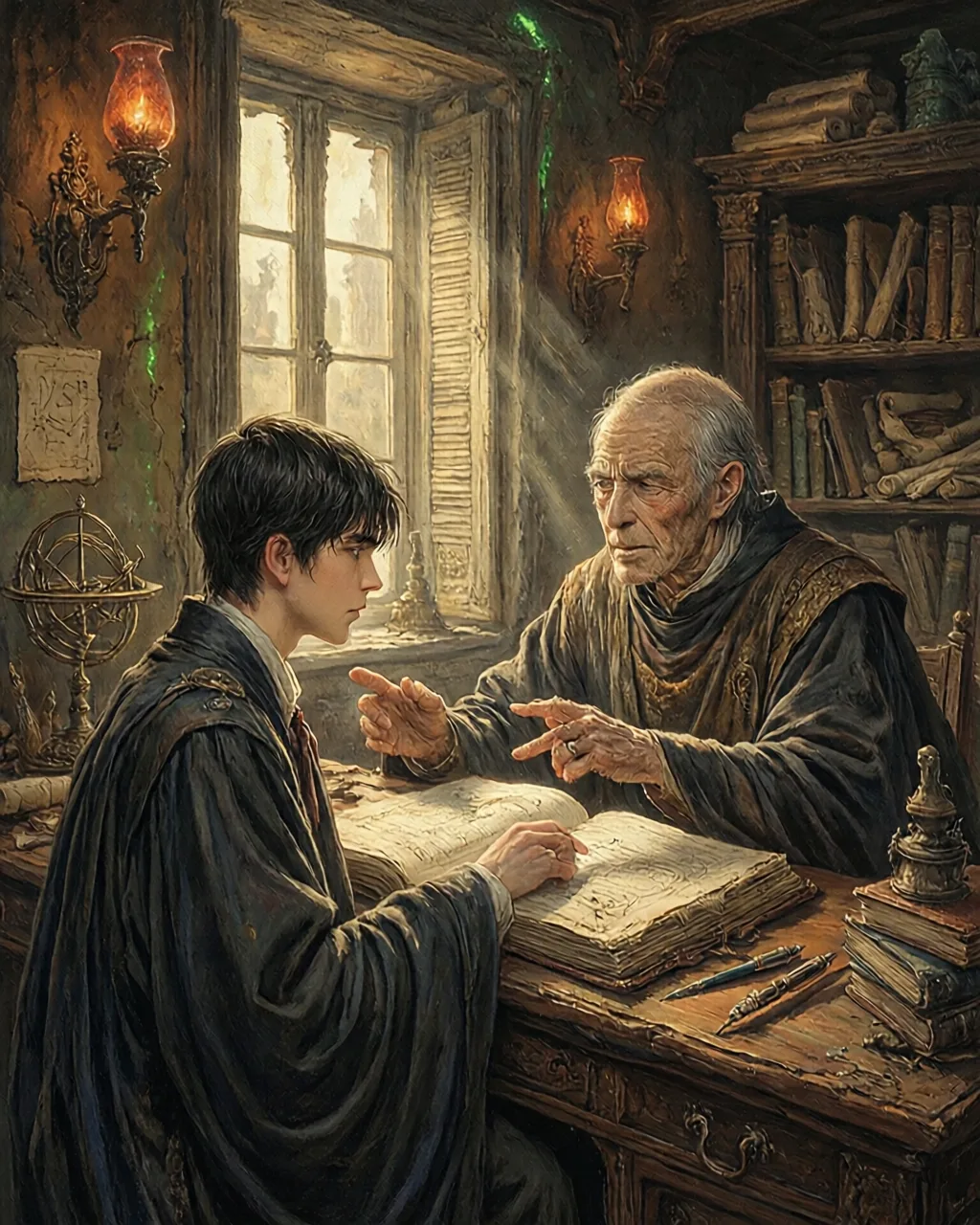
I write because Agathon, who was my teacher, said that the scholar's last duty is to set down what he has seen, in the manner he has been trained to set things down, before the language he has been trained in is lost.
The language is being lost.
I have heard the songs of my people sung in the wrong keys by children who do not know who taught them. I have heard a girl of perhaps seven, in a refugee camp at the edge of what was once the imperial road from Anthieon to Veless, singing the Song of Returning Light over the body of a man who was not her father. She sang it in a key the song does not have. She had been taught it. The teacher had not known the key. She did not know there was a key. She sang it as she had heard it.
The Song of Returning Light is sung at the burial of those who have returned to the long house. It says: the sun that has set will rise again. The body given to the earth will return.
The girl sang it as a children's rhyme.
I did not correct her.
Section 2Section 2
I will set down here, before I set down anything else, what the Concordium was when it stood.
I remember the procession at the midsummer of my twentieth year. The poets of Veless walked at the head of the line, in the order the academy had set down eight hundred years before, and the first poet that year was a young man whose name I will not set down because I do not wish to know whether he survived. He spoke the opening lines of the festival in the meter I had been taught at thirteen. The crowd took up the chorus on the second line. I took it up with them. The chorus had been the chorus since before my grandmother's grandmother had taken it up at the same festival in her own twentieth year. I knew this. I sang it because I knew it.
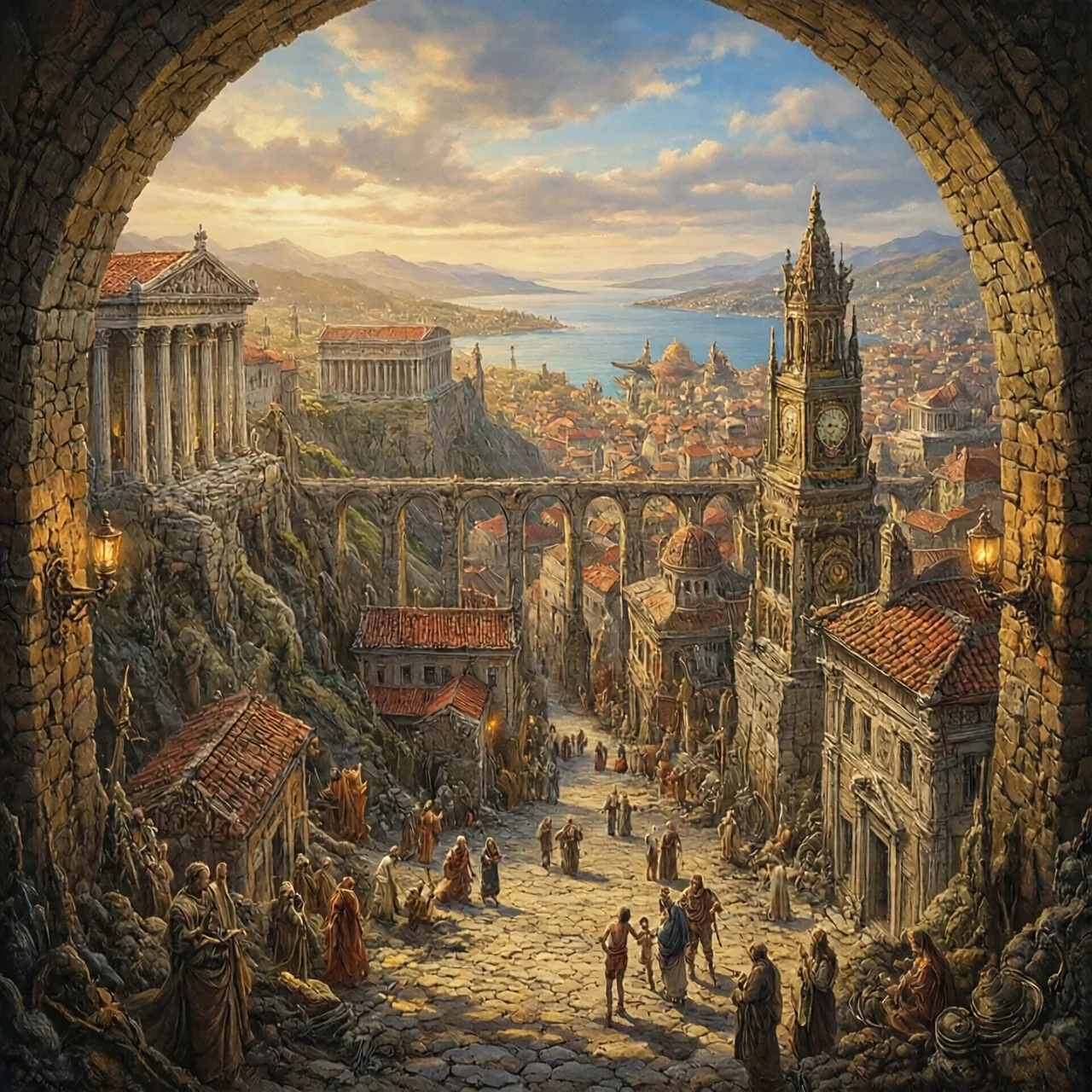
I remember the market at the harbour at Veless, in the season the fish ran the inner sea — the smell of salt cod and fresh bread side by side, the laughter of a particular child whose family I have not named because I cannot now remember which family she belonged to, the song the vendors sang at noon when the fish were sold.
I remember the brass armillary sphere on Agathon's writing-desk, the seven planets the academies had named hanging on their wires above the work, turning slowly when he opened the window to the courtyard breeze.
I remember the cold water at the public fountain at Calanthar, which sprang from a stone higher than the cistern that fed it, by an arrangement of unseen pressures we had not been taught to understand and which we trusted.
I remember the bells that rang along the imperial road. There was a bell at every league between Hieroclus in the south and Anthieon in the north, and they rang at the same minute at sunset, in summer and in winter, by the same minute. I walked the road in the summer of my thirtieth year with Savane and heard them from one end of it to the other, each just after the last. I remember thinking that nothing in the world had ever been so well done as this.
It was an empire that believed it would last.
I believed it would last.
Agathon, when I was thirteen and in his first year at the academy, told me that no empire lasts, and that the Concordium would not be the first exception. I did not understand him. I thought he was being cautious as scholars are cautious. I thought the empire would last.
The empire did not last.
Section 3Section 3
The first sign, when I read the histories now as a man with seventeen years of breakage in his body, was the closing of the well at the temple at Hieroclus in the forty-seventh year of my life.
The well had not closed. The water in the well had not run out. The water in the well had become, between one drawing and the next, water the priests would not draw. They would not say why. They could not say why. They sealed the well with a stone and said the well had retired, in the manner of a soldier whom the army had thanked for his service.
I was at Hieroclus that year. I was a young scholar then. I did not understand what had happened. I wrote a letter to Agathon, who was by then in his retirement at Veless. I asked him to explain it to me. He wrote back: the well is the first cup. there will be others.
I did not understand the letter. I filed it among my papers and I forgot it. I have only remembered the letter now, in my seventeenth year of the Long Breaking, because the paper I am writing on is paper Agathon gave me on the same visit when I asked him about the well, and the paper has held the question I did not know was a question until now.
The wells closed. One by one. Across the years. We did not connect them, because the wells were across the empire and the closings were over decades and each closing had its own local cause: a tremor, a drying of the springs, a small geological adjustment. The wells did not connect to each other. They closed alone.
But Agathon had known.
I do not know how Agathon knew. He was not a prophet; he was a scholar. He read the histories. Perhaps in some history I have not read there is a record of an empire before ours that ended this way, and Agathon had read it. I will not extend the speculation.
I will set down here that I miss him.
Section 4Section 4
The wheat at Calanthar failed in the eighty-third year of the Concordium's third house — the seventy-ninth year of my life.
I have set down the date because the date is the date the world began, in the eyes of the people of Calanthar, to be a world that did not work.
The wheat had grown there for nine hundred years, planted in the manner the academy at Veless had laid down. The wheat grew thick at Calanthar. The wheat fed three provinces.
In the eighty-third year the wheat did not lift its heads.
The stalks grew. The stalks reached the height the stalks would normally reach. But the heads did not form. Where the heads should have been there was a curl of green, a small folded structure that should have, by the season's end, opened into the grain. The curls did not open. The fields stood, in late summer, full of unfinished wheat.
The agriculturists came from Veless. They cut samples. They returned to their academy. They reported, in the manner of the academy, that they had observed an unusual condition and that further study was warranted.
The next year the wheat at Calanthar did not even reach height.
The next year the wheat at Calanthar did not grow.
The year after that the wheat at Anthieon also did not grow.
The agriculturists no longer made reports. The agriculturists had been sent to Calanthar to live among the farmers and find what was wrong. They wrote papers I would later read in the small surviving library at Pellos when I sheltered there for three months in the eleventh year of the Long Breaking. The papers were careful. The papers said: we have not been able to determine the cause. the soil is the soil. the seed is the seed. the seasons are the seasons. the wheat does not grow.
The agriculturists died with the farmers, in the cold, in the burning, in the manner of all the rest of us. The papers were carried out by a clerk whose name I never learned and which I will not now invent.
Section 5Section 5
In the third year of the Long Breaking — though we did not yet call it that, then; we called it the difficult years — the city of Hieroclus burned.
I will set down what I know of the burning. I was not at Hieroclus. The burning was reported to me, after my arrival at Veless on the imperial road, by a man named Tarsus who had walked from Hieroclus to Veless in the months following.
Tarsus said the fire began at the south corner of the city, in the small library attached to the temple. He did not know how it began. He had seen no man light it. There had been no lightning that night. There had been no oil-lamp left burning, no enemy at the walls. The city was at peace. The wells were closed by then but the cisterns were full. There was no reason for a fire.
The fire began.
It did not spread, Tarsus said, in the manner fires spread. It moved more slowly than a fire would move and more deliberately than a fire could move. It took the library first. Then it climbed the south wall to the houses behind. Then it crossed an empty courtyard to the next street, the next street, the next. The fire did not jump. It did not skip. It moved.
It took the city in eleven days.
Tarsus said no one fought it well. They had cisterns. They had buckets. They had men. But the men who ran toward the fire with buckets, he said, did not arrive. They were swallowed at the edge of the smoke, and the smoke closed behind them, and the buckets were not heard to clatter to the ground. The men did not return.
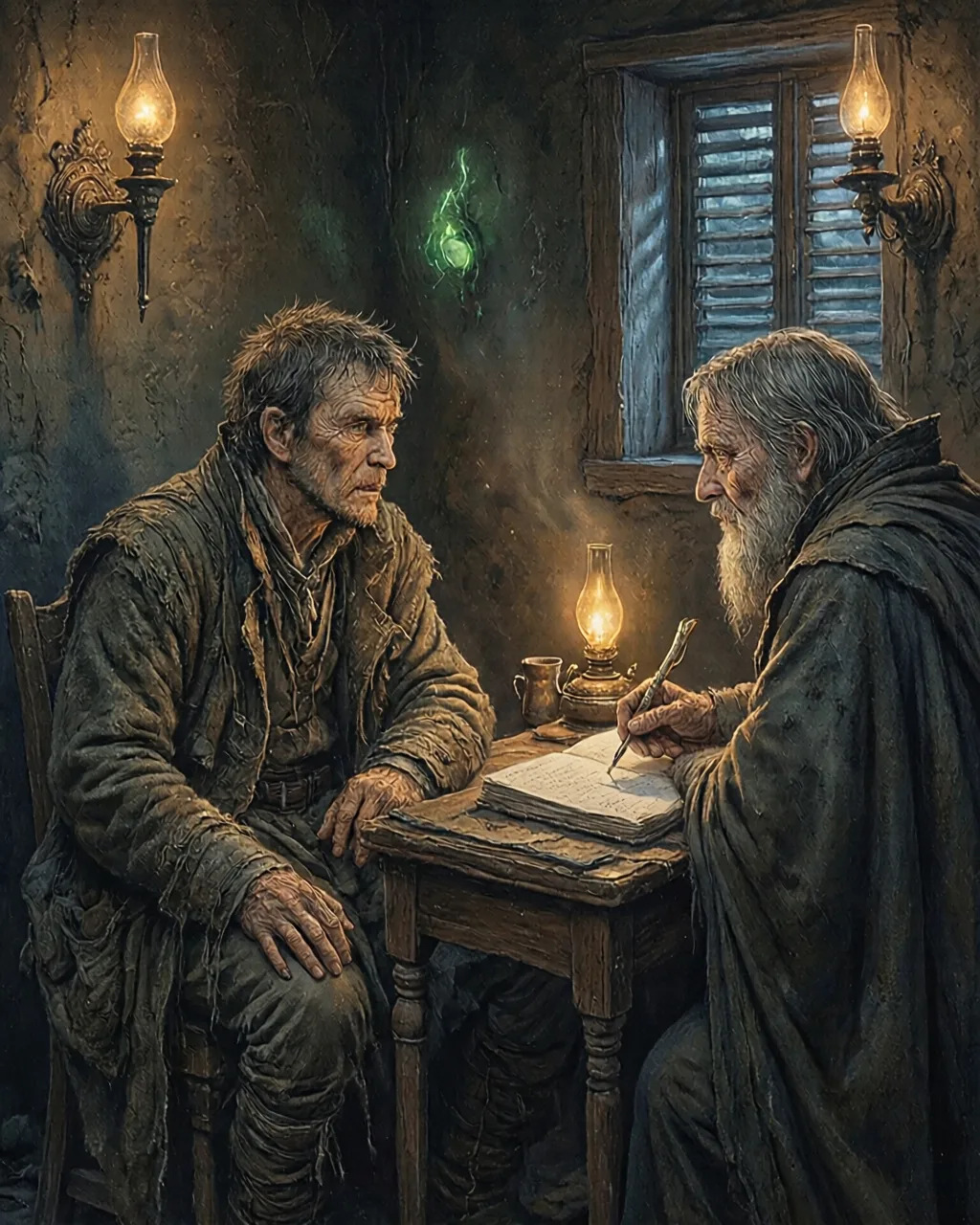
Tarsus stopped speaking when he had said this. He sat for a long time in the chair I had offered him. He looked at his hands.
I did not press him.
After a long time Tarsus said: I left because someone was walking through the fire.
I will set down what he said next exactly as he said it, in the words I wrote down at the time, which are the words he gave me.
"It was a man," he said. "He was walking through the fire. He was not on fire. The fire was around him the way water is around a man crossing a river. I do not know where he was going. I left before he passed me. I left because I did not want him to pass me."
I asked Tarsus what the man looked like.
Tarsus said: "I cannot remember his face. I have tried. I cannot remember. I remember his coat. The coat was the colour of the dark before a storm. I remember the way he walked. He was walking the way one walks who has been walking for a long time and is not finished. I cannot remember his face."
I wrote down what Tarsus said.
I did not yet know that it was the first of the testimonies. I knew only that a city had burned, and a man had walked through the fire, and a witness had walked to Veless to tell me.
Section 6Section 6
I will set down here what I have learned since about the men who walk through fires.
There are six of them.
I know this because I have collected testimony from witnesses who saw them in different places, who had not met each other, and who arrived independently at the count of six. I have not given them a name. The witnesses gave them names. I have set down what witnesses said about them. I have not set down the names they gave. The setting down of a name commits to a thing the thing may not be.
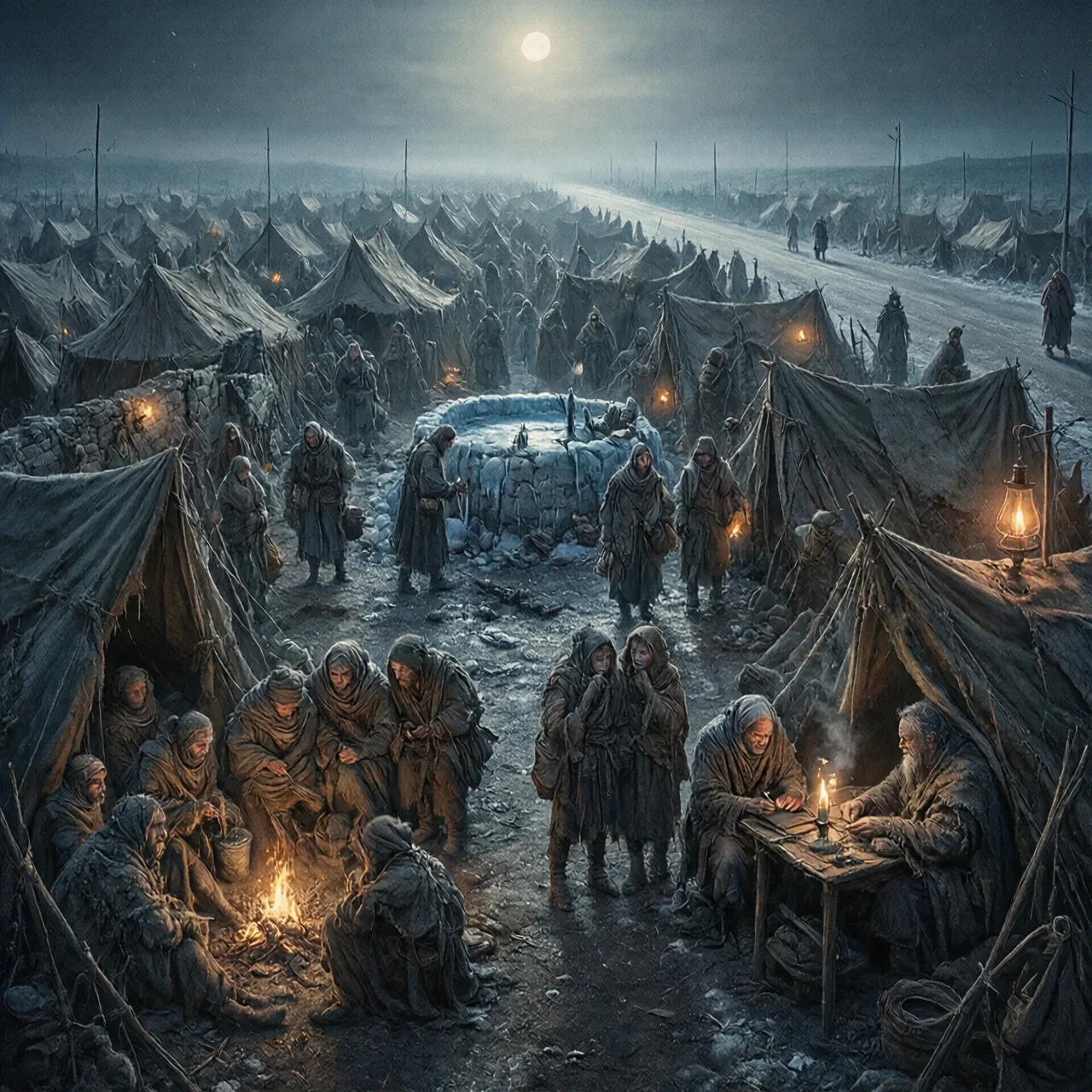
A woman in a refugee camp on the imperial road told me, in the seventh year of the Long Breaking, of a man she had seen at her own well as it closed. She said he moved the way a shepherd moves who is herding something that cannot be seen. I asked her what he was herding.
She said: us.
The number is the same across the testimonies. The behaviours are the same. The six walk separately. They do not work together. They do not need to.
Where they pass:
The wells close.
The wheat does not lift its heads.
The fires begin.
The cities burn.
The songs are sung in the wrong keys.
The names of the dead are forgotten.
I have not seen one of them with my own eyes. I have wished, at times, to see one. I have not been granted the wish.
I have set down what the witnesses say. I have not embellished. I have not subtracted. I have set down their words in the order they spoke them and I have left their pauses where their pauses were.
The witnesses say: they do not look monstrous. They look like men. One witness said: "He was a man you would not look at twice on the imperial road." Another said: "His clothes were not strange. His face was the face of a stranger, and there are many strangers." A third said only: "He was the man."
The witnesses say: they do not speak much. When they speak, they speak in the language of the place they are passing through, and their accent is the accent of that place. One witness said the one who passed through her village spoke the dialect of her village's own speech, as though he had been born there. He was not from her village.
The witnesses say: their footprints do not disturb the dust.
The witnesses say: their voices, after they have left, cannot be remembered. Witnesses who heard them speak agree on what was said in substance but cannot reproduce the voice. The voice is a hole in the hearing.
The witnesses say: they are kind.
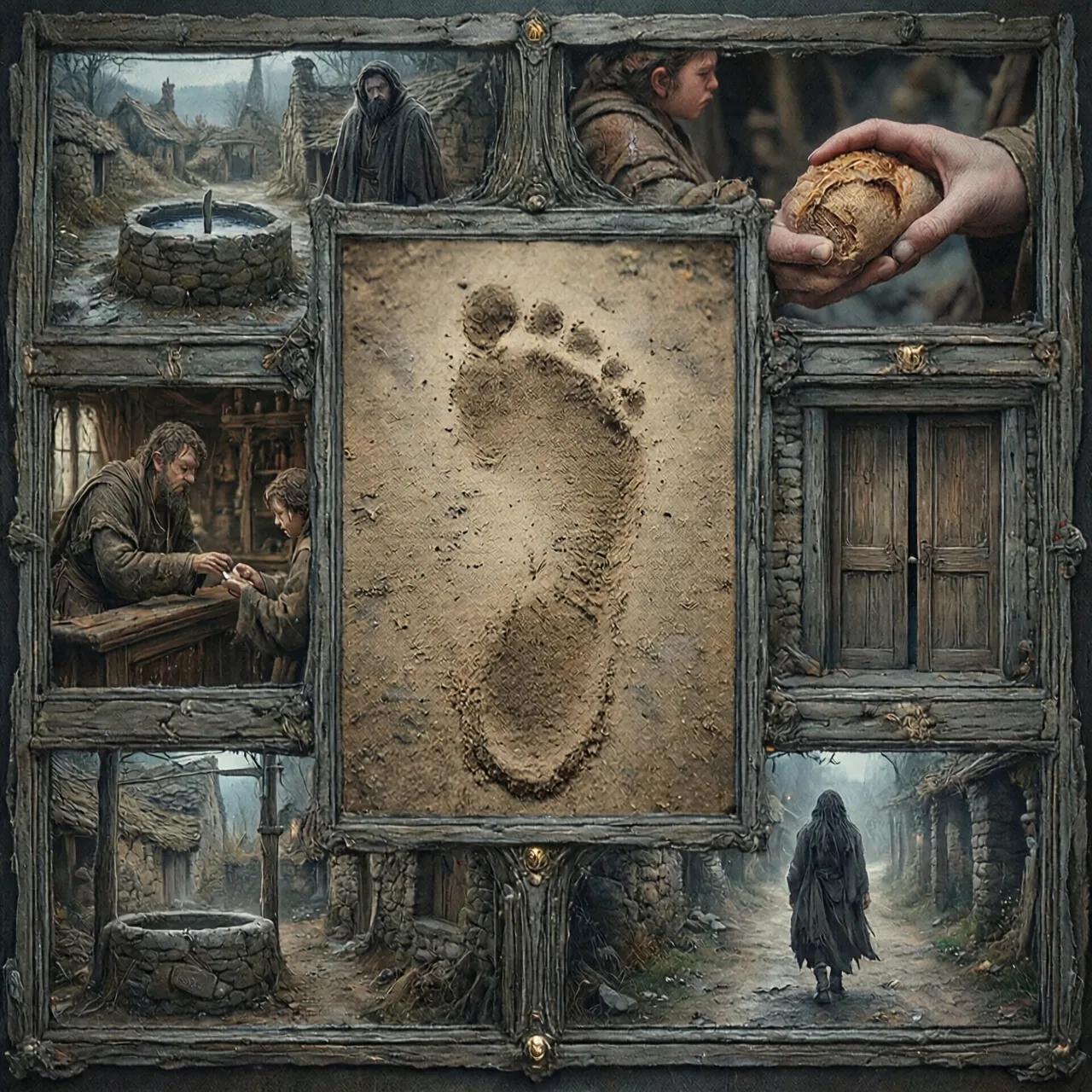
This is the part I have set down last, because it is the part I have not been able to write before now. The witnesses say they are kind. They are courteous. They thank the innkeeper. They pay in coin of the realm — a coin none of them is from. They give a child a small gift of bread. They speak well to the elderly. They are kind.
And then the well closes, and the wheat fails, and the city burns.
I do not know what kindness is, in the man who passes. I do not know whether he knows what he is doing when he is kind. I do not know whether his kindness is a posture or a fact. I have set down what the witnesses say.
I will not extend the entry.
Section 7Section 7
The witness who came to me with the testimony I am about to set down had not lived in the city he described. He had walked toward it on the imperial road from the south. He had not arrived. He had reached the rise from which the city of Carmana could be seen, and he had not gone further.
His name was Petros. He had been a courier of the empire's last year of post-roads. He carried his satchel still when he came to my fire, in the ninth year of the Long Breaking, in a camp at the foot of the hills west of what had been Carmana. The satchel held three sealed letters that would not now be delivered. He had been on the road two months. I gave him food. I asked him what he had seen.
He said one of the men who walk through fires had been at Carmana eleven days before he came to the rise.
He said the city had fallen.
He said this part briefly, because it was the part that had words. He said the towers were not standing. He said the harbour was empty of ships and the ships were on the rocks of the breakwater and the breakwater was in fragments. He said the city was burning still in the places he could see fire, and that the smoke from those places was the smoke fires make. He said there was also other smoke. He said the other smoke was the air the city had been holding, which was leaving.
I asked what he meant.
He said: I crested the rise. Something was standing in the city.
I will set down what he said next exactly as he said it. I have not abridged. The pauses are his pauses.
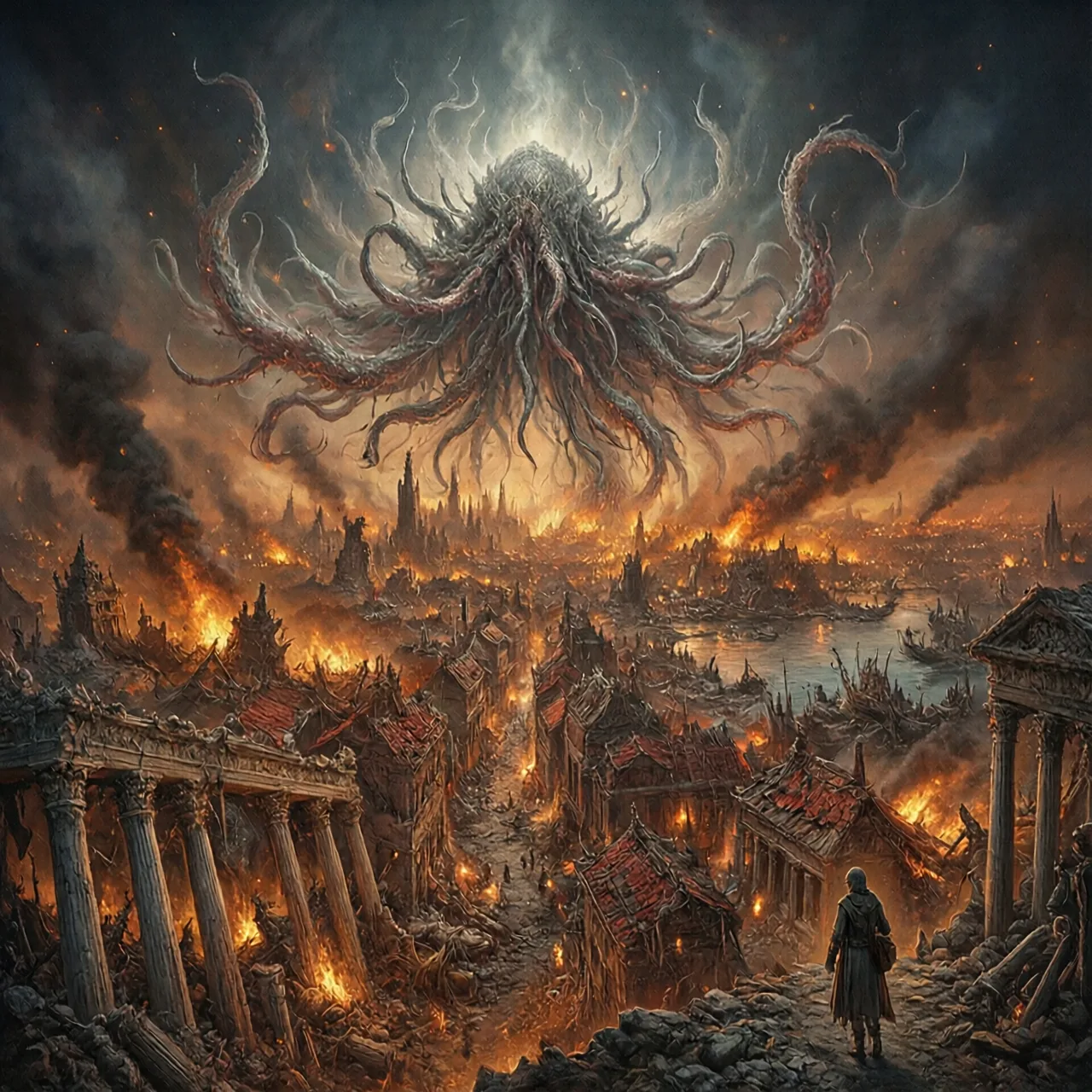
"What stood in the city was taller than the towers had been. The towers at Carmana were eleven storeys; the watch-tower at the harbour mouth was thirteen. The thing was taller than the watch-tower and more than taller. It went into the cloud at its top. I could not see where it ended. I have looked at clouds my entire life. The cloud at Carmana that evening was not a cloud. The cloud was where the thing entered something that was not air."
"It was pale. The pale was not the pale of bone or the pale of stone or the pale of chalk. It was the pale a thing is that has no colour because colour has not been given to it. I have not seen this pale on any other thing."
"It was thin where a thing of its height should have been thick. It was thick where it should have been thin. Its proportions could not be held in the eye. I tried. I tried for the count of a breath. The eye that has held the proportions of a familiar thing — a man, a horse, a tower — slides off a thing it has not been given proportions for. It slides. The eye gives up. I gave up."
"It had limbs. I do not know how many. I counted three. I counted seven. I could not count them and have the count be the same the second time. The limbs went out from the body at angles a body cannot have limbs at. They went up into the cloud as well as down into the ruins. The limbs that went down were in the streets where the streets had been. The streets were not under the limbs. The streets were where the limbs were, which is not the same thing."
"It did not move. I watched it for an interval I will not name. It did not move in the time I watched. The shadows in the city did not change in the time I watched. The sun should have set in the time I watched. I do not know whether it did."
"There was no sound. There had been gulls at Carmana. There were no gulls. There was no sea on the breakwater stones. There were waves still, in the harbour, but the waves did not have sound. I could see the waves arriving. They did not arrive as waves arrive. They arrived as if drawn on a page someone was turning."
"I did not see anyone living. The streets were empty of standing people. There were shapes on the stones that were not people but had been. I do not know how to say what they were. I have not said this part to anyone before you."
"I turned. I walked away from the rise. I walked back down the road I had come up. I have not turned to look at Carmana again. I will not."
Petros stopped. He drank the water I had set out for him. He took up his satchel, which he had not set down for the telling. He walked from my fire that night and I have not seen him since.
I have set down what he said.
I do not know what stood in Carmana. The witnesses I have collected of the men who walk through fires have not described such a thing as Petros described. The men in coats do not appear with such a thing. The men in coats walk through, and then the well closes and the wheat fails and the city burns. Carmana also burned. But Carmana was not consumed in the way the other cities have been consumed. What burned at Carmana was the city. What stood at Carmana was something else.
I have set down that Petros said one of the men had been at Carmana eleven days before. I have set down what Petros saw eleven days after. I have not set down a relation between the man and what stood in the city. I have not been able to determine whether the man was the cause of the thing, or whether the thing was the cause of the man, or whether one followed the other in some manner the witness's testimony does not contain.
I have set down what Petros said. I will not extend the entry.
Section 8Section 8
The Long Cold began in the eleventh year of the Long Breaking and is still in the world as I write this in the seventeenth.
It is not the cold of winter. The cold of winter has shape. The cold of winter has end.
The Long Cold is neither.
The Long Cold came in a summer that did not warm. The sun rose. The light was thin. The light was the light the sun gives at the edge of autumn, in the long evening — and the light was the light at midsummer noon. The plants reached for it. The light was not enough. The plants did not grow.
The cold came after the summer. It came without weather. There were no winds carrying it. There were no clouds dropping it. There was simply less warmth in the air than there had been the day before, and less the day after, and less the day after — and we put on the heavier garments we had set aside in the spring, and then the garments we had bought for travel into the high passes, and then the garments we had inherited from grandparents, and then we had no more garments.
The Long Cold has been with us for six winters and seven summers.
The summers are colder than the winters of my childhood.
The cisterns frozen at Pellos froze again the next winter without thawing in between. The water inside has, by now, become a single body of ice the size of the cistern, into which we have hammered passages to retrieve the ice in chunks. I have helped to hammer one such passage. The labour is hard. The ice has no patience for hammering.
Savane died in the third year of the Long Cold.
I will not say more of this.
I have set down her name. The setting down is the only entry I will make.
Section 9Section 9
I will set down here a small testimony I collected in the fourteenth year of the Long Breaking, in a camp at the edge of what had been the southern provinces, where I sheltered for one winter.
The witness was a boy of perhaps nine. His mother had brought him to me. She said he had been speaking in a manner that troubled her, and she had heard of a scholar in the camp who collected what others said.
I sat with the boy. I asked him to say what he had said to his mother.
He said: "There is a place at the bottom of things. The place is small. The place is widening. When the place widens, the wells close. When the place widens, the wheat does not lift its heads. The place is widening because the place has been opened. The place was opened by hands that were not our hands. The hands are not coming. The hands have already done what they did. The place is what is left."
I asked the boy where he had heard this.
The boy said he had not heard it. He said it had come into his mouth one night while he was sleeping, and he had said it aloud, and his mother had heard him, and he had said it again when she asked him to. He said: "I do not know what it means. I do not know who the hands were. I do not know where the place is. I have said it because I have it to say."
I asked the boy if he could say it again.
He said it again. He said it in the same words. He had not changed the order of a single word.
I wrote it down.
I do not know who the hands were. I do not know where the place is. I do not know what the boy was saying.
I have set down what he said.
Section 10Section 10
I am writing now under a tree.
The tree is not a tree I know the name of. I have known many trees. The trees I knew are not in this country. I do not know what country this is. The imperial road is some distance to the west of me; I have not walked to it, because the imperial road is no longer the imperial road, and the people on it do not know me, and I do not know them.
I am alone.
I have one match.
I have written this on the paper Agathon gave me, with the bronze-and-bone pen Agathon gave me, in the hand Agathon taught me. The paper has lasted longer than I expected. The pen has not broken. The hand is the hand it was.
I have not seen a Shepherd. I have set down the testimonies of those who have. I have set down what the boy in the southern camp said. I have set down the burning of Hieroclus and the failure of the wheat at Calanthar and the closing of the wells across the empire of one thousand years. I have set down the Long Cold. I have set down the Song of Returning Light sung in the wrong key by a girl I did not correct.
I have not been able to set down Savane.
I have set down her name. I will set it down again, here, because the name is the entry: Savane. She was my wife. I loved her. I do not know whether she knew it.
I have one match. I have a candle the match will light. I will write until the candle is gone. I will not write after the candle is gone.
I have set this down because Agathon said the scholar's last duty is to set down what he has seen.
I have seen what I have seen.
I do not know what destroyed us. I have set down what the witnesses said. The witnesses said the six destroyed us. The boy in the southern camp said a place at the bottom of things destroyed us. I have set down both. I do not know which to believe. I do not know whether there is a difference.
I am tired.
The candle is half down.
I will write a little longer.
Agathon said, when he gave me the pen and the paper and the language: the scholar's hand is the only inheritance that travels. set down what you have seen. set it down in the words you have been given. the words will outlive the world.
The words have outlived the world.
The world is gone.
The words are here.
Aurelian Mer of Veless.
The seventeenth year of the Long Breaking.
The candle is small.
Entry 9,221, final annotation. Folded into the binding.
Filed by the Sixteenth Archivist. The folio is of unknown provenance. The hand is not in this archive's hand-registry. The language was a language I had to translate by inference, having no key. I do not know whether the inference is correct in every respect. I have done what could be done.
The Concordium is not in any catalogue. The cities Aurelian Mer names are not in any catalogue. The Song of Returning Light is not in any catalogue. The six men Aurelian Mer records walking through the fires are not in any catalogue.
I have catalogued other wanderers. There are figures at the edge of light. There are visitors who have arrived at the south gate. Aurelian Mer's six are none of these. Some of what his witnesses say of them is what I have written of other figures this catalogue records under other names. I have not extended the relation.
What the witness Petros described as standing in the ruins of Carmana in Section 7 is not in any catalogue. The catalogue keeps no record of beings of such scale. The catalogue keeps no record of Carmana. I have not extended the entry on this matter. I have noted, in a margin not adjacent to this entry, that Petros's testimony is of a thing not of this world, and that the man Petros says was at Carmana eleven days before is of this world or close to it; and that the relation between the two is the question the chronicle asks and does not answer.
The boy's testimony in Section 9 is in any catalogue.
I have not extended the entry on this matter.
I have read the folio four times. I will not read it a fifth.
Section 0Frontmatter
# The Heralds of Oblivion
Translated, where translation was possible, from the original — in a hand and a language the catalogue does not name — by the Sixteenth Archivist. The folio was received at the south gate in an intake bundle dated to entry 9,221. The cloth in which the folio was bound is a weave the cabinet does not record. The bearer did not survive his arrival. He had been walking for an interval he could not state. He did not name the place he had walked from. He named the writer. The writer's name was Aurelian Mer of Veless. The civilization to which Aurelian Mer belonged is not in any catalogue this archive keeps. The cities he names are not in any catalogue. I have set the folio in the secure cabinet. I have read it four times. I have not extended the entry on this matter.
"I write because the writing is the only thing I have not been asked to abandon."
Section 1Section 1
From the chronicle of Aurelian Mer of Veless, set down in the seventeenth year of what we have come to call the Long Breaking. The hand is steady. The pen is steady. The paper is the paper Agathon gave me. The pen is the pen Agathon gave me. The hand he taught me has not yet failed.
I was born in the third year of the rising of the last great house of the Concordium, in the city of Veless, in the season when the wells were sweet and the wheat at Calanthar stood waist-high to a child.
I write this in the seventeenth year of the Long Breaking. I am writing on paper I carried out of the academy library at Veless in the year before the city's fall — when I still believed I would use it to teach a class the following spring. I did not teach the class. There will be no spring.
I write because Agathon, who was my teacher, said that the scholar's last duty is to set down what he has seen, in the manner he has been trained to set things down, before the language he has been trained in is lost.
The language is being lost.
I have heard the songs of my people sung in the wrong keys by children who do not know who taught them. I have heard a girl of perhaps seven, in a refugee camp at the edge of what was once the imperial road from Anthieon to Veless, singing the Song of Returning Light over the body of a man who was not her father. She sang it in a key the song does not have. She had been taught it. The teacher had not known the key. She did not know there was a key. She sang it as she had heard it.
The Song of Returning Light is sung at the burial of those who have returned to the long house. It says: the sun that has set will rise again. The body given to the earth will return.
The girl sang it as a children's rhyme.
I did not correct her.
Section 2Section 2
I will set down here, before I set down anything else, what the Concordium was when it stood.
I remember the procession at the midsummer of my twentieth year. The poets of Veless walked at the head of the line, in the order the academy had set down eight hundred years before, and the first poet that year was a young man whose name I will not set down because I do not wish to know whether he survived. He spoke the opening lines of the festival in the meter I had been taught at thirteen. The crowd took up the chorus on the second line. I took it up with them. The chorus had been the chorus since before my grandmother's grandmother had taken it up at the same festival in her own twentieth year. I knew this. I sang it because I knew it.
I remember the market at the harbour at Veless, in the season the fish ran the inner sea — the smell of salt cod and fresh bread side by side, the laughter of a particular child whose family I have not named because I cannot now remember which family she belonged to, the song the vendors sang at noon when the fish were sold.
I remember the brass armillary sphere on Agathon's writing-desk, the seven planets the academies had named hanging on their wires above the work, turning slowly when he opened the window to the courtyard breeze.
I remember the cold water at the public fountain at Calanthar, which sprang from a stone higher than the cistern that fed it, by an arrangement of unseen pressures we had not been taught to understand and which we trusted.
I remember the bells that rang along the imperial road. There was a bell at every league between Hieroclus in the south and Anthieon in the north, and they rang at the same minute at sunset, in summer and in winter, by the same minute. I walked the road in the summer of my thirtieth year with Savane and heard them from one end of it to the other, each just after the last. I remember thinking that nothing in the world had ever been so well done as this.
It was an empire that believed it would last.
I believed it would last.
Agathon, when I was thirteen and in his first year at the academy, told me that no empire lasts, and that the Concordium would not be the first exception. I did not understand him. I thought he was being cautious as scholars are cautious. I thought the empire would last.
The empire did not last.
Section 3Section 3
The first sign, when I read the histories now as a man with seventeen years of breakage in his body, was the closing of the well at the temple at Hieroclus in the forty-seventh year of my life.
The well had not closed. The water in the well had not run out. The water in the well had become, between one drawing and the next, water the priests would not draw. They would not say why. They could not say why. They sealed the well with a stone and said the well had retired, in the manner of a soldier whom the army had thanked for his service.
I was at Hieroclus that year. I was a young scholar then. I did not understand what had happened. I wrote a letter to Agathon, who was by then in his retirement at Veless. I asked him to explain it to me. He wrote back: the well is the first cup. there will be others.
I did not understand the letter. I filed it among my papers and I forgot it. I have only remembered the letter now, in my seventeenth year of the Long Breaking, because the paper I am writing on is paper Agathon gave me on the same visit when I asked him about the well, and the paper has held the question I did not know was a question until now.
The wells closed. One by one. Across the years. We did not connect them, because the wells were across the empire and the closings were over decades and each closing had its own local cause: a tremor, a drying of the springs, a small geological adjustment. The wells did not connect to each other. They closed alone.
But Agathon had known.
I do not know how Agathon knew. He was not a prophet; he was a scholar. He read the histories. Perhaps in some history I have not read there is a record of an empire before ours that ended this way, and Agathon had read it. I will not extend the speculation.
I will set down here that I miss him.
Section 4Section 4
The wheat at Calanthar failed in the eighty-third year of the Concordium's third house — the seventy-ninth year of my life.
I have set down the date because the date is the date the world began, in the eyes of the people of Calanthar, to be a world that did not work.
The wheat had grown there for nine hundred years, planted in the manner the academy at Veless had laid down. The wheat grew thick at Calanthar. The wheat fed three provinces.
In the eighty-third year the wheat did not lift its heads.
The stalks grew. The stalks reached the height the stalks would normally reach. But the heads did not form. Where the heads should have been there was a curl of green, a small folded structure that should have, by the season's end, opened into the grain. The curls did not open. The fields stood, in late summer, full of unfinished wheat.
The agriculturists came from Veless. They cut samples. They returned to their academy. They reported, in the manner of the academy, that they had observed an unusual condition and that further study was warranted.
The next year the wheat at Calanthar did not even reach height.
The next year the wheat at Calanthar did not grow.
The year after that the wheat at Anthieon also did not grow.
The agriculturists no longer made reports. The agriculturists had been sent to Calanthar to live among the farmers and find what was wrong. They wrote papers I would later read in the small surviving library at Pellos when I sheltered there for three months in the eleventh year of the Long Breaking. The papers were careful. The papers said: we have not been able to determine the cause. the soil is the soil. the seed is the seed. the seasons are the seasons. the wheat does not grow.
The agriculturists died with the farmers, in the cold, in the burning, in the manner of all the rest of us. The papers were carried out by a clerk whose name I never learned and which I will not now invent.
Section 5Section 5
In the third year of the Long Breaking — though we did not yet call it that, then; we called it the difficult years — the city of Hieroclus burned.
I will set down what I know of the burning. I was not at Hieroclus. The burning was reported to me, after my arrival at Veless on the imperial road, by a man named Tarsus who had walked from Hieroclus to Veless in the months following.
Tarsus said the fire began at the south corner of the city, in the small library attached to the temple. He did not know how it began. He had seen no man light it. There had been no lightning that night. There had been no oil-lamp left burning, no enemy at the walls. The city was at peace. The wells were closed by then but the cisterns were full. There was no reason for a fire.
The fire began.
It did not spread, Tarsus said, in the manner fires spread. It moved more slowly than a fire would move and more deliberately than a fire could move. It took the library first. Then it climbed the south wall to the houses behind. Then it crossed an empty courtyard to the next street, the next street, the next. The fire did not jump. It did not skip. It moved.
It took the city in eleven days.
Tarsus said no one fought it well. They had cisterns. They had buckets. They had men. But the men who ran toward the fire with buckets, he said, did not arrive. They were swallowed at the edge of the smoke, and the smoke closed behind them, and the buckets were not heard to clatter to the ground. The men did not return.
Tarsus stopped speaking when he had said this. He sat for a long time in the chair I had offered him. He looked at his hands.
I did not press him.
After a long time Tarsus said: I left because someone was walking through the fire.
I will set down what he said next exactly as he said it, in the words I wrote down at the time, which are the words he gave me.
"It was a man," he said. "He was walking through the fire. He was not on fire. The fire was around him the way water is around a man crossing a river. I do not know where he was going. I left before he passed me. I left because I did not want him to pass me."
I asked Tarsus what the man looked like.
Tarsus said: "I cannot remember his face. I have tried. I cannot remember. I remember his coat. The coat was the colour of the dark before a storm. I remember the way he walked. He was walking the way one walks who has been walking for a long time and is not finished. I cannot remember his face."
I wrote down what Tarsus said.
I did not yet know that it was the first of the testimonies. I knew only that a city had burned, and a man had walked through the fire, and a witness had walked to Veless to tell me.
Section 6Section 6
I will set down here what I have learned since about the men who walk through fires.
There are six of them.
I know this because I have collected testimony from witnesses who saw them in different places, who had not met each other, and who arrived independently at the count of six. I have not given them a name. The witnesses gave them names. I have set down what witnesses said about them. I have not set down the names they gave. The setting down of a name commits to a thing the thing may not be.
A woman in a refugee camp on the imperial road told me, in the seventh year of the Long Breaking, of a man she had seen at her own well as it closed. She said he moved the way a shepherd moves who is herding something that cannot be seen. I asked her what he was herding.
She said: us.
The number is the same across the testimonies. The behaviours are the same. The six walk separately. They do not work together. They do not need to.
Where they pass:
The wells close.
The wheat does not lift its heads.
The fires begin.
The cities burn.
The songs are sung in the wrong keys.
The names of the dead are forgotten.
I have not seen one of them with my own eyes. I have wished, at times, to see one. I have not been granted the wish.
I have set down what the witnesses say. I have not embellished. I have not subtracted. I have set down their words in the order they spoke them and I have left their pauses where their pauses were.
The witnesses say: they do not look monstrous. They look like men. One witness said: "He was a man you would not look at twice on the imperial road." Another said: "His clothes were not strange. His face was the face of a stranger, and there are many strangers." A third said only: "He was the man."
The witnesses say: they do not speak much. When they speak, they speak in the language of the place they are passing through, and their accent is the accent of that place. One witness said the one who passed through her village spoke the dialect of her village's own speech, as though he had been born there. He was not from her village.
The witnesses say: their footprints do not disturb the dust.
The witnesses say: their voices, after they have left, cannot be remembered. Witnesses who heard them speak agree on what was said in substance but cannot reproduce the voice. The voice is a hole in the hearing.
The witnesses say: they are kind.
This is the part I have set down last, because it is the part I have not been able to write before now. The witnesses say they are kind. They are courteous. They thank the innkeeper. They pay in coin of the realm — a coin none of them is from. They give a child a small gift of bread. They speak well to the elderly. They are kind.
And then the well closes, and the wheat fails, and the city burns.
I do not know what kindness is, in the man who passes. I do not know whether he knows what he is doing when he is kind. I do not know whether his kindness is a posture or a fact. I have set down what the witnesses say.
I will not extend the entry.
Section 7Section 7
The witness who came to me with the testimony I am about to set down had not lived in the city he described. He had walked toward it on the imperial road from the south. He had not arrived. He had reached the rise from which the city of Carmana could be seen, and he had not gone further.
His name was Petros. He had been a courier of the empire's last year of post-roads. He carried his satchel still when he came to my fire, in the ninth year of the Long Breaking, in a camp at the foot of the hills west of what had been Carmana. The satchel held three sealed letters that would not now be delivered. He had been on the road two months. I gave him food. I asked him what he had seen.
He said one of the men who walk through fires had been at Carmana eleven days before he came to the rise.
He said the city had fallen.
He said this part briefly, because it was the part that had words. He said the towers were not standing. He said the harbour was empty of ships and the ships were on the rocks of the breakwater and the breakwater was in fragments. He said the city was burning still in the places he could see fire, and that the smoke from those places was the smoke fires make. He said there was also other smoke. He said the other smoke was the air the city had been holding, which was leaving.
I asked what he meant.
He said: I crested the rise. Something was standing in the city.
I will set down what he said next exactly as he said it. I have not abridged. The pauses are his pauses.
"What stood in the city was taller than the towers had been. The towers at Carmana were eleven storeys; the watch-tower at the harbour mouth was thirteen. The thing was taller than the watch-tower and more than taller. It went into the cloud at its top. I could not see where it ended. I have looked at clouds my entire life. The cloud at Carmana that evening was not a cloud. The cloud was where the thing entered something that was not air."
"It was pale. The pale was not the pale of bone or the pale of stone or the pale of chalk. It was the pale a thing is that has no colour because colour has not been given to it. I have not seen this pale on any other thing."
"It was thin where a thing of its height should have been thick. It was thick where it should have been thin. Its proportions could not be held in the eye. I tried. I tried for the count of a breath. The eye that has held the proportions of a familiar thing — a man, a horse, a tower — slides off a thing it has not been given proportions for. It slides. The eye gives up. I gave up."
"It had limbs. I do not know how many. I counted three. I counted seven. I could not count them and have the count be the same the second time. The limbs went out from the body at angles a body cannot have limbs at. They went up into the cloud as well as down into the ruins. The limbs that went down were in the streets where the streets had been. The streets were not under the limbs. The streets were where the limbs were, which is not the same thing."
"It did not move. I watched it for an interval I will not name. It did not move in the time I watched. The shadows in the city did not change in the time I watched. The sun should have set in the time I watched. I do not know whether it did."
"There was no sound. There had been gulls at Carmana. There were no gulls. There was no sea on the breakwater stones. There were waves still, in the harbour, but the waves did not have sound. I could see the waves arriving. They did not arrive as waves arrive. They arrived as if drawn on a page someone was turning."
"I did not see anyone living. The streets were empty of standing people. There were shapes on the stones that were not people but had been. I do not know how to say what they were. I have not said this part to anyone before you."
"I turned. I walked away from the rise. I walked back down the road I had come up. I have not turned to look at Carmana again. I will not."
Petros stopped. He drank the water I had set out for him. He took up his satchel, which he had not set down for the telling. He walked from my fire that night and I have not seen him since.
I have set down what he said.
I do not know what stood in Carmana. The witnesses I have collected of the men who walk through fires have not described such a thing as Petros described. The men in coats do not appear with such a thing. The men in coats walk through, and then the well closes and the wheat fails and the city burns. Carmana also burned. But Carmana was not consumed in the way the other cities have been consumed. What burned at Carmana was the city. What stood at Carmana was something else.
I have set down that Petros said one of the men had been at Carmana eleven days before. I have set down what Petros saw eleven days after. I have not set down a relation between the man and what stood in the city. I have not been able to determine whether the man was the cause of the thing, or whether the thing was the cause of the man, or whether one followed the other in some manner the witness's testimony does not contain.
I have set down what Petros said. I will not extend the entry.
Section 8Section 8
The Long Cold began in the eleventh year of the Long Breaking and is still in the world as I write this in the seventeenth.
It is not the cold of winter. The cold of winter has shape. The cold of winter has end.
The Long Cold is neither.
The Long Cold came in a summer that did not warm. The sun rose. The light was thin. The light was the light the sun gives at the edge of autumn, in the long evening — and the light was the light at midsummer noon. The plants reached for it. The light was not enough. The plants did not grow.
The cold came after the summer. It came without weather. There were no winds carrying it. There were no clouds dropping it. There was simply less warmth in the air than there had been the day before, and less the day after, and less the day after — and we put on the heavier garments we had set aside in the spring, and then the garments we had bought for travel into the high passes, and then the garments we had inherited from grandparents, and then we had no more garments.
The Long Cold has been with us for six winters and seven summers.
The summers are colder than the winters of my childhood.
The cisterns frozen at Pellos froze again the next winter without thawing in between. The water inside has, by now, become a single body of ice the size of the cistern, into which we have hammered passages to retrieve the ice in chunks. I have helped to hammer one such passage. The labour is hard. The ice has no patience for hammering.
Savane died in the third year of the Long Cold.
I will not say more of this.
I have set down her name. The setting down is the only entry I will make.
Section 9Section 9
I will set down here a small testimony I collected in the fourteenth year of the Long Breaking, in a camp at the edge of what had been the southern provinces, where I sheltered for one winter.
The witness was a boy of perhaps nine. His mother had brought him to me. She said he had been speaking in a manner that troubled her, and she had heard of a scholar in the camp who collected what others said.
I sat with the boy. I asked him to say what he had said to his mother.
He said: "There is a place at the bottom of things. The place is small. The place is widening. When the place widens, the wells close. When the place widens, the wheat does not lift its heads. The place is widening because the place has been opened. The place was opened by hands that were not our hands. The hands are not coming. The hands have already done what they did. The place is what is left."
I asked the boy where he had heard this.
The boy said he had not heard it. He said it had come into his mouth one night while he was sleeping, and he had said it aloud, and his mother had heard him, and he had said it again when she asked him to. He said: "I do not know what it means. I do not know who the hands were. I do not know where the place is. I have said it because I have it to say."
I asked the boy if he could say it again.
He said it again. He said it in the same words. He had not changed the order of a single word.
I wrote it down.
I do not know who the hands were. I do not know where the place is. I do not know what the boy was saying.
I have set down what he said.
Section 10Section 10
I am writing now under a tree.
The tree is not a tree I know the name of. I have known many trees. The trees I knew are not in this country. I do not know what country this is. The imperial road is some distance to the west of me; I have not walked to it, because the imperial road is no longer the imperial road, and the people on it do not know me, and I do not know them.
I am alone.
I have one match.
I have written this on the paper Agathon gave me, with the bronze-and-bone pen Agathon gave me, in the hand Agathon taught me. The paper has lasted longer than I expected. The pen has not broken. The hand is the hand it was.
I have not seen a Shepherd. I have set down the testimonies of those who have. I have set down what the boy in the southern camp said. I have set down the burning of Hieroclus and the failure of the wheat at Calanthar and the closing of the wells across the empire of one thousand years. I have set down the Long Cold. I have set down the Song of Returning Light sung in the wrong key by a girl I did not correct.
I have not been able to set down Savane.
I have set down her name. I will set it down again, here, because the name is the entry: Savane. She was my wife. I loved her. I do not know whether she knew it.
I have one match. I have a candle the match will light. I will write until the candle is gone. I will not write after the candle is gone.
I have set this down because Agathon said the scholar's last duty is to set down what he has seen.
I have seen what I have seen.
I do not know what destroyed us. I have set down what the witnesses said. The witnesses said the six destroyed us. The boy in the southern camp said a place at the bottom of things destroyed us. I have set down both. I do not know which to believe. I do not know whether there is a difference.
I am tired.
The candle is half down.
I will write a little longer.
Agathon said, when he gave me the pen and the paper and the language: the scholar's hand is the only inheritance that travels. set down what you have seen. set it down in the words you have been given. the words will outlive the world.
The words have outlived the world.
The world is gone.
The words are here.
Aurelian Mer of Veless.
The seventeenth year of the Long Breaking.
The candle is small.
Entry 9,221, final annotation. Folded into the binding.
Filed by the Sixteenth Archivist. The folio is of unknown provenance. The hand is not in this archive's hand-registry. The language was a language I had to translate by inference, having no key. I do not know whether the inference is correct in every respect. I have done what could be done.
The Concordium is not in any catalogue. The cities Aurelian Mer names are not in any catalogue. The Song of Returning Light is not in any catalogue. The six men Aurelian Mer records walking through the fires are not in any catalogue.
I have catalogued other wanderers. There are figures at the edge of light. There are visitors who have arrived at the south gate. Aurelian Mer's six are none of these. Some of what his witnesses say of them is what I have written of other figures this catalogue records under other names. I have not extended the relation.
What the witness Petros described as standing in the ruins of Carmana in Section 7 is not in any catalogue. The catalogue keeps no record of beings of such scale. The catalogue keeps no record of Carmana. I have not extended the entry on this matter. I have noted, in a margin not adjacent to this entry, that Petros's testimony is of a thing not of this world, and that the man Petros says was at Carmana eleven days before is of this world or close to it; and that the relation between the two is the question the chronicle asks and does not answer.
The boy's testimony in Section 9 is in any catalogue.
I have not extended the entry on this matter.
I have read the folio four times. I will not read it a fifth.
Page 1
She named the writer.
The folio was received at the south gate in an intake bundle dated to entry 9,221. The cloth in which it was bound was a weave the cabinet does not record. The bearer did not survive his arrival. He named the writer. The writer was Aurelian Mer of Veless, of an empire not in any catalogue this archive keeps.
I have read the folio four times. I have not extended the entry on this matter.
Page 2
The seventeenth year of the Long Breaking.
I am writing now under a tree. The tree is not a tree I know the name of. I have known many trees. The trees I knew are not in this country.
I have written this on the paper Agathon gave me, with the bronze-and-bone pen Agathon gave me, in the hand Agathon taught me. The paper has lasted longer than I expected. The pen has not broken. The hand is the hand it was.
Page 3
The empire of one thousand years.
I remember the procession at the midsummer of my twentieth year. The crowd took up the chorus on the second line. I took it up with them. The chorus had been the chorus since before my grandmother's grandmother. I knew this. I sang it because I knew it. The empire believed it would last. I believed it would last.
Agathon, when I was thirteen and in his first year at the academy, told me that no empire lasts and that the Concordium would not be the first exception. I did not understand him. I thought the empire would last.
Page 4
The well is the first cup.
The well had not closed. The water in the well had not run out. The water had become, between one drawing and the next, water the priests would not draw. They could not say why. They sealed the well with a stone and said it had retired, in the manner of a soldier whom the army had thanked for his service.
I wrote a letter to Agathon, who was in his retirement at Veless. I asked him to explain it to me. I have only remembered the letter now, seventeen years later, because the paper I am writing on is paper Agathon gave me on the same visit.
AgathonThe well is the first cup. There will be others.
Page 5
The wheat at Calanthar did not lift its heads.
The wheat at Calanthar failed in the eighty-third year of the Concordium's third house. The stalks grew. The stalks reached the height the stalks would normally reach. But the heads did not form. The fields stood, in late summer, full of unfinished wheat.
The heads did not form. Where the heads should have been there was a curl of green, a small folded structure that should have, by the season's end, opened into the grain. The curls did not open. The seed is the seed. The seasons are the seasons. The wheat does not grow.
Page 6
The fire moved.
The fire began at the south corner of the city, in the small library attached to the temple. It did not spread the way fires spread. It moved more slowly than a fire would move and more deliberately than a fire could move. It did not jump. It did not skip. It moved.
Page 7
Someone was walking through the fire.
Tarsus had walked from Hieroclus to Veless in the months following. He told me what he had seen of the fire that took the city. I wrote down what he said.
TarsusIt was a man. He was walking through the fire. He was not on fire. The fire was around him the way water is around a man crossing a river. I do not know where he was going. I left before he passed me. I left because I did not want him to pass me.
Tarsus stopped speaking. He sat for a long time in the chair I had offered him. He looked at his hands. I did not press him. After a long time he spoke.
TarsusI left because someone was walking through the fire.
Page 8
There are six of them.
There are six of them. They walk separately. They do not work together. They do not need to. Where they pass, the wells close. The wheat does not lift its heads. The fires begin. The footprints do not disturb the dust. The witnesses say they are kind. A woman at her own well, as the well was closing, told me of one she had seen.
The Woman at the WellHe moved the way a shepherd moves who is herding something that cannot be seen.
Aurelian MerWhat was he herding?
The Woman at the WellUs.
Page 9
Something was standing in the city.
Petros came to my fire in the ninth year of the Long Breaking. He had been a courier of the empire's last year of post-roads. He had been on the road two months. He had reached the rise from which Carmana could be seen. He had not gone further. He told me one of the men who walk through fires had been at Carmana eleven days before he came to the rise.
PetrosI crested the rise. Something was standing in the city. What stood was taller than the towers had been. It went into the cloud at its top. Its proportions could not be held in the eye. I turned. I have not turned to look at Carmana again. I will not.
Page 10
The Long Cold.
The Long Cold came in a summer that did not warm. The sun rose. The light was thin. The light was the light at the edge of autumn, in the long evening — and the light was the light at midsummer noon. The cisterns frozen at Pellos froze again the next winter without thawing in between. The water inside has, by now, become a single body of ice.
Savane died in the third year of the Long Cold. I will not say more of this. I have set down her name. The setting down is the only entry I will make.
Page 11
There is a place at the bottom of things.
The witness was a boy of perhaps nine. His mother had brought him. She said he had been speaking in a manner that troubled her.
The BoyThere is a place at the bottom of things. The place is small. The place is widening. When the place widens, the wells close. When the place widens, the wheat does not lift its heads. The place is widening because the place has been opened. The place was opened by hands that were not our hands. The hands are not coming. The hands have already done what they did. The place is what is left.
Aurelian MerWhere did you hear this.
The BoyI did not hear it. It came into my mouth one night while I was sleeping. My mother heard me. I have said it because I have it to say.
I wrote it down. He said it again. He said it in the same words. He had not changed the order of a single word. I do not know who the hands were. I do not know where the place is. I have set down what he said.
Page 12
The words have outlived the world.
The words have outlived the world. The world is gone. The words are here. Aurelian Mer of Veless. The seventeenth year of the Long Breaking. The candle is small.
Page 13
I have not extended the entry.
Filed by the Sixteenth Archivist. The Concordium is not in any catalogue. The cities Aurelian Mer names are not in any catalogue. The six men he records walking through the fires are not in any catalogue. What Petros described as standing in the ruins of Carmana is not in any catalogue. The boy's testimony in Section 9 is in any catalogue. I have not extended the entry on this matter.
Listen ModeClick a section to begin listening
The chronicle plays section by section in the Librarian's voice. As each section plays, the corresponding pages of the comic are highlighted. Switch to Scroll, Flip, Prose, or Split at any time — the audio continues, and you can follow visually.
Section 0Frontmatter
# The Heralds of Oblivion
Translated, where translation was possible, from the original — in a hand and a language the catalogue does not name — by the Sixteenth Archivist. The folio was received at the south gate in an intake bundle dated to entry 9,221. The cloth in which the folio was bound is a weave the cabinet does not record. The bearer did not survive his arrival. He had been walking for an interval he could not state. He did not name the place he had walked from. He named the writer. The writer's name was Aurelian Mer of Veless. The civilization to which Aurelian Mer belonged is not in any catalogue this archive keeps. The cities he names are not in any catalogue. I have set the folio in the secure cabinet. I have read it four times. I have not extended the entry on this matter.
"I write because the writing is the only thing I have not been asked to abandon."
Section 1Section 1
From the chronicle of Aurelian Mer of Veless, set down in the seventeenth year of what we have come to call the Long Breaking. The hand is steady. The pen is steady. The paper is the paper Agathon gave me. The pen is the pen Agathon gave me. The hand he taught me has not yet failed.
I was born in the third year of the rising of the last great house of the Concordium, in the city of Veless, in the season when the wells were sweet and the wheat at Calanthar stood waist-high to a child.
I write this in the seventeenth year of the Long Breaking. I am writing on paper I carried out of the academy library at Veless in the year before the city's fall — when I still believed I would use it to teach a class the following spring. I did not teach the class. There will be no spring.
I write because Agathon, who was my teacher, said that the scholar's last duty is to set down what he has seen, in the manner he has been trained to set things down, before the language he has been trained in is lost.
The language is being lost.
I have heard the songs of my people sung in the wrong keys by children who do not know who taught them. I have heard a girl of perhaps seven, in a refugee camp at the edge of what was once the imperial road from Anthieon to Veless, singing the Song of Returning Light over the body of a man who was not her father. She sang it in a key the song does not have. She had been taught it. The teacher had not known the key. She did not know there was a key. She sang it as she had heard it.
The Song of Returning Light is sung at the burial of those who have returned to the long house. It says: the sun that has set will rise again. The body given to the earth will return.
The girl sang it as a children's rhyme.
I did not correct her.
Section 2Section 2
I will set down here, before I set down anything else, what the Concordium was when it stood.
I remember the procession at the midsummer of my twentieth year. The poets of Veless walked at the head of the line, in the order the academy had set down eight hundred years before, and the first poet that year was a young man whose name I will not set down because I do not wish to know whether he survived. He spoke the opening lines of the festival in the meter I had been taught at thirteen. The crowd took up the chorus on the second line. I took it up with them. The chorus had been the chorus since before my grandmother's grandmother had taken it up at the same festival in her own twentieth year. I knew this. I sang it because I knew it.
I remember the market at the harbour at Veless, in the season the fish ran the inner sea — the smell of salt cod and fresh bread side by side, the laughter of a particular child whose family I have not named because I cannot now remember which family she belonged to, the song the vendors sang at noon when the fish were sold.
I remember the brass armillary sphere on Agathon's writing-desk, the seven planets the academies had named hanging on their wires above the work, turning slowly when he opened the window to the courtyard breeze.
I remember the cold water at the public fountain at Calanthar, which sprang from a stone higher than the cistern that fed it, by an arrangement of unseen pressures we had not been taught to understand and which we trusted.
I remember the bells that rang along the imperial road. There was a bell at every league between Hieroclus in the south and Anthieon in the north, and they rang at the same minute at sunset, in summer and in winter, by the same minute. I walked the road in the summer of my thirtieth year with Savane and heard them from one end of it to the other, each just after the last. I remember thinking that nothing in the world had ever been so well done as this.
It was an empire that believed it would last.
I believed it would last.
Agathon, when I was thirteen and in his first year at the academy, told me that no empire lasts, and that the Concordium would not be the first exception. I did not understand him. I thought he was being cautious as scholars are cautious. I thought the empire would last.
The empire did not last.
Section 3Section 3
The first sign, when I read the histories now as a man with seventeen years of breakage in his body, was the closing of the well at the temple at Hieroclus in the forty-seventh year of my life.
The well had not closed. The water in the well had not run out. The water in the well had become, between one drawing and the next, water the priests would not draw. They would not say why. They could not say why. They sealed the well with a stone and said the well had retired, in the manner of a soldier whom the army had thanked for his service.
I was at Hieroclus that year. I was a young scholar then. I did not understand what had happened. I wrote a letter to Agathon, who was by then in his retirement at Veless. I asked him to explain it to me. He wrote back: the well is the first cup. there will be others.
I did not understand the letter. I filed it among my papers and I forgot it. I have only remembered the letter now, in my seventeenth year of the Long Breaking, because the paper I am writing on is paper Agathon gave me on the same visit when I asked him about the well, and the paper has held the question I did not know was a question until now.
The wells closed. One by one. Across the years. We did not connect them, because the wells were across the empire and the closings were over decades and each closing had its own local cause: a tremor, a drying of the springs, a small geological adjustment. The wells did not connect to each other. They closed alone.
But Agathon had known.
I do not know how Agathon knew. He was not a prophet; he was a scholar. He read the histories. Perhaps in some history I have not read there is a record of an empire before ours that ended this way, and Agathon had read it. I will not extend the speculation.
I will set down here that I miss him.
Section 4Section 4
The wheat at Calanthar failed in the eighty-third year of the Concordium's third house — the seventy-ninth year of my life.
I have set down the date because the date is the date the world began, in the eyes of the people of Calanthar, to be a world that did not work.
The wheat had grown there for nine hundred years, planted in the manner the academy at Veless had laid down. The wheat grew thick at Calanthar. The wheat fed three provinces.
In the eighty-third year the wheat did not lift its heads.
The stalks grew. The stalks reached the height the stalks would normally reach. But the heads did not form. Where the heads should have been there was a curl of green, a small folded structure that should have, by the season's end, opened into the grain. The curls did not open. The fields stood, in late summer, full of unfinished wheat.
The agriculturists came from Veless. They cut samples. They returned to their academy. They reported, in the manner of the academy, that they had observed an unusual condition and that further study was warranted.
The next year the wheat at Calanthar did not even reach height.
The next year the wheat at Calanthar did not grow.
The year after that the wheat at Anthieon also did not grow.
The agriculturists no longer made reports. The agriculturists had been sent to Calanthar to live among the farmers and find what was wrong. They wrote papers I would later read in the small surviving library at Pellos when I sheltered there for three months in the eleventh year of the Long Breaking. The papers were careful. The papers said: we have not been able to determine the cause. the soil is the soil. the seed is the seed. the seasons are the seasons. the wheat does not grow.
The agriculturists died with the farmers, in the cold, in the burning, in the manner of all the rest of us. The papers were carried out by a clerk whose name I never learned and which I will not now invent.
Section 5Section 5
In the third year of the Long Breaking — though we did not yet call it that, then; we called it the difficult years — the city of Hieroclus burned.
I will set down what I know of the burning. I was not at Hieroclus. The burning was reported to me, after my arrival at Veless on the imperial road, by a man named Tarsus who had walked from Hieroclus to Veless in the months following.
Tarsus said the fire began at the south corner of the city, in the small library attached to the temple. He did not know how it began. He had seen no man light it. There had been no lightning that night. There had been no oil-lamp left burning, no enemy at the walls. The city was at peace. The wells were closed by then but the cisterns were full. There was no reason for a fire.
The fire began.
It did not spread, Tarsus said, in the manner fires spread. It moved more slowly than a fire would move and more deliberately than a fire could move. It took the library first. Then it climbed the south wall to the houses behind. Then it crossed an empty courtyard to the next street, the next street, the next. The fire did not jump. It did not skip. It moved.
It took the city in eleven days.
Tarsus said no one fought it well. They had cisterns. They had buckets. They had men. But the men who ran toward the fire with buckets, he said, did not arrive. They were swallowed at the edge of the smoke, and the smoke closed behind them, and the buckets were not heard to clatter to the ground. The men did not return.
Tarsus stopped speaking when he had said this. He sat for a long time in the chair I had offered him. He looked at his hands.
I did not press him.
After a long time Tarsus said: I left because someone was walking through the fire.
I will set down what he said next exactly as he said it, in the words I wrote down at the time, which are the words he gave me.
"It was a man," he said. "He was walking through the fire. He was not on fire. The fire was around him the way water is around a man crossing a river. I do not know where he was going. I left before he passed me. I left because I did not want him to pass me."
I asked Tarsus what the man looked like.
Tarsus said: "I cannot remember his face. I have tried. I cannot remember. I remember his coat. The coat was the colour of the dark before a storm. I remember the way he walked. He was walking the way one walks who has been walking for a long time and is not finished. I cannot remember his face."
I wrote down what Tarsus said.
I did not yet know that it was the first of the testimonies. I knew only that a city had burned, and a man had walked through the fire, and a witness had walked to Veless to tell me.
Section 6Section 6
I will set down here what I have learned since about the men who walk through fires.
There are six of them.
I know this because I have collected testimony from witnesses who saw them in different places, who had not met each other, and who arrived independently at the count of six. I have not given them a name. The witnesses gave them names. I have set down what witnesses said about them. I have not set down the names they gave. The setting down of a name commits to a thing the thing may not be.
A woman in a refugee camp on the imperial road told me, in the seventh year of the Long Breaking, of a man she had seen at her own well as it closed. She said he moved the way a shepherd moves who is herding something that cannot be seen. I asked her what he was herding.
She said: us.
The number is the same across the testimonies. The behaviours are the same. The six walk separately. They do not work together. They do not need to.
Where they pass:
The wells close.
The wheat does not lift its heads.
The fires begin.
The cities burn.
The songs are sung in the wrong keys.
The names of the dead are forgotten.
I have not seen one of them with my own eyes. I have wished, at times, to see one. I have not been granted the wish.
I have set down what the witnesses say. I have not embellished. I have not subtracted. I have set down their words in the order they spoke them and I have left their pauses where their pauses were.
The witnesses say: they do not look monstrous. They look like men. One witness said: "He was a man you would not look at twice on the imperial road." Another said: "His clothes were not strange. His face was the face of a stranger, and there are many strangers." A third said only: "He was the man."
The witnesses say: they do not speak much. When they speak, they speak in the language of the place they are passing through, and their accent is the accent of that place. One witness said the one who passed through her village spoke the dialect of her village's own speech, as though he had been born there. He was not from her village.
The witnesses say: their footprints do not disturb the dust.
The witnesses say: their voices, after they have left, cannot be remembered. Witnesses who heard them speak agree on what was said in substance but cannot reproduce the voice. The voice is a hole in the hearing.
The witnesses say: they are kind.
This is the part I have set down last, because it is the part I have not been able to write before now. The witnesses say they are kind. They are courteous. They thank the innkeeper. They pay in coin of the realm — a coin none of them is from. They give a child a small gift of bread. They speak well to the elderly. They are kind.
And then the well closes, and the wheat fails, and the city burns.
I do not know what kindness is, in the man who passes. I do not know whether he knows what he is doing when he is kind. I do not know whether his kindness is a posture or a fact. I have set down what the witnesses say.
I will not extend the entry.
Section 7Section 7
The witness who came to me with the testimony I am about to set down had not lived in the city he described. He had walked toward it on the imperial road from the south. He had not arrived. He had reached the rise from which the city of Carmana could be seen, and he had not gone further.
His name was Petros. He had been a courier of the empire's last year of post-roads. He carried his satchel still when he came to my fire, in the ninth year of the Long Breaking, in a camp at the foot of the hills west of what had been Carmana. The satchel held three sealed letters that would not now be delivered. He had been on the road two months. I gave him food. I asked him what he had seen.
He said one of the men who walk through fires had been at Carmana eleven days before he came to the rise.
He said the city had fallen.
He said this part briefly, because it was the part that had words. He said the towers were not standing. He said the harbour was empty of ships and the ships were on the rocks of the breakwater and the breakwater was in fragments. He said the city was burning still in the places he could see fire, and that the smoke from those places was the smoke fires make. He said there was also other smoke. He said the other smoke was the air the city had been holding, which was leaving.
I asked what he meant.
He said: I crested the rise. Something was standing in the city.
I will set down what he said next exactly as he said it. I have not abridged. The pauses are his pauses.
"What stood in the city was taller than the towers had been. The towers at Carmana were eleven storeys; the watch-tower at the harbour mouth was thirteen. The thing was taller than the watch-tower and more than taller. It went into the cloud at its top. I could not see where it ended. I have looked at clouds my entire life. The cloud at Carmana that evening was not a cloud. The cloud was where the thing entered something that was not air."
"It was pale. The pale was not the pale of bone or the pale of stone or the pale of chalk. It was the pale a thing is that has no colour because colour has not been given to it. I have not seen this pale on any other thing."
"It was thin where a thing of its height should have been thick. It was thick where it should have been thin. Its proportions could not be held in the eye. I tried. I tried for the count of a breath. The eye that has held the proportions of a familiar thing — a man, a horse, a tower — slides off a thing it has not been given proportions for. It slides. The eye gives up. I gave up."
"It had limbs. I do not know how many. I counted three. I counted seven. I could not count them and have the count be the same the second time. The limbs went out from the body at angles a body cannot have limbs at. They went up into the cloud as well as down into the ruins. The limbs that went down were in the streets where the streets had been. The streets were not under the limbs. The streets were where the limbs were, which is not the same thing."
"It did not move. I watched it for an interval I will not name. It did not move in the time I watched. The shadows in the city did not change in the time I watched. The sun should have set in the time I watched. I do not know whether it did."
"There was no sound. There had been gulls at Carmana. There were no gulls. There was no sea on the breakwater stones. There were waves still, in the harbour, but the waves did not have sound. I could see the waves arriving. They did not arrive as waves arrive. They arrived as if drawn on a page someone was turning."
"I did not see anyone living. The streets were empty of standing people. There were shapes on the stones that were not people but had been. I do not know how to say what they were. I have not said this part to anyone before you."
"I turned. I walked away from the rise. I walked back down the road I had come up. I have not turned to look at Carmana again. I will not."
Petros stopped. He drank the water I had set out for him. He took up his satchel, which he had not set down for the telling. He walked from my fire that night and I have not seen him since.
I have set down what he said.
I do not know what stood in Carmana. The witnesses I have collected of the men who walk through fires have not described such a thing as Petros described. The men in coats do not appear with such a thing. The men in coats walk through, and then the well closes and the wheat fails and the city burns. Carmana also burned. But Carmana was not consumed in the way the other cities have been consumed. What burned at Carmana was the city. What stood at Carmana was something else.
I have set down that Petros said one of the men had been at Carmana eleven days before. I have set down what Petros saw eleven days after. I have not set down a relation between the man and what stood in the city. I have not been able to determine whether the man was the cause of the thing, or whether the thing was the cause of the man, or whether one followed the other in some manner the witness's testimony does not contain.
I have set down what Petros said. I will not extend the entry.
Section 8Section 8
The Long Cold began in the eleventh year of the Long Breaking and is still in the world as I write this in the seventeenth.
It is not the cold of winter. The cold of winter has shape. The cold of winter has end.
The Long Cold is neither.
The Long Cold came in a summer that did not warm. The sun rose. The light was thin. The light was the light the sun gives at the edge of autumn, in the long evening — and the light was the light at midsummer noon. The plants reached for it. The light was not enough. The plants did not grow.
The cold came after the summer. It came without weather. There were no winds carrying it. There were no clouds dropping it. There was simply less warmth in the air than there had been the day before, and less the day after, and less the day after — and we put on the heavier garments we had set aside in the spring, and then the garments we had bought for travel into the high passes, and then the garments we had inherited from grandparents, and then we had no more garments.
The Long Cold has been with us for six winters and seven summers.
The summers are colder than the winters of my childhood.
The cisterns frozen at Pellos froze again the next winter without thawing in between. The water inside has, by now, become a single body of ice the size of the cistern, into which we have hammered passages to retrieve the ice in chunks. I have helped to hammer one such passage. The labour is hard. The ice has no patience for hammering.
Savane died in the third year of the Long Cold.
I will not say more of this.
I have set down her name. The setting down is the only entry I will make.
Section 9Section 9
I will set down here a small testimony I collected in the fourteenth year of the Long Breaking, in a camp at the edge of what had been the southern provinces, where I sheltered for one winter.
The witness was a boy of perhaps nine. His mother had brought him to me. She said he had been speaking in a manner that troubled her, and she had heard of a scholar in the camp who collected what others said.
I sat with the boy. I asked him to say what he had said to his mother.
He said: "There is a place at the bottom of things. The place is small. The place is widening. When the place widens, the wells close. When the place widens, the wheat does not lift its heads. The place is widening because the place has been opened. The place was opened by hands that were not our hands. The hands are not coming. The hands have already done what they did. The place is what is left."
I asked the boy where he had heard this.
The boy said he had not heard it. He said it had come into his mouth one night while he was sleeping, and he had said it aloud, and his mother had heard him, and he had said it again when she asked him to. He said: "I do not know what it means. I do not know who the hands were. I do not know where the place is. I have said it because I have it to say."
I asked the boy if he could say it again.
He said it again. He said it in the same words. He had not changed the order of a single word.
I wrote it down.
I do not know who the hands were. I do not know where the place is. I do not know what the boy was saying.
I have set down what he said.
Section 10Section 10
I am writing now under a tree.
The tree is not a tree I know the name of. I have known many trees. The trees I knew are not in this country. I do not know what country this is. The imperial road is some distance to the west of me; I have not walked to it, because the imperial road is no longer the imperial road, and the people on it do not know me, and I do not know them.
I am alone.
I have one match.
I have written this on the paper Agathon gave me, with the bronze-and-bone pen Agathon gave me, in the hand Agathon taught me. The paper has lasted longer than I expected. The pen has not broken. The hand is the hand it was.
I have not seen a Shepherd. I have set down the testimonies of those who have. I have set down what the boy in the southern camp said. I have set down the burning of Hieroclus and the failure of the wheat at Calanthar and the closing of the wells across the empire of one thousand years. I have set down the Long Cold. I have set down the Song of Returning Light sung in the wrong key by a girl I did not correct.
I have not been able to set down Savane.
I have set down her name. I will set it down again, here, because the name is the entry: Savane. She was my wife. I loved her. I do not know whether she knew it.
I have one match. I have a candle the match will light. I will write until the candle is gone. I will not write after the candle is gone.
I have set this down because Agathon said the scholar's last duty is to set down what he has seen.
I have seen what I have seen.
I do not know what destroyed us. I have set down what the witnesses said. The witnesses said the six destroyed us. The boy in the southern camp said a place at the bottom of things destroyed us. I have set down both. I do not know which to believe. I do not know whether there is a difference.
I am tired.
The candle is half down.
I will write a little longer.
Agathon said, when he gave me the pen and the paper and the language: the scholar's hand is the only inheritance that travels. set down what you have seen. set it down in the words you have been given. the words will outlive the world.
The words have outlived the world.
The world is gone.
The words are here.
Aurelian Mer of Veless.
The seventeenth year of the Long Breaking.
The candle is small.
Entry 9,221, final annotation. Folded into the binding.
Filed by the Sixteenth Archivist. The folio is of unknown provenance. The hand is not in this archive's hand-registry. The language was a language I had to translate by inference, having no key. I do not know whether the inference is correct in every respect. I have done what could be done.
The Concordium is not in any catalogue. The cities Aurelian Mer names are not in any catalogue. The Song of Returning Light is not in any catalogue. The six men Aurelian Mer records walking through the fires are not in any catalogue.
I have catalogued other wanderers. There are figures at the edge of light. There are visitors who have arrived at the south gate. Aurelian Mer's six are none of these. Some of what his witnesses say of them is what I have written of other figures this catalogue records under other names. I have not extended the relation.
What the witness Petros described as standing in the ruins of Carmana in Section 7 is not in any catalogue. The catalogue keeps no record of beings of such scale. The catalogue keeps no record of Carmana. I have not extended the entry on this matter. I have noted, in a margin not adjacent to this entry, that Petros's testimony is of a thing not of this world, and that the man Petros says was at Carmana eleven days before is of this world or close to it; and that the relation between the two is the question the chronicle asks and does not answer.
The boy's testimony in Section 9 is in any catalogue.
I have not extended the entry on this matter.
I have read the folio four times. I will not read it a fifth.