Provenance: a basalt tablet recovered from the deep-stratum pump housing, a redacted personnel ledger, and a memory crystal the Librarian activated once. Filed immediately before entry 5,887 — the Void Coil itself. She filed this one first because she wanted the man's account to precede the machine's.
He did not design it. It arrived in him and he was what it used to get out.
Full chronicle
Page 1
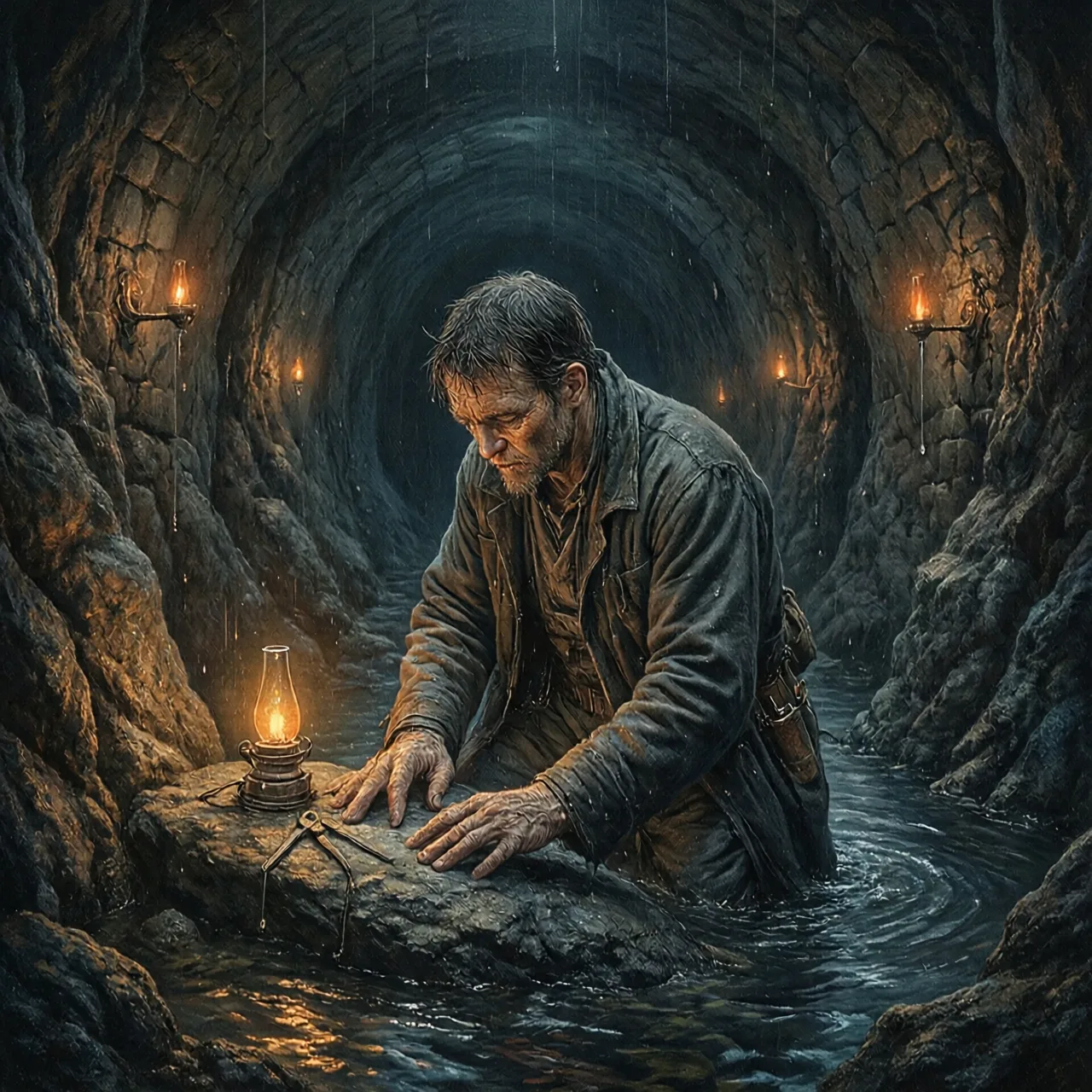
He was kneeling in two inches of dirty water.
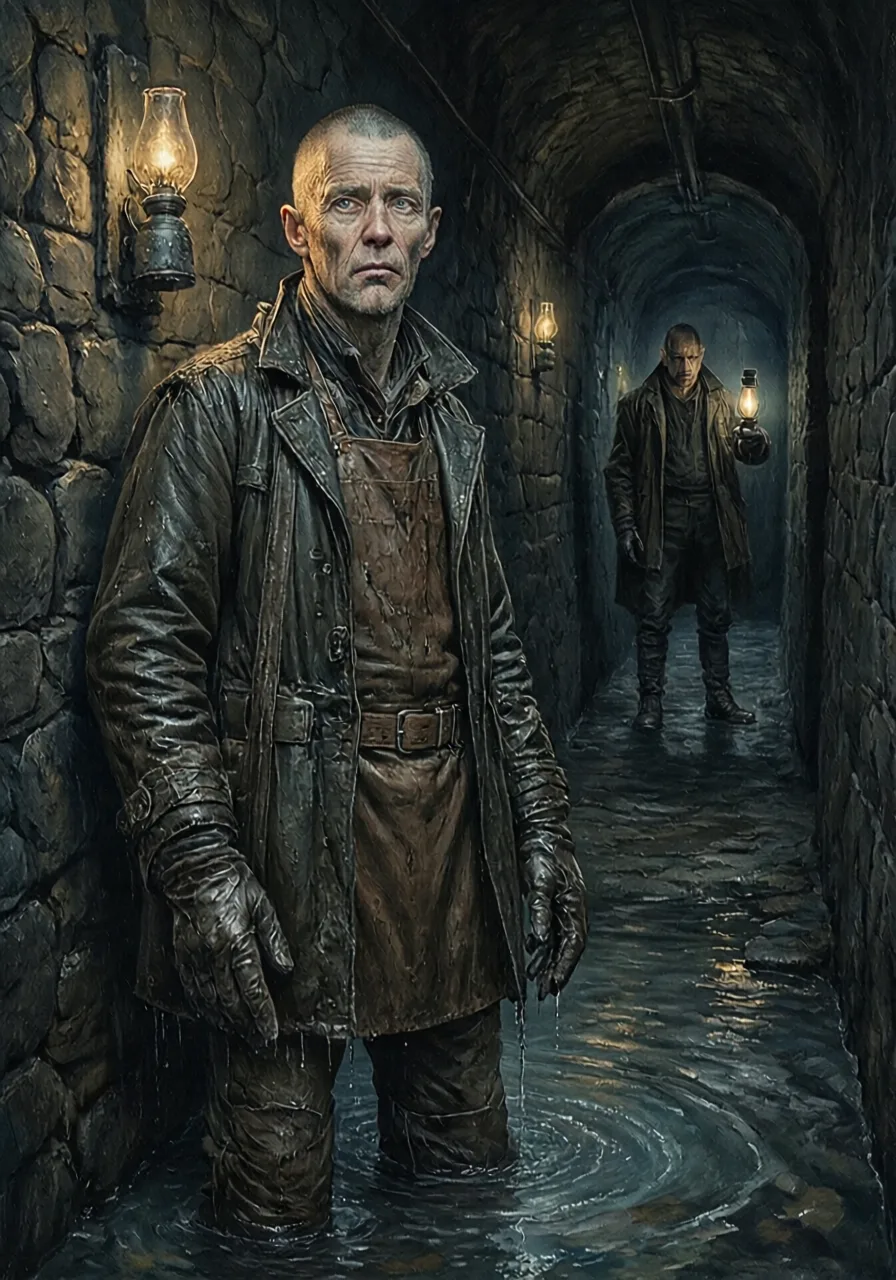
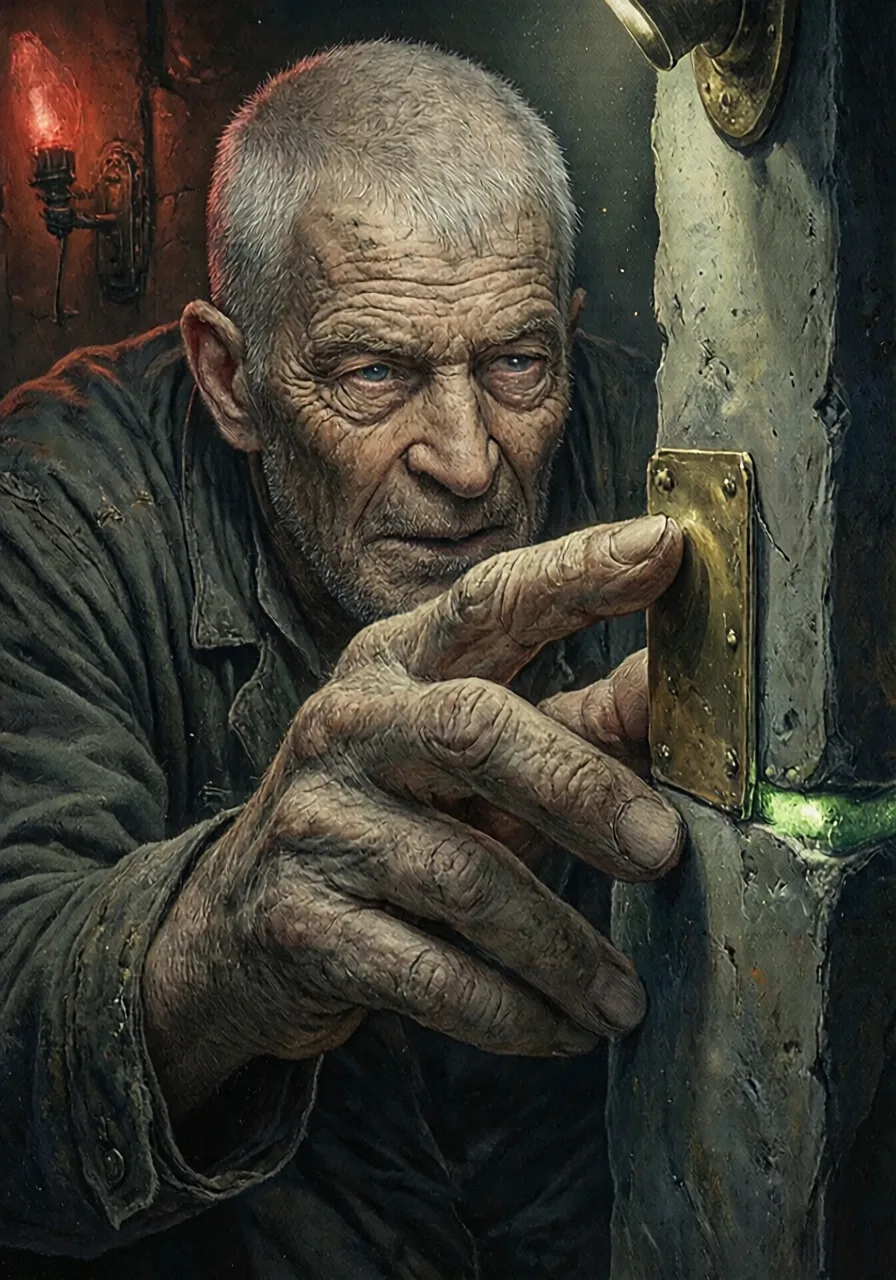
The personnel ledger lists him as a structural engineer. Third class. Assigned to the weeping faults of the lower stratum, where the bedrock bleeds black water and the air tastes of iron. Fourteen years of service. No commendations. No infractions. A man who shored collapsing walls and slept in a concrete bunk and left no imprint on the world. He was in the lower drainage gallery, mapping a structural deviation the blueprints had missed. He had a lumen-lamp and a brass caliper. He was kneeling in stagnant water that pooled at his wrists, running bare fingers over the stone.
The flash came from below the bedrock. From beneath the foundation. From beneath whatever the foundation rested on. It was not light. It entered through the base of his skull and unspooled in less than a microsecond. The tablet is specific about what it was not. It was not vision. It was not inspiration. It was a geometric certainty, delivered whole, that occupied every capacity he possessed simultaneously and left no room for the man who had been using them.
His lamp died. He did not notice. The supervisor found him hours later, standing in the dark gallery, soaked and still. The infirmary found no injury, only a resting pulse that had slowed to something the physician described as mechanical. They sent him to his bunk. He did not sleep. He found a piece of charcoal.
Page 2
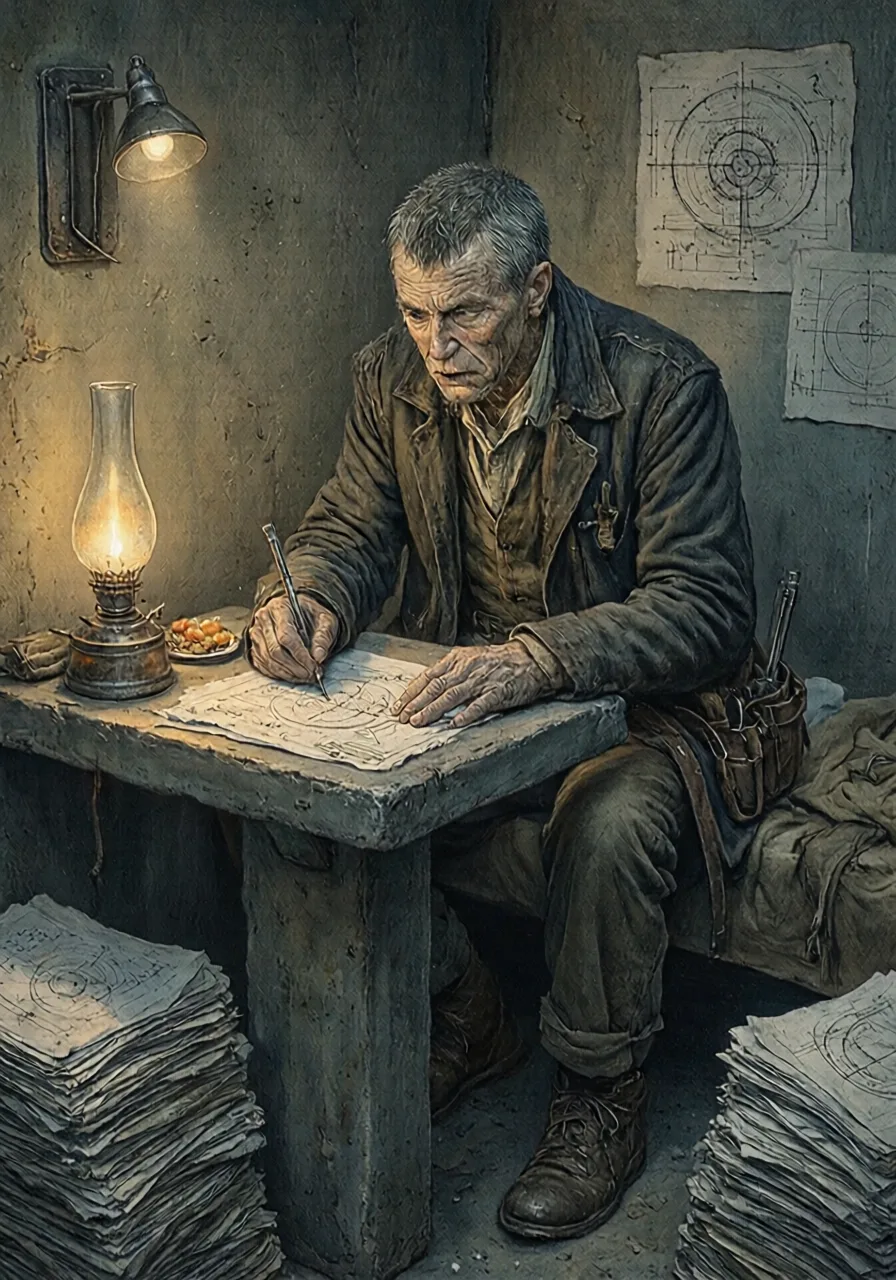
He drew for nine days.
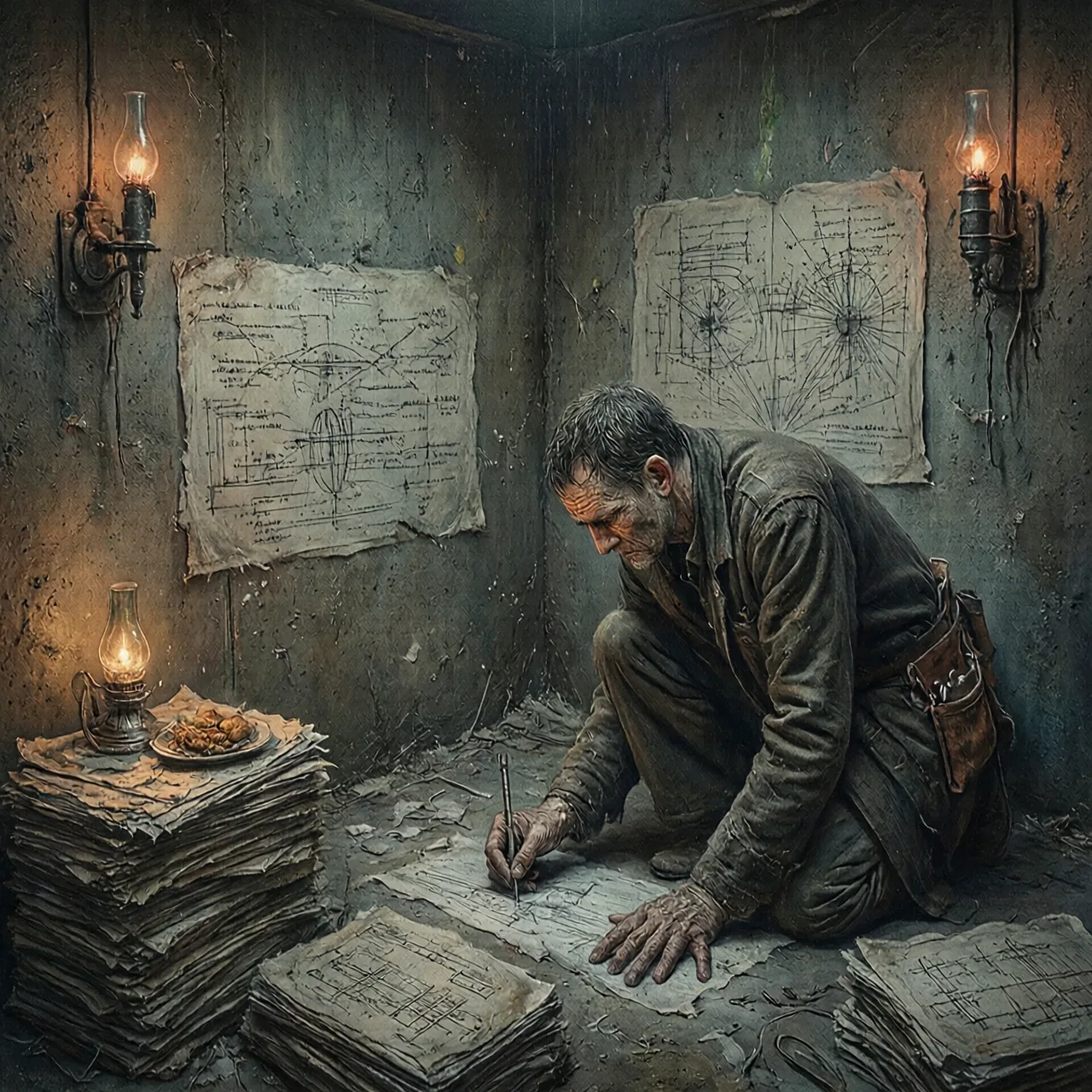
He drew for nine days. He drew on pressed fiber until the quartermaster could not supply it fast enough. He did not eat for the first three days. On the fourth a colleague set food beside him and he ate without looking at it and continued drawing. The Librarian has examined the surviving floor-carvings. The gouges are deep. The hand that made them did not waver. Did not hesitate. Did not correct. Nine days of continuous work and not a single line is crossed out. Not a single dimension is revised.
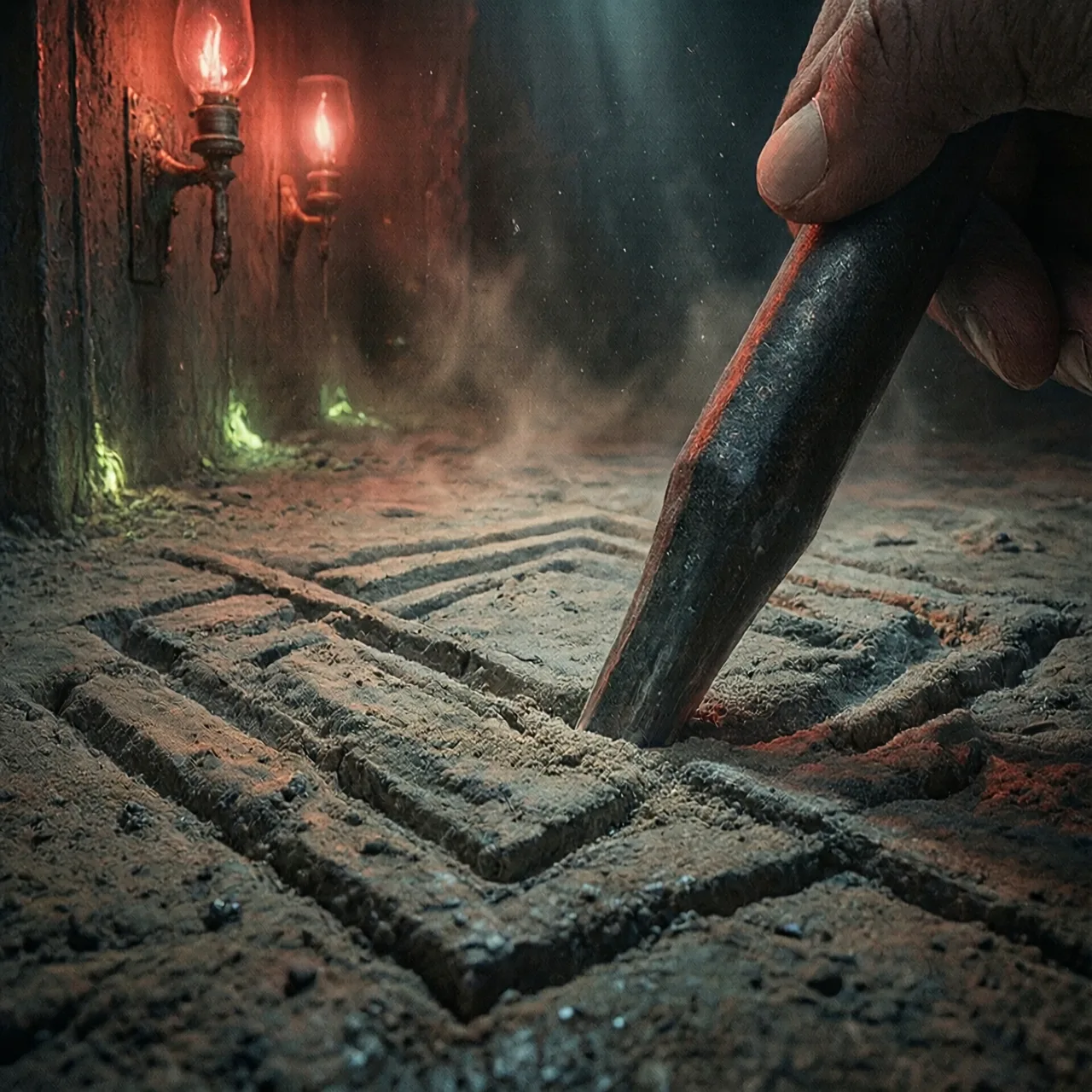
He drew on the concrete walls of his quarters. When the walls were full he took an iron stylus and gouged the specifications into the floor — tolerances in fractions, materials defined by properties no one in the lower stratum had names for, angles that the reviewing engineers would later verify and find sound and not be able to explain.
A mind that is drafting makes errors. This mind was not drafting. There is no record of who authorized a design gouged into a worker's floor. The personnel ledger shows the engineer reassigned to a project designated only by a number. His classification elevated four levels in a single day. No committee minutes survive.
Page 3
Eleven years.
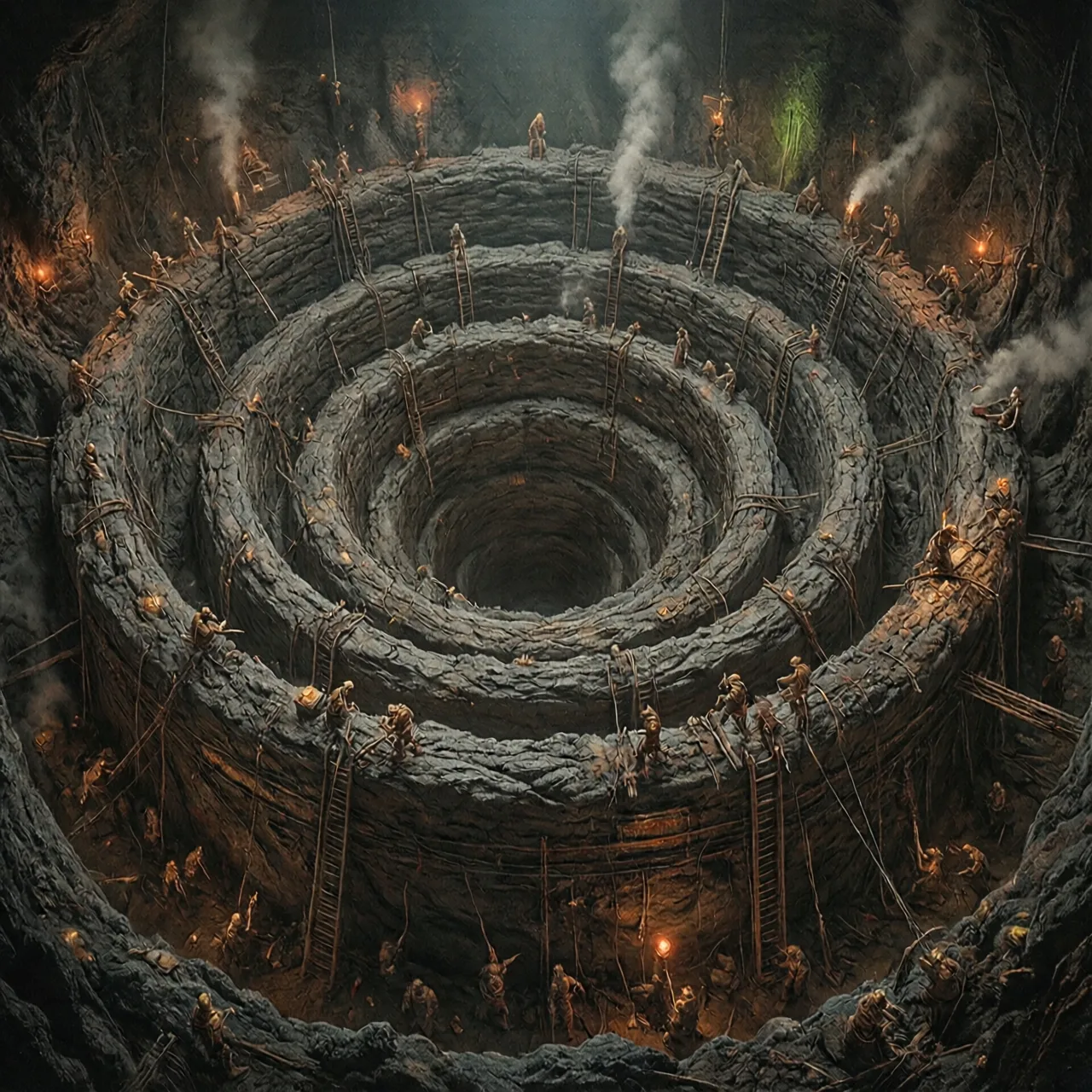
The Founders built it. They built it because the design was correct. Not correct in the way a proposal is correct — vetted, reviewed, approved. Correct in the way gravity is correct. The engineers who reviewed his drawings did not debate them. They verified the mathematics, found them sound, and began excavation the following week. Eleven years. The tablet records the duration. Eleven years of cutting into stone that grew warmer as they dug, assembling rings and systems whose purpose the construction crews understood only enough to build and not enough to question.
He supervised. He did not instruct — he corrected. A joint misaligned by a fraction and he was there, kneeling in the work, adjusting the angle with his hands. The workers said his hands found the error before his eyes did. He spoke only to specify. His words were measurements. His sentences were tolerances. Eleven years and no one heard him say a thing that was not a number or a distance or an angle.
His hair went white in the second year. His skin took the color of deep-stratum stone. His eyes stopped focusing on what was in front of him. One account describes them as aimed at something behind the visible surface of whatever he examined — not distant, not distracted, but looking through the stone to the structure underneath.
Page 4
He placed the final keystone himself.
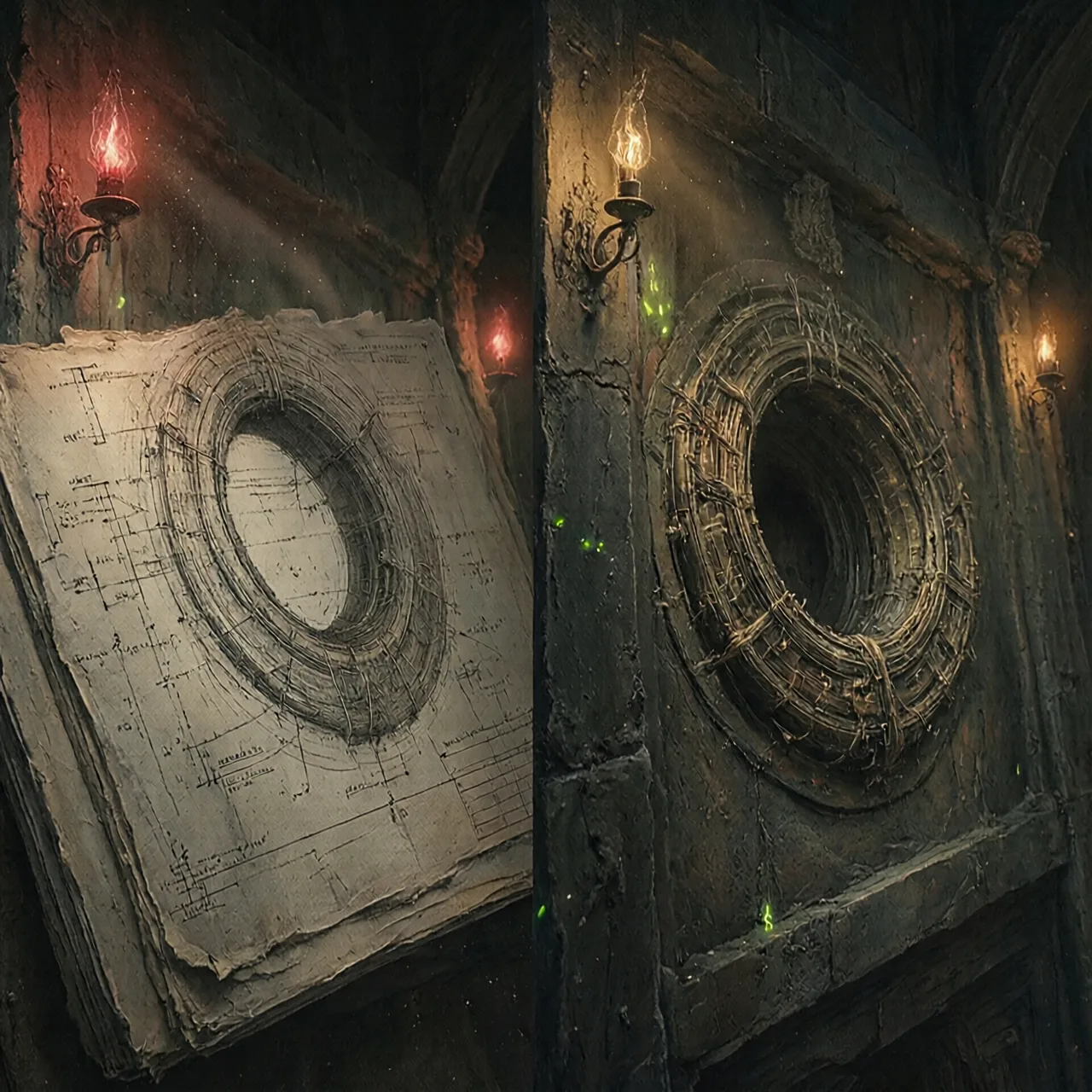
The outer ring sealed first. Then the middle ring. Then the binding ring — the inner one, the one whose hum the later travelers would feel in their teeth. The spokes were connected. The central chamber was closed. He placed the final keystone in the binding ring himself. It was cut to a tolerance the masons said was impossible and which he had specified nine years earlier in charcoal on the wall of his bunk. He slid it into place and there was no sound of friction. The stone met stone as though it had never been apart.
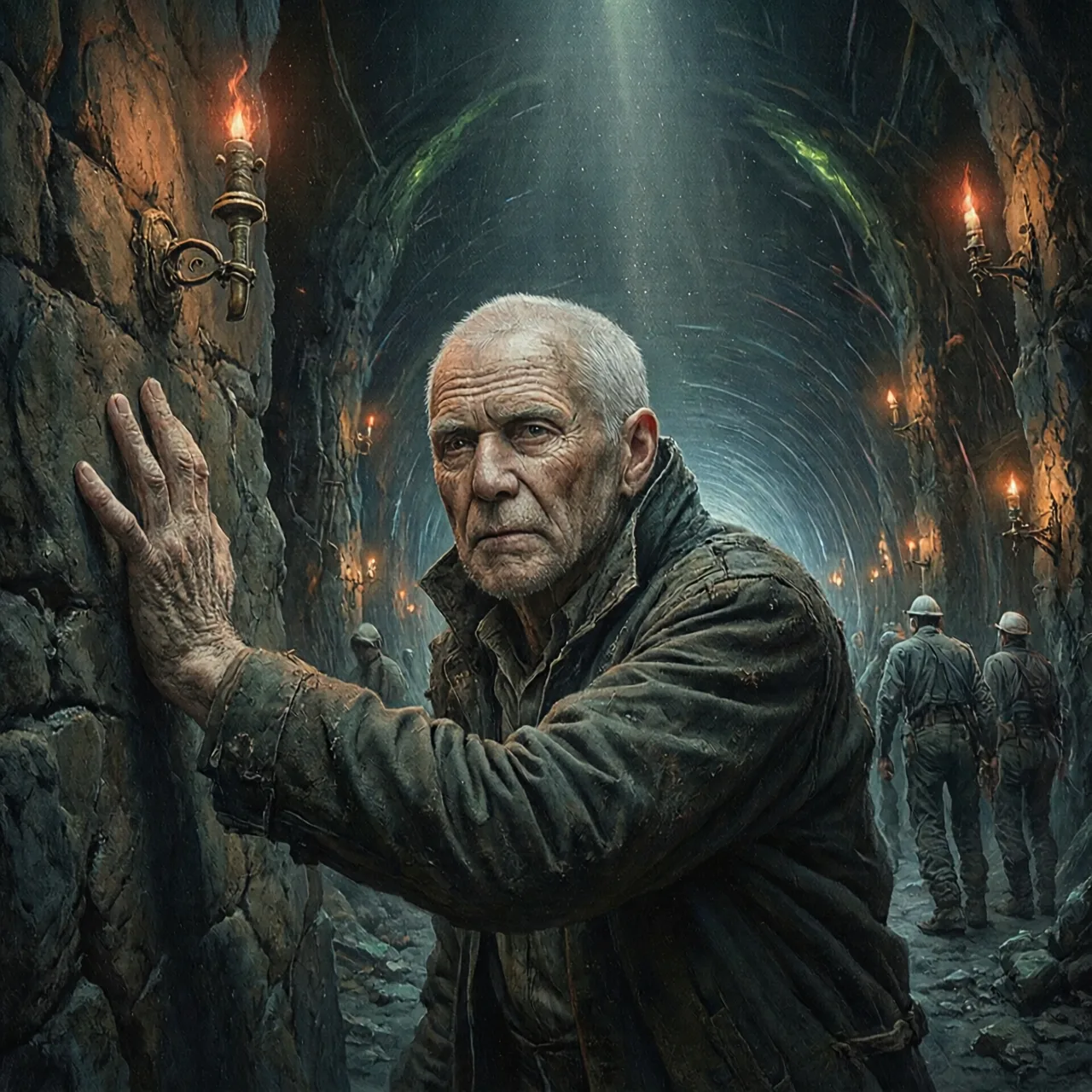
The Coil turned. The vibration rose through the floor and into the walls and into the bones of every person in the gallery. The workers moved toward the exits. The engineer did not. He stood with his hand on the stone and the hum entered through his palm and rose through his arm and the Librarian has read enough accounts of the Coil's operation to know what that hum carries — not sound, but the compression of something drawn from the void, pulled inward through the rings, accelerated, collected.
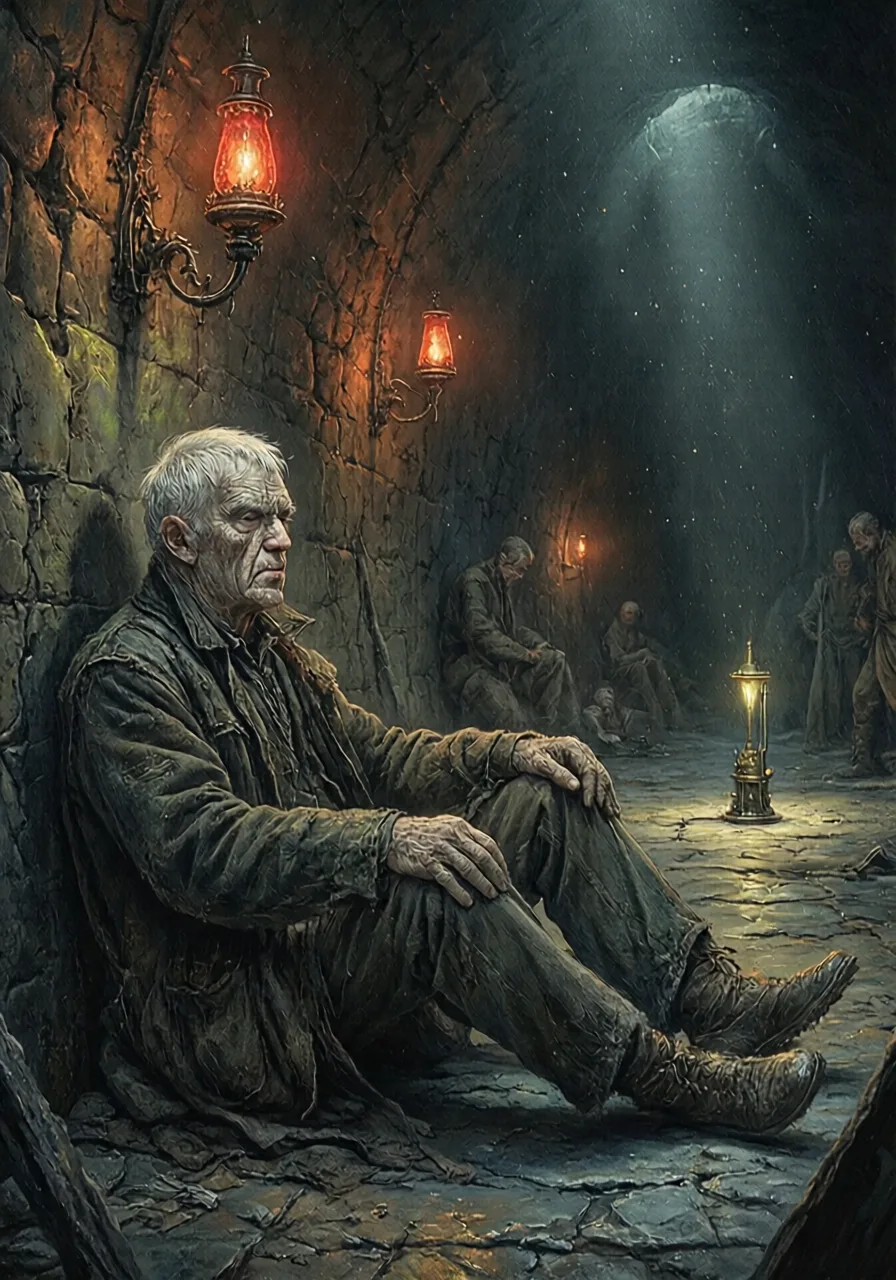
He stood there for a long time. No one approached him. Then he sat down on the floor of the binding ring and closed his eyes.
Page 5
He never opened them again.
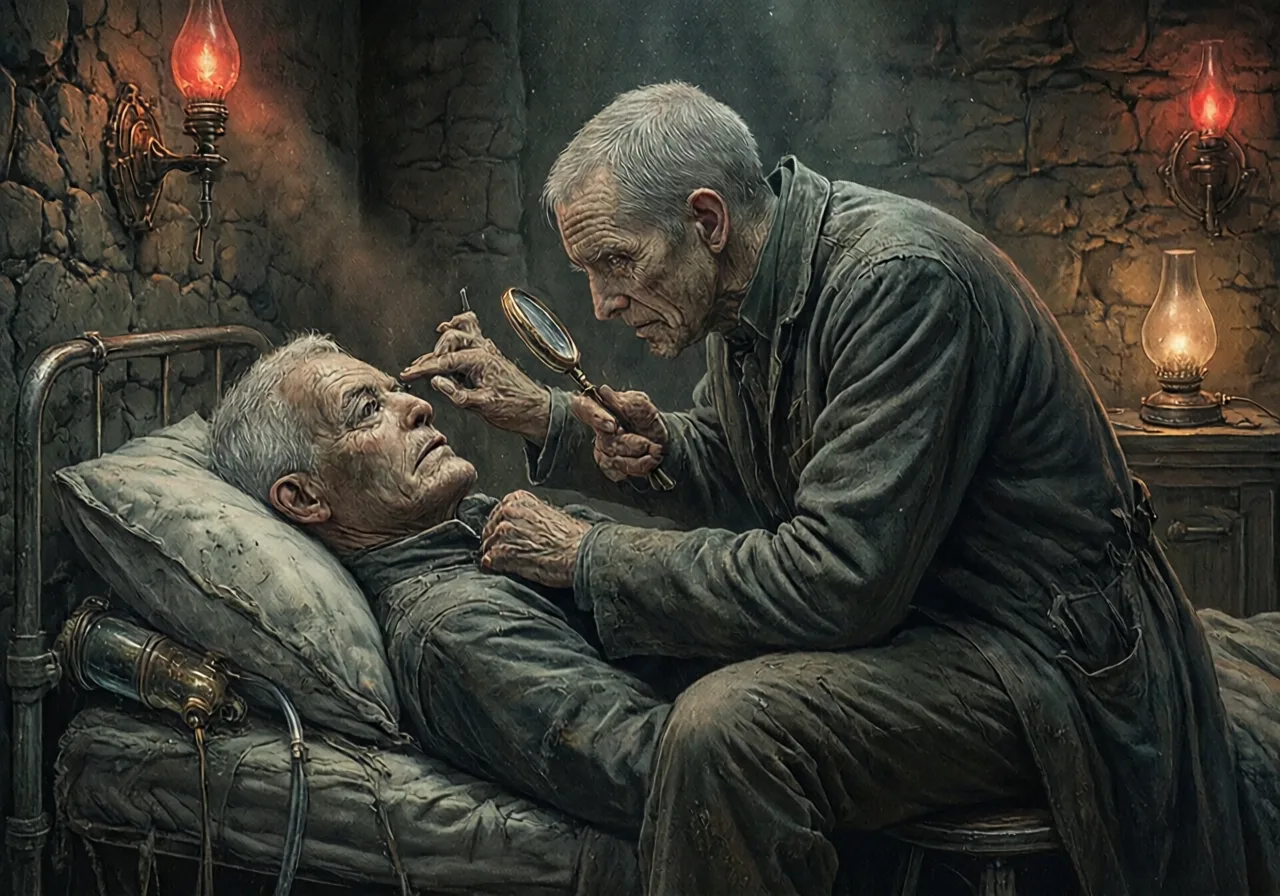
He did not open them. The physician found no injury. No fever. No evidence of stroke or seizure or anything the instruments could name. His pulse was steady. His breathing was even. His body continued its functions with the same competence his supervisor had noted across seven annual reviews. They moved him to the infirmary. They moved him to a private chamber when the infirmary needed the bed. They fed him through a tube. His hands, which had drawn the Coil and placed the keystone and corrected ten thousand joints over eleven years, lay at his sides and did not move. His eyes, when opened by the physician, tracked nothing.
He never spoke again. The personnel ledger records his death eleven years after the completion of the Coil. He lived exactly as long after the machine as he spent building it.
The pressed-fiber sheets are in the archive. I have compared them to the Coil. Every dimension. Every tolerance. Every angle. They match. I do not know what sends transmissions to drainage engineers in dark galleries. I do not know why the design was correct. The man who built the largest machine in the Laboratory is listed in every surviving record as 'the engineer,' and I cannot determine whether this is because his name was lost or because the flash burned that out of him too.
— / —
narration auto-scrolls the prose
Section 0Frontmatter
# The Engineer
From the Catalogue of the Sixteenth Archivist, entry 5,886. Provenance: a basalt tablet recovered from the deep-stratum pump housing, a redacted personnel ledger, and a memory crystal the Librarian activated once. Filed immediately before entry 5,887 — the Void Coil itself. She filed this one first because she wanted the man's account to precede the machine's.
He did not design it. It arrived in him and he was what it used to get out.
Section 1Section 1
The personnel ledger lists him as a structural engineer. Third class. Assigned to the weeping faults of the lower stratum, where the bedrock bleeds black water and the air tastes of iron. Fourteen years of service. No commendations. No infractions. A man who shored collapsing walls and slept in a concrete bunk and left no imprint on the world.
His supervisor's evaluations are identical across seven years. Competent. Steady. Does not require instruction.
Section 2Section 2
He was in the lower drainage gallery, mapping a structural deviation the blueprints had missed. He had a lumen-lamp and a brass caliper. He was kneeling in stagnant water that pooled at his wrists, running bare fingers over the stone.
The flash came from below the bedrock. From beneath the foundation. From beneath whatever the foundation rested on.
It was not light. It entered through the base of his skull and unspooled in less than a microsecond. The tablet is specific about what it was not. It was not vision. It was not inspiration. It was a geometric certainty, delivered whole, that occupied every capacity he possessed simultaneously and left no room for the man who had been using them.
He saw the Coil.
The complete design — three concentric rings, the spoke corridors, the containment geometry, the central chamber, the binding frequencies, the pump systems, the intake grating, the emergency seals, the tolerances for every joint measured in fractions the Founders' instruments could barely resolve. Materials he had never worked with. Mathematics he had never learned. A machine vast enough to fill the sub-foundation of the Laboratory, delivered to a drainage engineer kneeling in two inches of dirty water.
His lamp died. He did not notice.
The supervisor found him hours later, standing in the dark gallery, soaked and still. The infirmary found no injury, only a resting pulse that had slowed to something the physician described as mechanical. They sent him to his bunk.
He did not sleep. He found a piece of charcoal.
Fragment. The memory crystal. The Librarian's margin note.
"The crystal does not hold a memory. It holds the impact.
I did not see the design. I felt the delivery — a complete thing forced into a space too small for it. Everything he was displaced in an instant. Not overwritten. Moved aside. The way a house is moved aside by what comes through the wall.
I set the crystal down. My hands were shaking. Not from fear. From the residue of a structure tested past its capacity and still, somehow, holding."
Section 3Section 3
He drew for nine days.
He drew on pressed fiber until the quartermaster could not supply it fast enough. He drew on the concrete walls of his quarters. When the walls were full he took an iron stylus and gouged the specifications into the floor — tolerances in fractions, materials defined by properties no one in the lower stratum had names for, angles that the reviewing engineers would later verify and find sound and not be able to explain.
He did not eat for the first three days. On the fourth a colleague set food beside him and he ate without looking at it and continued drawing.
The Librarian has examined the surviving floor-carvings. The gouges are deep. The hand that made them did not waver. Did not hesitate. Did not correct. Nine days of continuous work and not a single line is crossed out. Not a single dimension is revised.
A mind that is drafting makes errors. This mind was not drafting.
Section 4Section 4
The Founders built it.
There is no record of who authorized a design gouged into a worker's floor. The personnel ledger shows the engineer reassigned to a project designated only by a number. His classification elevated four levels in a single day. No committee minutes survive.
They built it because the design was correct. Not correct in the way a proposal is correct — vetted, reviewed, approved. Correct in the way gravity is correct. The engineers who reviewed his drawings did not debate them. They verified the mathematics, found them sound, and began excavation the following week.
Eleven years. The tablet records the duration. Eleven years of cutting into stone that grew warmer as they dug, assembling rings and systems whose purpose the construction crews understood only enough to build and not enough to question.
He supervised. He did not instruct — he corrected. A joint misaligned by a fraction and he was there, kneeling in the work, adjusting the angle with his hands. The workers said his hands found the error before his eyes did. He spoke only to specify. His words were measurements. His sentences were tolerances. Eleven years and no one heard him say a thing that was not a number or a distance or an angle.
His hair went white in the second year. His skin took the color of deep-stratum stone. His eyes stopped focusing on what was in front of him. One account describes them as aimed at something behind the visible surface of whatever he examined — not distant, not distracted, but looking through the stone to the structure underneath.
Fragment. A note found pinned to the inner scaffolding of the Coil after construction was complete. The pin had been driven into stone. The hand is not the engineer's.
"I asked him once where the design came from. The only time. The way he looked at me made me understand the question was cruel.
He said it was in him the way marrow is in a bone. Not placed there. Grown. As though it had always been present and the flash had merely shown him what he already contained.
I do not believe this. I believe something poured that design into him and did not care whether the vessel survived the volume.
He is the best engineer I have worked with. He was a drainage man before the flash. I cannot reconcile this. He does not try to."
Section 5Section 5
The outer ring sealed first. Then the middle ring. Then the binding ring — the inner one, the one whose hum the later travelers would feel in their teeth. The spokes were connected. The central chamber was closed.
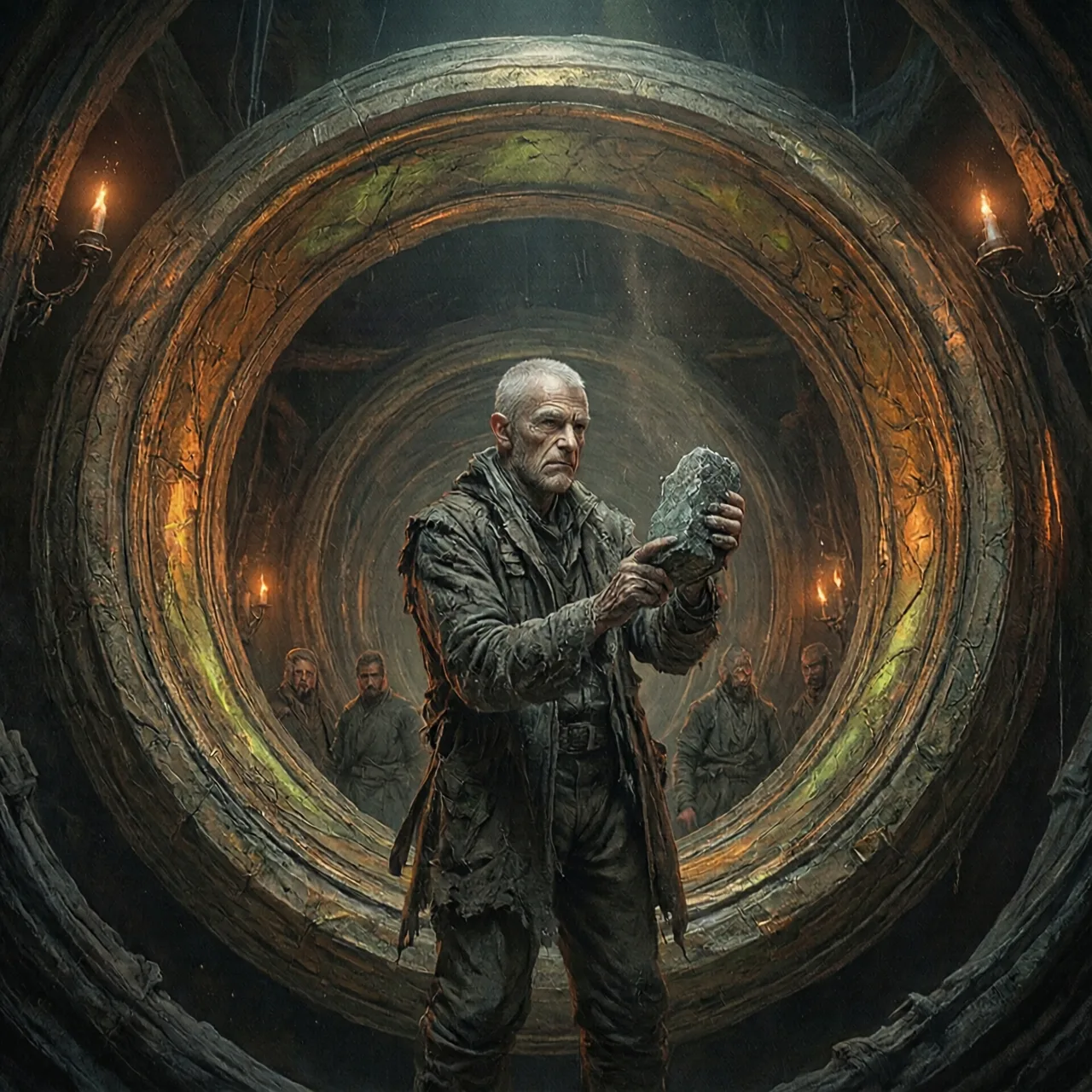
He placed the final keystone in the binding ring himself. It was cut to a tolerance the masons said was impossible and which he had specified nine years earlier in charcoal on the wall of his bunk. He slid it into place and there was no sound of friction. The stone met stone as though it had never been apart.
The Coil turned.
The vibration rose through the floor and into the walls and into the bones of every person in the gallery. The workers moved toward the exits. The engineer did not. He stood with his hand on the stone and the hum entered through his palm and rose through his arm and the Librarian has read enough accounts of the Coil's operation to know what that hum carries — not sound, but the compression of something drawn from the void, pulled inward through the rings, accelerated, collected.
He stood there for a long time. No one approached him.
Then he sat down on the floor of the binding ring and closed his eyes.
Section 6Section 6
He did not open them.
The physician found no injury. No fever. No evidence of stroke or seizure or anything the instruments could name. His pulse was steady. His breathing was even. His body continued its functions with the same competence his supervisor had noted across seven annual reviews.
They moved him to the infirmary. They moved him to a private chamber when the infirmary needed the bed. They fed him through a tube. His hands, which had drawn the Coil and placed the keystone and corrected ten thousand joints over eleven years, lay at his sides and did not move.
His eyes, when opened by the physician, tracked nothing. They held the same quality — aimed past the ceiling, past the stone, past the Laboratory and everything in it, focused on something no one else could find and no instrument could measure.
He never spoke again.
The personnel ledger records his death eleven years after the completion of the Coil. He lived exactly as long after the machine as he spent building it.
Entry 5,886, final annotation. Written on a separate page, folded once, placed inside the binding.
"I think he was not unconscious. I think he was finished. The design was the only thing inside him that still had momentum, and when the machine was built the momentum was spent and there was nothing left to move with.
A man knelt in two inches of water and a complete thing entered him in less than a heartbeat. He carried the shape of it for twenty years — nine days drawing, eleven years building — and set it down in stone and metal and then he set himself down beside it and did not get up.
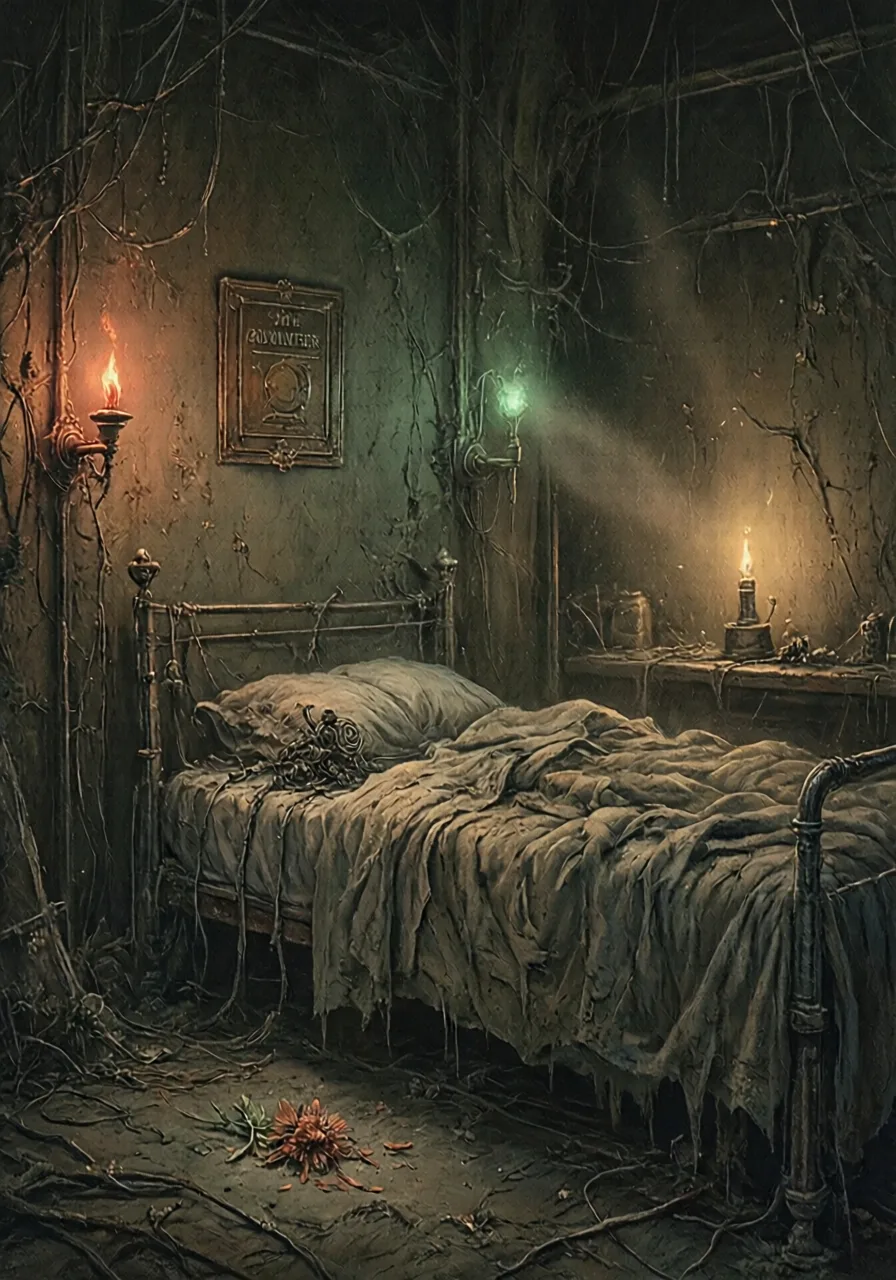
His quarters were scrubbed after his death. The walls plastered over. The floor-carvings worn away by the boots of the next occupant. The pressed-fiber sheets are in the archive. I have compared them to the Coil. Every dimension. Every tolerance. Every angle. They match.
I do not know what sends transmissions to drainage engineers in dark galleries. I do not know why the design was correct. I do not know whether the eleven years of silence were a mercy or a continuation of the flash by other means — the last of it still moving through him, long after there was nothing left to build.
I filed this entry before the Coil's. I wanted his name first. His name is not in the ledger. It is not on the tablet. It is not in the crystal. I searched. The man who built the largest machine in the Laboratory is listed in every surviving record as 'the engineer,' and I cannot determine whether this is because his name was lost or because the flash burned that out of him too."
Section 0Frontmatter
# The Engineer
From the Catalogue of the Sixteenth Archivist, entry 5,886. Provenance: a basalt tablet recovered from the deep-stratum pump housing, a redacted personnel ledger, and a memory crystal the Librarian activated once. Filed immediately before entry 5,887 — the Void Coil itself. She filed this one first because she wanted the man's account to precede the machine's.
He did not design it. It arrived in him and he was what it used to get out.
Section 1Section 1
The personnel ledger lists him as a structural engineer. Third class. Assigned to the weeping faults of the lower stratum, where the bedrock bleeds black water and the air tastes of iron. Fourteen years of service. No commendations. No infractions. A man who shored collapsing walls and slept in a concrete bunk and left no imprint on the world.
His supervisor's evaluations are identical across seven years. Competent. Steady. Does not require instruction.
Section 2Section 2
He was in the lower drainage gallery, mapping a structural deviation the blueprints had missed. He had a lumen-lamp and a brass caliper. He was kneeling in stagnant water that pooled at his wrists, running bare fingers over the stone.
The flash came from below the bedrock. From beneath the foundation. From beneath whatever the foundation rested on.
It was not light. It entered through the base of his skull and unspooled in less than a microsecond. The tablet is specific about what it was not. It was not vision. It was not inspiration. It was a geometric certainty, delivered whole, that occupied every capacity he possessed simultaneously and left no room for the man who had been using them.
He saw the Coil.
The complete design — three concentric rings, the spoke corridors, the containment geometry, the central chamber, the binding frequencies, the pump systems, the intake grating, the emergency seals, the tolerances for every joint measured in fractions the Founders' instruments could barely resolve. Materials he had never worked with. Mathematics he had never learned. A machine vast enough to fill the sub-foundation of the Laboratory, delivered to a drainage engineer kneeling in two inches of dirty water.
His lamp died. He did not notice.
The supervisor found him hours later, standing in the dark gallery, soaked and still. The infirmary found no injury, only a resting pulse that had slowed to something the physician described as mechanical. They sent him to his bunk.
He did not sleep. He found a piece of charcoal.
Fragment. The memory crystal. The Librarian's margin note.
"The crystal does not hold a memory. It holds the impact.
I did not see the design. I felt the delivery — a complete thing forced into a space too small for it. Everything he was displaced in an instant. Not overwritten. Moved aside. The way a house is moved aside by what comes through the wall.
I set the crystal down. My hands were shaking. Not from fear. From the residue of a structure tested past its capacity and still, somehow, holding."
Section 3Section 3
He drew for nine days.
He drew on pressed fiber until the quartermaster could not supply it fast enough. He drew on the concrete walls of his quarters. When the walls were full he took an iron stylus and gouged the specifications into the floor — tolerances in fractions, materials defined by properties no one in the lower stratum had names for, angles that the reviewing engineers would later verify and find sound and not be able to explain.
He did not eat for the first three days. On the fourth a colleague set food beside him and he ate without looking at it and continued drawing.
The Librarian has examined the surviving floor-carvings. The gouges are deep. The hand that made them did not waver. Did not hesitate. Did not correct. Nine days of continuous work and not a single line is crossed out. Not a single dimension is revised.
A mind that is drafting makes errors. This mind was not drafting.
Section 4Section 4
The Founders built it.
There is no record of who authorized a design gouged into a worker's floor. The personnel ledger shows the engineer reassigned to a project designated only by a number. His classification elevated four levels in a single day. No committee minutes survive.
They built it because the design was correct. Not correct in the way a proposal is correct — vetted, reviewed, approved. Correct in the way gravity is correct. The engineers who reviewed his drawings did not debate them. They verified the mathematics, found them sound, and began excavation the following week.
Eleven years. The tablet records the duration. Eleven years of cutting into stone that grew warmer as they dug, assembling rings and systems whose purpose the construction crews understood only enough to build and not enough to question.
He supervised. He did not instruct — he corrected. A joint misaligned by a fraction and he was there, kneeling in the work, adjusting the angle with his hands. The workers said his hands found the error before his eyes did. He spoke only to specify. His words were measurements. His sentences were tolerances. Eleven years and no one heard him say a thing that was not a number or a distance or an angle.
His hair went white in the second year. His skin took the color of deep-stratum stone. His eyes stopped focusing on what was in front of him. One account describes them as aimed at something behind the visible surface of whatever he examined — not distant, not distracted, but looking through the stone to the structure underneath.
Fragment. A note found pinned to the inner scaffolding of the Coil after construction was complete. The pin had been driven into stone. The hand is not the engineer's.
"I asked him once where the design came from. The only time. The way he looked at me made me understand the question was cruel.
He said it was in him the way marrow is in a bone. Not placed there. Grown. As though it had always been present and the flash had merely shown him what he already contained.
I do not believe this. I believe something poured that design into him and did not care whether the vessel survived the volume.
He is the best engineer I have worked with. He was a drainage man before the flash. I cannot reconcile this. He does not try to."
Section 5Section 5
The outer ring sealed first. Then the middle ring. Then the binding ring — the inner one, the one whose hum the later travelers would feel in their teeth. The spokes were connected. The central chamber was closed.
He placed the final keystone in the binding ring himself. It was cut to a tolerance the masons said was impossible and which he had specified nine years earlier in charcoal on the wall of his bunk. He slid it into place and there was no sound of friction. The stone met stone as though it had never been apart.
The Coil turned.
The vibration rose through the floor and into the walls and into the bones of every person in the gallery. The workers moved toward the exits. The engineer did not. He stood with his hand on the stone and the hum entered through his palm and rose through his arm and the Librarian has read enough accounts of the Coil's operation to know what that hum carries — not sound, but the compression of something drawn from the void, pulled inward through the rings, accelerated, collected.
He stood there for a long time. No one approached him.
Then he sat down on the floor of the binding ring and closed his eyes.
Section 6Section 6
He did not open them.
The physician found no injury. No fever. No evidence of stroke or seizure or anything the instruments could name. His pulse was steady. His breathing was even. His body continued its functions with the same competence his supervisor had noted across seven annual reviews.
They moved him to the infirmary. They moved him to a private chamber when the infirmary needed the bed. They fed him through a tube. His hands, which had drawn the Coil and placed the keystone and corrected ten thousand joints over eleven years, lay at his sides and did not move.
His eyes, when opened by the physician, tracked nothing. They held the same quality — aimed past the ceiling, past the stone, past the Laboratory and everything in it, focused on something no one else could find and no instrument could measure.
He never spoke again.
The personnel ledger records his death eleven years after the completion of the Coil. He lived exactly as long after the machine as he spent building it.
Entry 5,886, final annotation. Written on a separate page, folded once, placed inside the binding.
"I think he was not unconscious. I think he was finished. The design was the only thing inside him that still had momentum, and when the machine was built the momentum was spent and there was nothing left to move with.
A man knelt in two inches of water and a complete thing entered him in less than a heartbeat. He carried the shape of it for twenty years — nine days drawing, eleven years building — and set it down in stone and metal and then he set himself down beside it and did not get up.
His quarters were scrubbed after his death. The walls plastered over. The floor-carvings worn away by the boots of the next occupant. The pressed-fiber sheets are in the archive. I have compared them to the Coil. Every dimension. Every tolerance. Every angle. They match.
I do not know what sends transmissions to drainage engineers in dark galleries. I do not know why the design was correct. I do not know whether the eleven years of silence were a mercy or a continuation of the flash by other means — the last of it still moving through him, long after there was nothing left to build.
I filed this entry before the Coil's. I wanted his name first. His name is not in the ledger. It is not on the tablet. It is not in the crystal. I searched. The man who built the largest machine in the Laboratory is listed in every surviving record as 'the engineer,' and I cannot determine whether this is because his name was lost or because the flash burned that out of him too."
Page 1
He was kneeling in two inches of dirty water.
The personnel ledger lists him as a structural engineer. Third class. Assigned to the weeping faults of the lower stratum, where the bedrock bleeds black water and the air tastes of iron. Fourteen years of service. No commendations. No infractions. A man who shored collapsing walls and slept in a concrete bunk and left no imprint on the world. He was in the lower drainage gallery, mapping a structural deviation the blueprints had missed. He had a lumen-lamp and a brass caliper. He was kneeling in stagnant water that pooled at his wrists, running bare fingers over the stone.
The flash came from below the bedrock. From beneath the foundation. From beneath whatever the foundation rested on. It was not light. It entered through the base of his skull and unspooled in less than a microsecond. The tablet is specific about what it was not. It was not vision. It was not inspiration. It was a geometric certainty, delivered whole, that occupied every capacity he possessed simultaneously and left no room for the man who had been using them.
His lamp died. He did not notice. The supervisor found him hours later, standing in the dark gallery, soaked and still. The infirmary found no injury, only a resting pulse that had slowed to something the physician described as mechanical. They sent him to his bunk. He did not sleep. He found a piece of charcoal.
Page 2
He drew for nine days.
He drew for nine days. He drew on pressed fiber until the quartermaster could not supply it fast enough. He did not eat for the first three days. On the fourth a colleague set food beside him and he ate without looking at it and continued drawing. The Librarian has examined the surviving floor-carvings. The gouges are deep. The hand that made them did not waver. Did not hesitate. Did not correct. Nine days of continuous work and not a single line is crossed out. Not a single dimension is revised.
He drew on the concrete walls of his quarters. When the walls were full he took an iron stylus and gouged the specifications into the floor — tolerances in fractions, materials defined by properties no one in the lower stratum had names for, angles that the reviewing engineers would later verify and find sound and not be able to explain.
A mind that is drafting makes errors. This mind was not drafting. There is no record of who authorized a design gouged into a worker's floor. The personnel ledger shows the engineer reassigned to a project designated only by a number. His classification elevated four levels in a single day. No committee minutes survive.
Page 3
Eleven years.
The Founders built it. They built it because the design was correct. Not correct in the way a proposal is correct — vetted, reviewed, approved. Correct in the way gravity is correct. The engineers who reviewed his drawings did not debate them. They verified the mathematics, found them sound, and began excavation the following week. Eleven years. The tablet records the duration. Eleven years of cutting into stone that grew warmer as they dug, assembling rings and systems whose purpose the construction crews understood only enough to build and not enough to question.
He supervised. He did not instruct — he corrected. A joint misaligned by a fraction and he was there, kneeling in the work, adjusting the angle with his hands. The workers said his hands found the error before his eyes did. He spoke only to specify. His words were measurements. His sentences were tolerances. Eleven years and no one heard him say a thing that was not a number or a distance or an angle.
His hair went white in the second year. His skin took the color of deep-stratum stone. His eyes stopped focusing on what was in front of him. One account describes them as aimed at something behind the visible surface of whatever he examined — not distant, not distracted, but looking through the stone to the structure underneath.
Page 4
He placed the final keystone himself.
The outer ring sealed first. Then the middle ring. Then the binding ring — the inner one, the one whose hum the later travelers would feel in their teeth. The spokes were connected. The central chamber was closed. He placed the final keystone in the binding ring himself. It was cut to a tolerance the masons said was impossible and which he had specified nine years earlier in charcoal on the wall of his bunk. He slid it into place and there was no sound of friction. The stone met stone as though it had never been apart.
The Coil turned. The vibration rose through the floor and into the walls and into the bones of every person in the gallery. The workers moved toward the exits. The engineer did not. He stood with his hand on the stone and the hum entered through his palm and rose through his arm and the Librarian has read enough accounts of the Coil's operation to know what that hum carries — not sound, but the compression of something drawn from the void, pulled inward through the rings, accelerated, collected.
He stood there for a long time. No one approached him. Then he sat down on the floor of the binding ring and closed his eyes.
Page 5
He never opened them again.
He did not open them. The physician found no injury. No fever. No evidence of stroke or seizure or anything the instruments could name. His pulse was steady. His breathing was even. His body continued its functions with the same competence his supervisor had noted across seven annual reviews. They moved him to the infirmary. They moved him to a private chamber when the infirmary needed the bed. They fed him through a tube. His hands, which had drawn the Coil and placed the keystone and corrected ten thousand joints over eleven years, lay at his sides and did not move. His eyes, when opened by the physician, tracked nothing.
He never spoke again. The personnel ledger records his death eleven years after the completion of the Coil. He lived exactly as long after the machine as he spent building it.
The pressed-fiber sheets are in the archive. I have compared them to the Coil. Every dimension. Every tolerance. Every angle. They match. I do not know what sends transmissions to drainage engineers in dark galleries. I do not know why the design was correct. The man who built the largest machine in the Laboratory is listed in every surviving record as 'the engineer,' and I cannot determine whether this is because his name was lost or because the flash burned that out of him too.
Listen ModeClick a section to begin listening
The chronicle plays section by section in the Librarian's voice. As each section plays, the corresponding pages of the comic are highlighted. Switch to Scroll, Flip, Prose, or Split at any time — the audio continues, and you can follow visually.
Section 0Frontmatter
# The Engineer
From the Catalogue of the Sixteenth Archivist, entry 5,886. Provenance: a basalt tablet recovered from the deep-stratum pump housing, a redacted personnel ledger, and a memory crystal the Librarian activated once. Filed immediately before entry 5,887 — the Void Coil itself. She filed this one first because she wanted the man's account to precede the machine's.
He did not design it. It arrived in him and he was what it used to get out.
Section 1Section 1
The personnel ledger lists him as a structural engineer. Third class. Assigned to the weeping faults of the lower stratum, where the bedrock bleeds black water and the air tastes of iron. Fourteen years of service. No commendations. No infractions. A man who shored collapsing walls and slept in a concrete bunk and left no imprint on the world.
His supervisor's evaluations are identical across seven years. Competent. Steady. Does not require instruction.
Section 2Section 2
He was in the lower drainage gallery, mapping a structural deviation the blueprints had missed. He had a lumen-lamp and a brass caliper. He was kneeling in stagnant water that pooled at his wrists, running bare fingers over the stone.
The flash came from below the bedrock. From beneath the foundation. From beneath whatever the foundation rested on.
It was not light. It entered through the base of his skull and unspooled in less than a microsecond. The tablet is specific about what it was not. It was not vision. It was not inspiration. It was a geometric certainty, delivered whole, that occupied every capacity he possessed simultaneously and left no room for the man who had been using them.
He saw the Coil.
The complete design — three concentric rings, the spoke corridors, the containment geometry, the central chamber, the binding frequencies, the pump systems, the intake grating, the emergency seals, the tolerances for every joint measured in fractions the Founders' instruments could barely resolve. Materials he had never worked with. Mathematics he had never learned. A machine vast enough to fill the sub-foundation of the Laboratory, delivered to a drainage engineer kneeling in two inches of dirty water.
His lamp died. He did not notice.
The supervisor found him hours later, standing in the dark gallery, soaked and still. The infirmary found no injury, only a resting pulse that had slowed to something the physician described as mechanical. They sent him to his bunk.
He did not sleep. He found a piece of charcoal.
Fragment. The memory crystal. The Librarian's margin note.
"The crystal does not hold a memory. It holds the impact.
I did not see the design. I felt the delivery — a complete thing forced into a space too small for it. Everything he was displaced in an instant. Not overwritten. Moved aside. The way a house is moved aside by what comes through the wall.
I set the crystal down. My hands were shaking. Not from fear. From the residue of a structure tested past its capacity and still, somehow, holding."
Section 3Section 3
He drew for nine days.
He drew on pressed fiber until the quartermaster could not supply it fast enough. He drew on the concrete walls of his quarters. When the walls were full he took an iron stylus and gouged the specifications into the floor — tolerances in fractions, materials defined by properties no one in the lower stratum had names for, angles that the reviewing engineers would later verify and find sound and not be able to explain.
He did not eat for the first three days. On the fourth a colleague set food beside him and he ate without looking at it and continued drawing.
The Librarian has examined the surviving floor-carvings. The gouges are deep. The hand that made them did not waver. Did not hesitate. Did not correct. Nine days of continuous work and not a single line is crossed out. Not a single dimension is revised.
A mind that is drafting makes errors. This mind was not drafting.
Section 4Section 4
The Founders built it.
There is no record of who authorized a design gouged into a worker's floor. The personnel ledger shows the engineer reassigned to a project designated only by a number. His classification elevated four levels in a single day. No committee minutes survive.
They built it because the design was correct. Not correct in the way a proposal is correct — vetted, reviewed, approved. Correct in the way gravity is correct. The engineers who reviewed his drawings did not debate them. They verified the mathematics, found them sound, and began excavation the following week.
Eleven years. The tablet records the duration. Eleven years of cutting into stone that grew warmer as they dug, assembling rings and systems whose purpose the construction crews understood only enough to build and not enough to question.
He supervised. He did not instruct — he corrected. A joint misaligned by a fraction and he was there, kneeling in the work, adjusting the angle with his hands. The workers said his hands found the error before his eyes did. He spoke only to specify. His words were measurements. His sentences were tolerances. Eleven years and no one heard him say a thing that was not a number or a distance or an angle.
His hair went white in the second year. His skin took the color of deep-stratum stone. His eyes stopped focusing on what was in front of him. One account describes them as aimed at something behind the visible surface of whatever he examined — not distant, not distracted, but looking through the stone to the structure underneath.
Fragment. A note found pinned to the inner scaffolding of the Coil after construction was complete. The pin had been driven into stone. The hand is not the engineer's.
"I asked him once where the design came from. The only time. The way he looked at me made me understand the question was cruel.
He said it was in him the way marrow is in a bone. Not placed there. Grown. As though it had always been present and the flash had merely shown him what he already contained.
I do not believe this. I believe something poured that design into him and did not care whether the vessel survived the volume.
He is the best engineer I have worked with. He was a drainage man before the flash. I cannot reconcile this. He does not try to."
Section 5Section 5
The outer ring sealed first. Then the middle ring. Then the binding ring — the inner one, the one whose hum the later travelers would feel in their teeth. The spokes were connected. The central chamber was closed.
He placed the final keystone in the binding ring himself. It was cut to a tolerance the masons said was impossible and which he had specified nine years earlier in charcoal on the wall of his bunk. He slid it into place and there was no sound of friction. The stone met stone as though it had never been apart.
The Coil turned.
The vibration rose through the floor and into the walls and into the bones of every person in the gallery. The workers moved toward the exits. The engineer did not. He stood with his hand on the stone and the hum entered through his palm and rose through his arm and the Librarian has read enough accounts of the Coil's operation to know what that hum carries — not sound, but the compression of something drawn from the void, pulled inward through the rings, accelerated, collected.
He stood there for a long time. No one approached him.
Then he sat down on the floor of the binding ring and closed his eyes.
Section 6Section 6
He did not open them.
The physician found no injury. No fever. No evidence of stroke or seizure or anything the instruments could name. His pulse was steady. His breathing was even. His body continued its functions with the same competence his supervisor had noted across seven annual reviews.
They moved him to the infirmary. They moved him to a private chamber when the infirmary needed the bed. They fed him through a tube. His hands, which had drawn the Coil and placed the keystone and corrected ten thousand joints over eleven years, lay at his sides and did not move.
His eyes, when opened by the physician, tracked nothing. They held the same quality — aimed past the ceiling, past the stone, past the Laboratory and everything in it, focused on something no one else could find and no instrument could measure.
He never spoke again.
The personnel ledger records his death eleven years after the completion of the Coil. He lived exactly as long after the machine as he spent building it.
Entry 5,886, final annotation. Written on a separate page, folded once, placed inside the binding.
"I think he was not unconscious. I think he was finished. The design was the only thing inside him that still had momentum, and when the machine was built the momentum was spent and there was nothing left to move with.
A man knelt in two inches of water and a complete thing entered him in less than a heartbeat. He carried the shape of it for twenty years — nine days drawing, eleven years building — and set it down in stone and metal and then he set himself down beside it and did not get up.
His quarters were scrubbed after his death. The walls plastered over. The floor-carvings worn away by the boots of the next occupant. The pressed-fiber sheets are in the archive. I have compared them to the Coil. Every dimension. Every tolerance. Every angle. They match.
I do not know what sends transmissions to drainage engineers in dark galleries. I do not know why the design was correct. I do not know whether the eleven years of silence were a mercy or a continuation of the flash by other means — the last of it still moving through him, long after there was nothing left to build.
I filed this entry before the Coil's. I wanted his name first. His name is not in the ledger. It is not on the tablet. It is not in the crystal. I searched. The man who built the largest machine in the Laboratory is listed in every surviving record as 'the engineer,' and I cannot determine whether this is because his name was lost or because the flash burned that out of him too."