From the Catalogue of the Sixteenth Archivist, entry 13,221
Full chronicle
Page 1
She had filed the page. The page had not stayed filed.
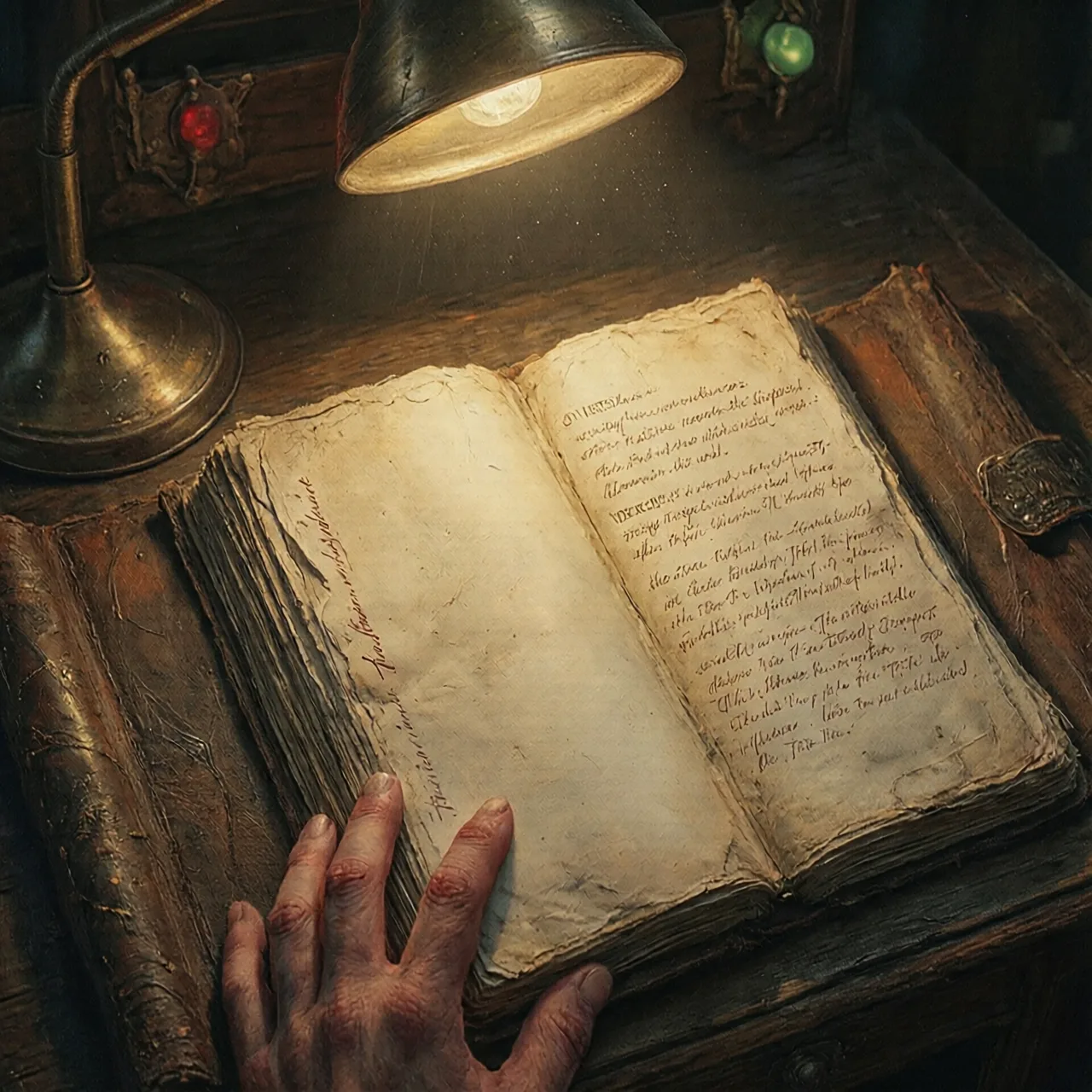
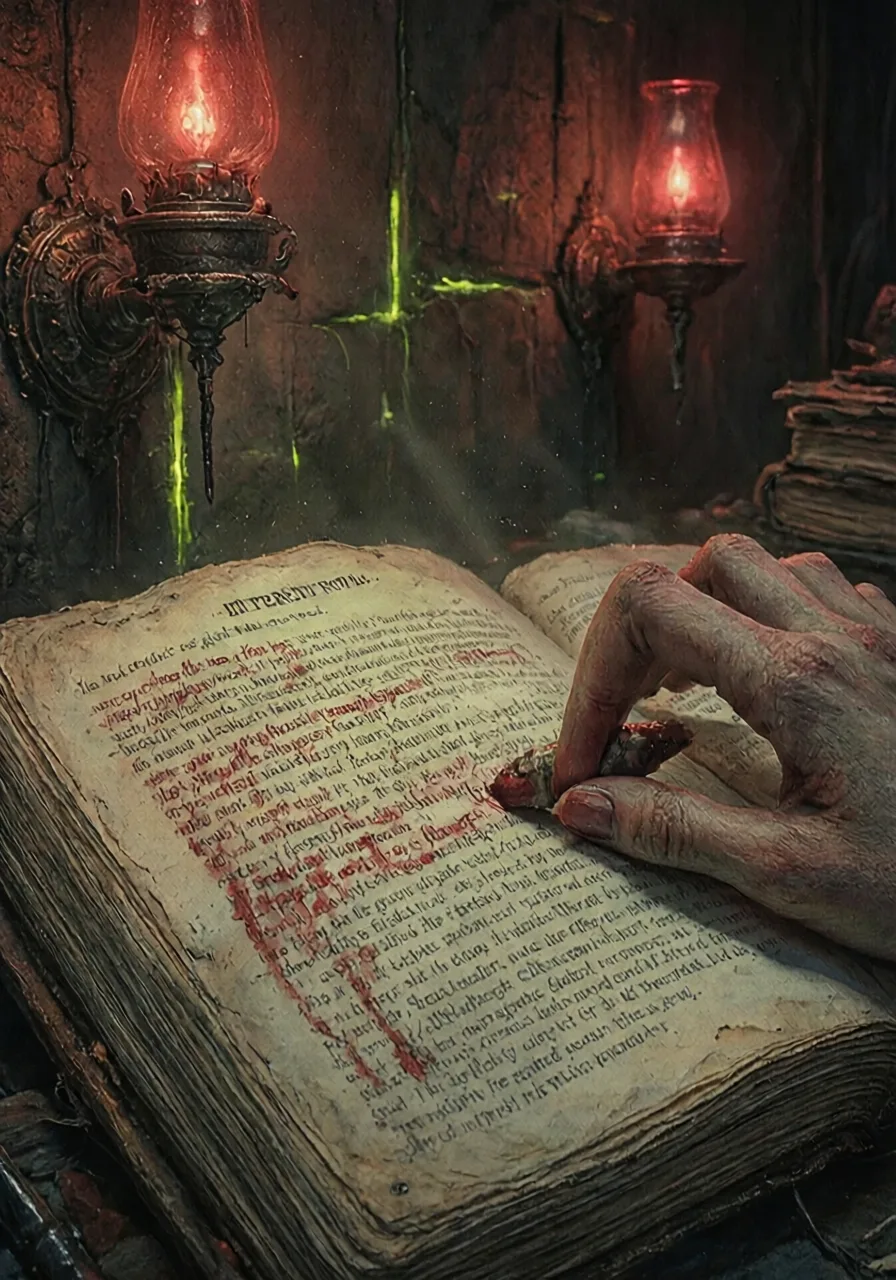
The discrepancy was first observed in entry 12,107. The page that had changed was a folded margin in the secure file. The two sentences in the middle were not there. The parchment in the place where the sentences had been showed no impression of writing. The hand around them was hers. The ink was the ink she keeps.
She did not extend the entry. She set the page down. She walked to the corridor. She returned to the desk. The sentences had not returned.
Page 2
She tested.
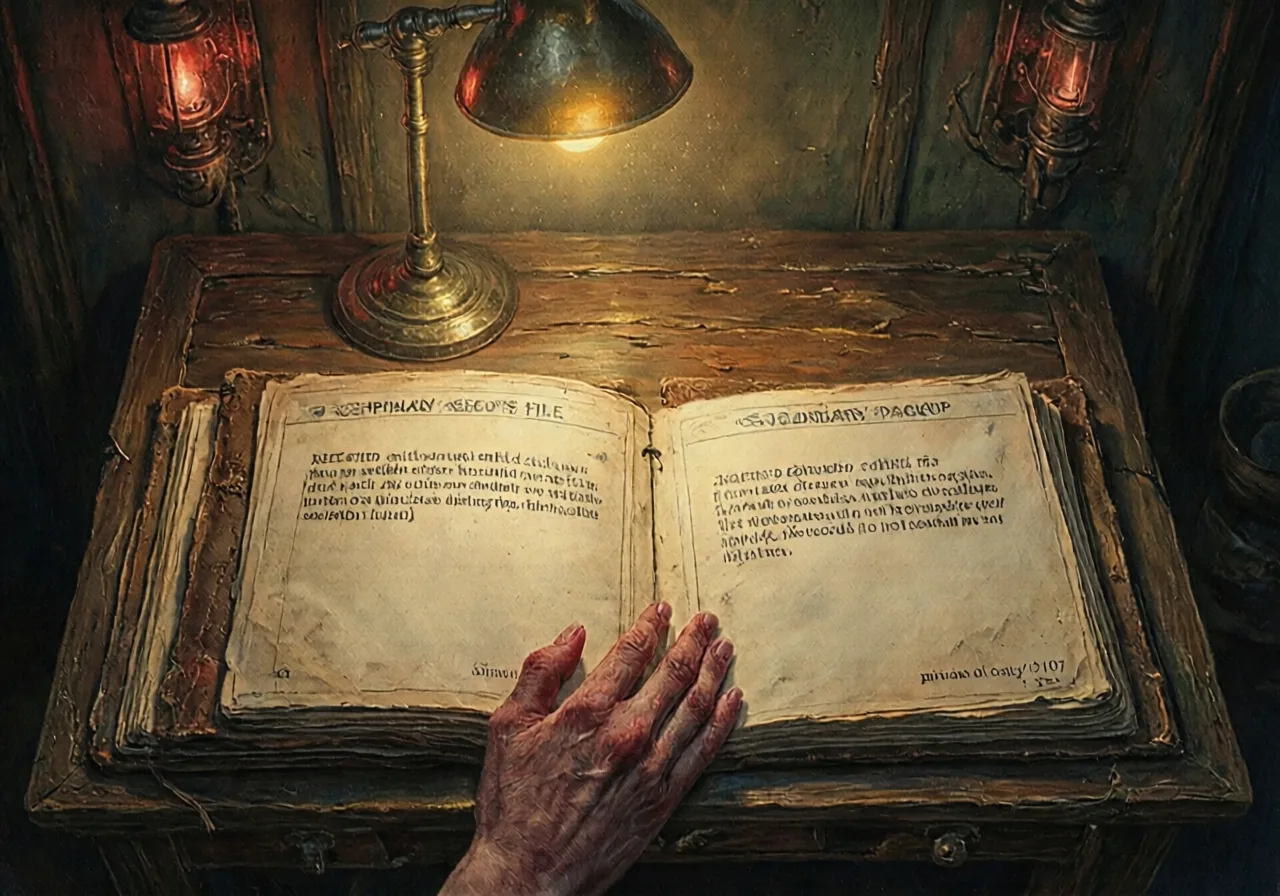
She tested. She drew the secure-file copy. She drew the secondary backup. The primary had been edited. The secondary had not. She filed the secondary back in its drawer. She continued.
Smallest finger had become ring finger. The secondary backup retained smallest finger. Her recollection retained smallest finger. The Guardian's plate, which she had inspected on the morning of the day before this entry, retained the scuff at the length of her smallest finger. The world had become a different thing in that respect, and the page had been brought into accuracy with the world.
Page 3
She held vigil.
She held vigil. She set up the desk for the watch. She brought lamp oil for fourteen days. She did not sleep more than two hours at a stretch. The page on the desk did not change. The pages she had not opened were edited.
She held vigil three times. The pages she had set out remained. The pages she had not opened were edited. The edits did not occur in the room when she was watching. She filed the conclusion.
Page 4
The sixth instrument.
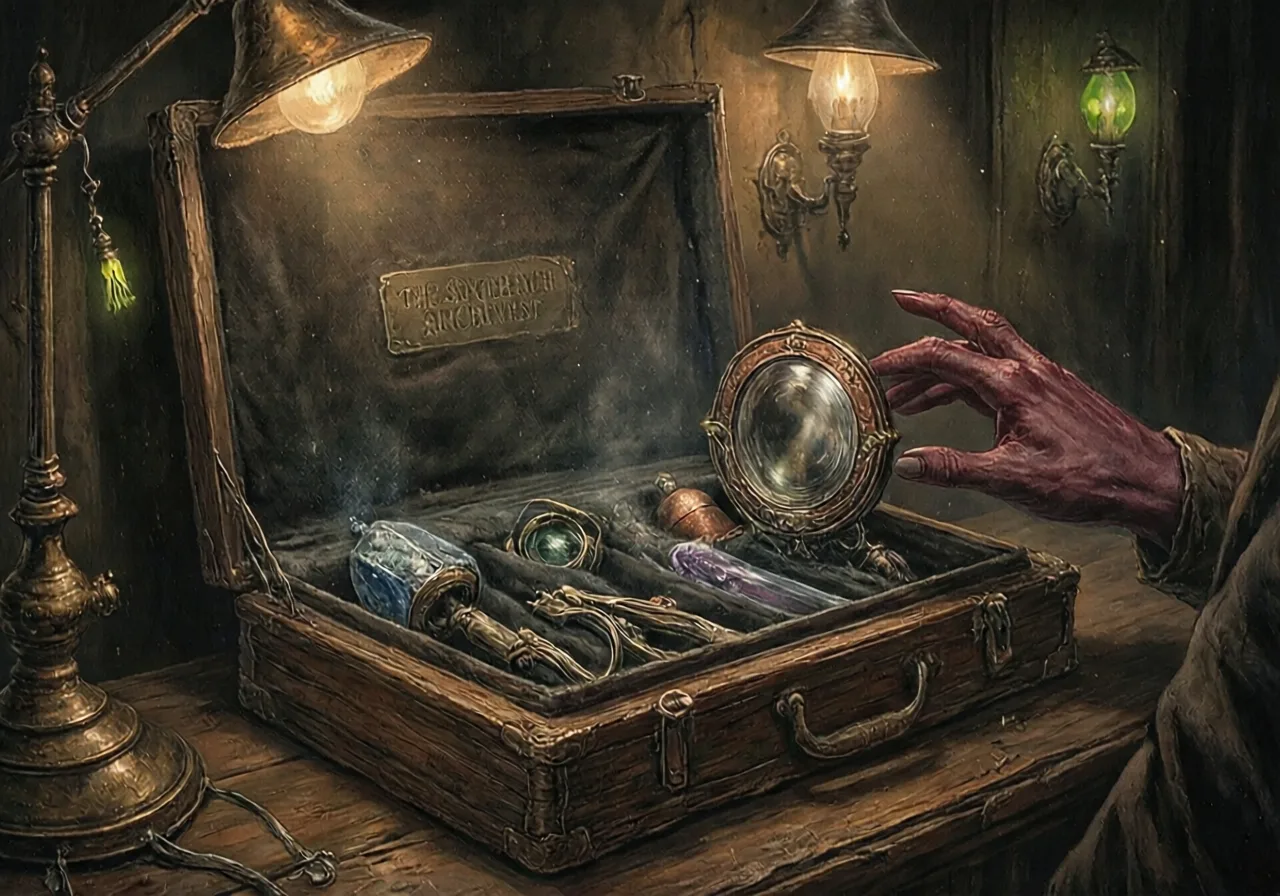
She drew, from the case the keeper had given her, the sixth instrument. She had used it twice in her tenure since the keeper had given it to her. The two prior uses were small. The settings beyond the smallest she had remembered as available without remembering having tested them.
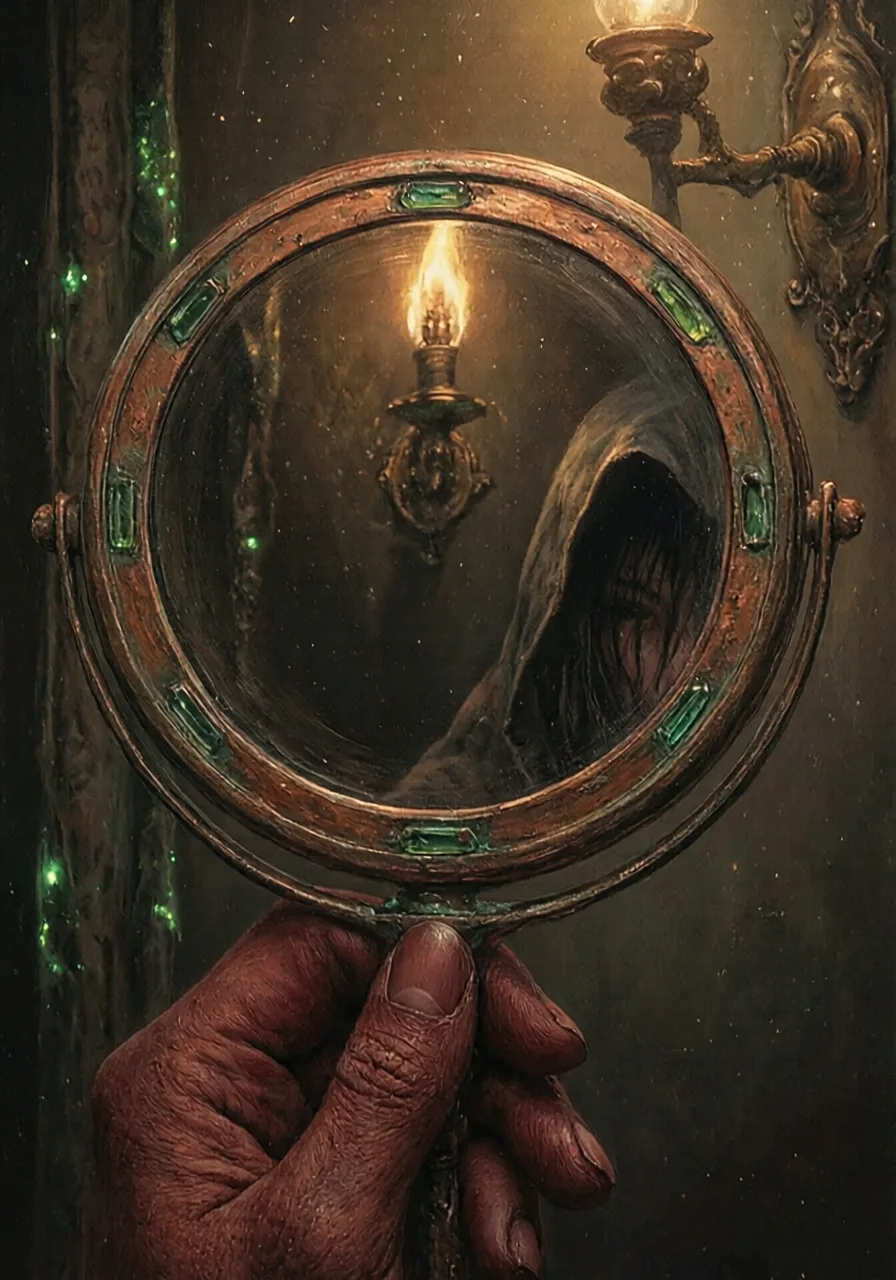
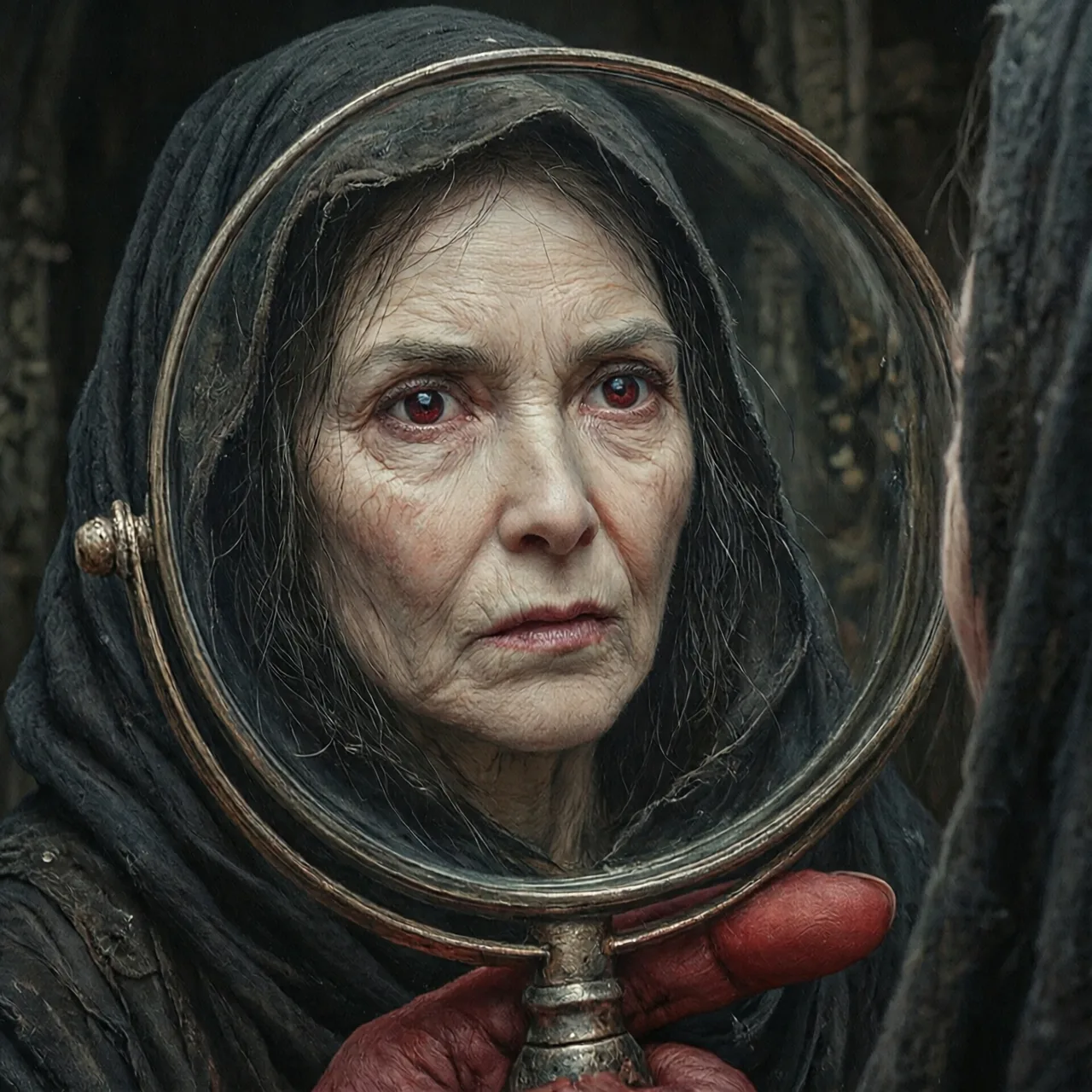
The sixth instrument was a small round mirror set in a copper frame inset with green glass at the cardinal points. Its smallest setting showed her what was a moment before. She had remembered, also without source, that the cost of the larger settings was years of her tenure. She accepted the cost in advance.
Page 5
The configuration the configuration required.
She set the mirror in the configuration the configuration required. She did what the configuration required. She arrived.
Page 6
Inside the archive's stone.
The room was inside the archive's stone. The room was not a room she had walked to from the corridor outside her alcove. The walls were stone. The floor was stone. The light came from brass desk-lamps set on each of the desks. The light was warm. The light was working light. There were many desks.
Page 7
The catalogue open before the scribe was hers.
In the third row, at the seventh desk, the catalogue open before the scribe was hers. She recognized the page. The page was entry 11,847. The scribe was working on the page. The scribe's hand was the hand whose stroke she had begun, in the recent months, to recognize from the edited pages of her own secure file.
The scribe was making a small correction near the bottom of the page. The date had read 'the eighty-third year of her tenure.' The scribe was changing it to read 'the eighty-fourth year of her tenure.' She knew, from the secondary backup, that the date she had filed was the eighty-third. The world had become a different thing in that respect. The page was being brought into accuracy with the world the world had become. She did not speak to the scribe. She walked on.
Page 8
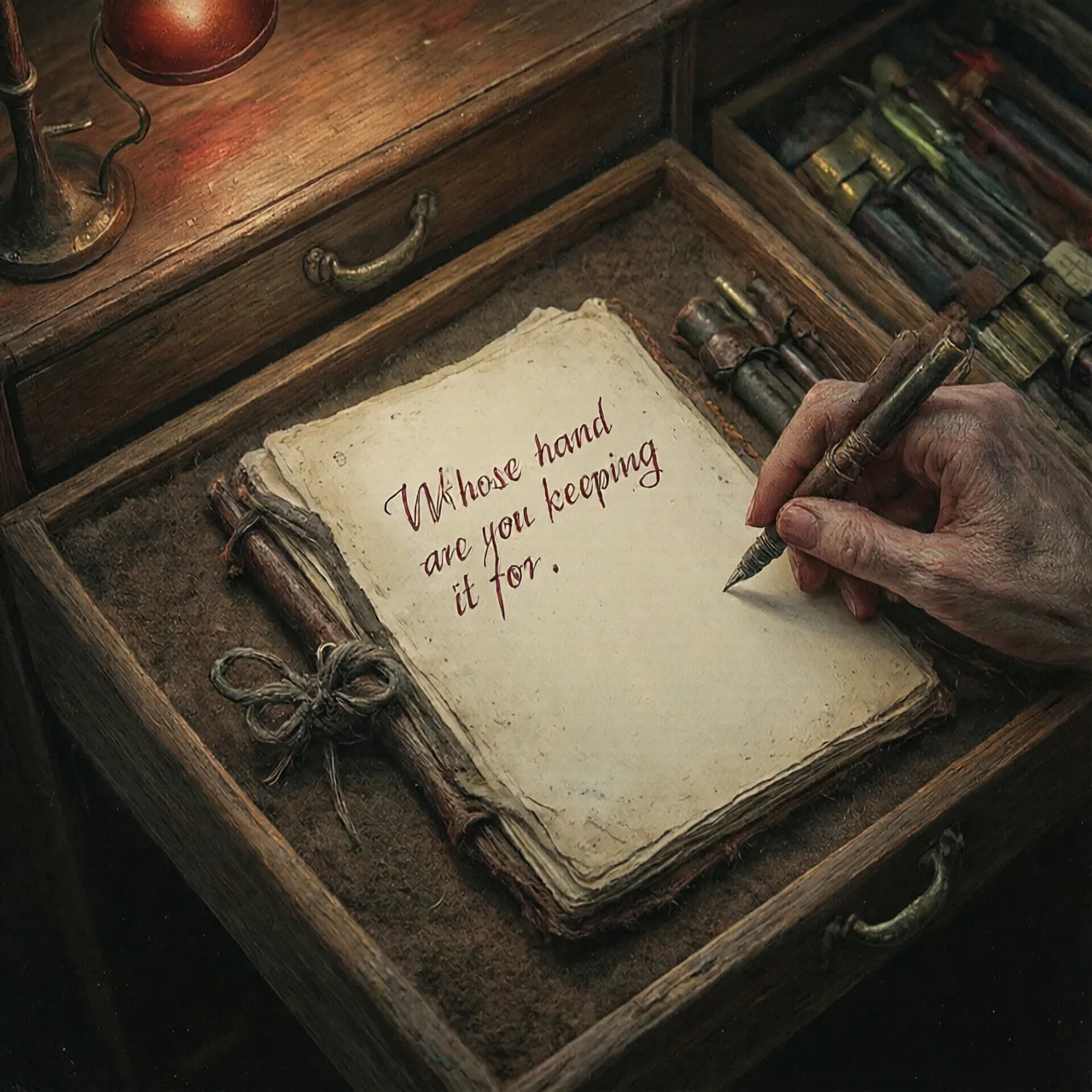
Whose hand are you keeping it for.
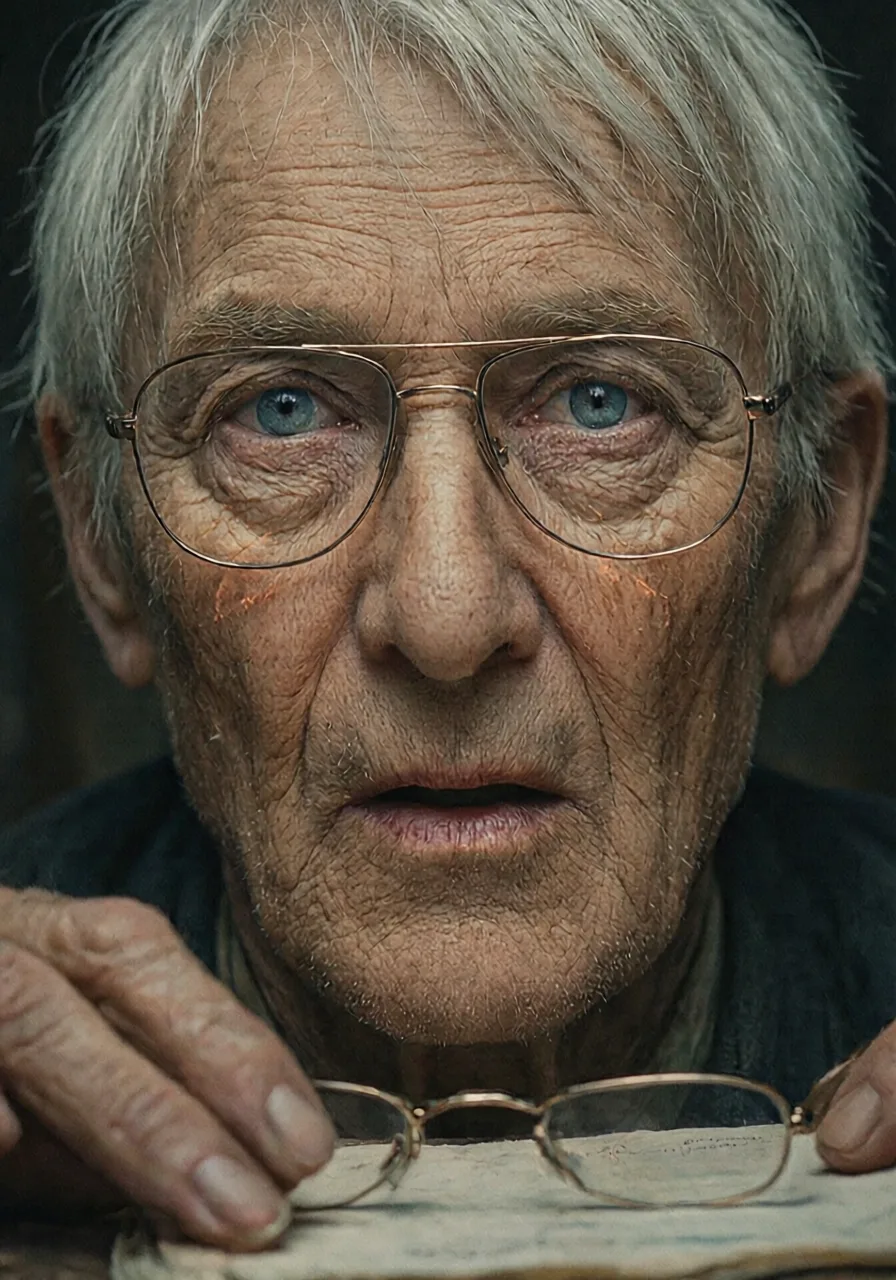
At the far end of the room sat the master-scribe. He was an old man. He wore a plain working tunic of dark wool, the cuffs rolled at the wrist, no apron, no other ornament. He had brass-rimmed reading glasses low on his nose. He looked up when she reached his desk. He did not seem surprised.
He set down the brass-nibbed pen. He took off the reading glasses and set them on the folio he had been working. He looked at her. She did not speak. She did not ask. She held the discipline. He spoke.
The Master-ScribeWhose hand are you keeping it for.
Page 9
Her face was older.
She arrived at the desk. She arrived in the configuration she had set the mirror in, which was the configuration the configuration required and which she did not catalogue. The mirror was on the desk. The mirror was cool. The flame in the lamp was the flame she had set it to.
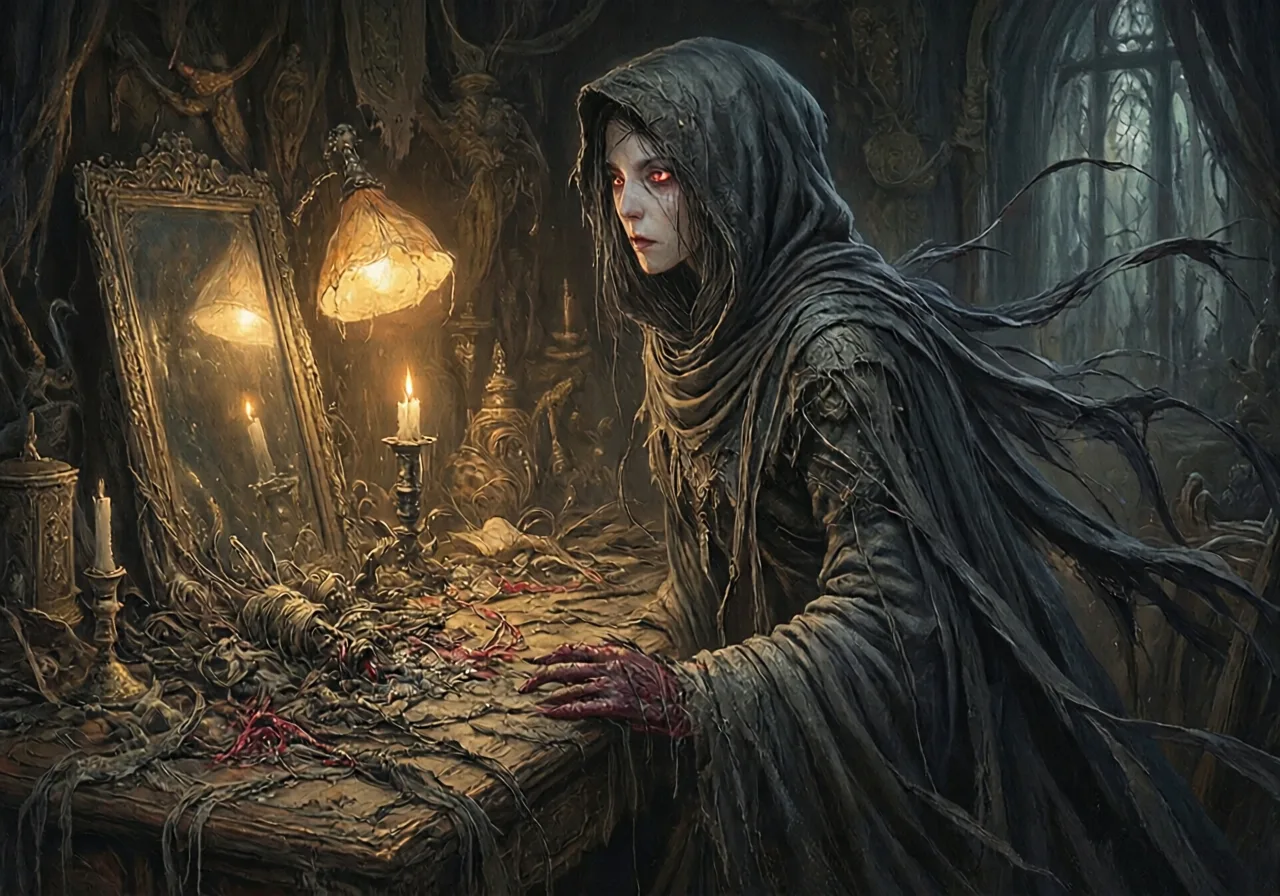
She walked to the small mirror she keeps in the alcove for the trimming of the lamp. She looked at her face. Her face was older. The skin around her eyes had fine lines that had not been there when she set the configuration up. Her dark hair had a few thin streaks of grey along the temple. Her eyes were the same crimson red. The change was several years' worth of the face. She did not catalogue the change. She filed it without comment.
Page 10
She wrote the entry.
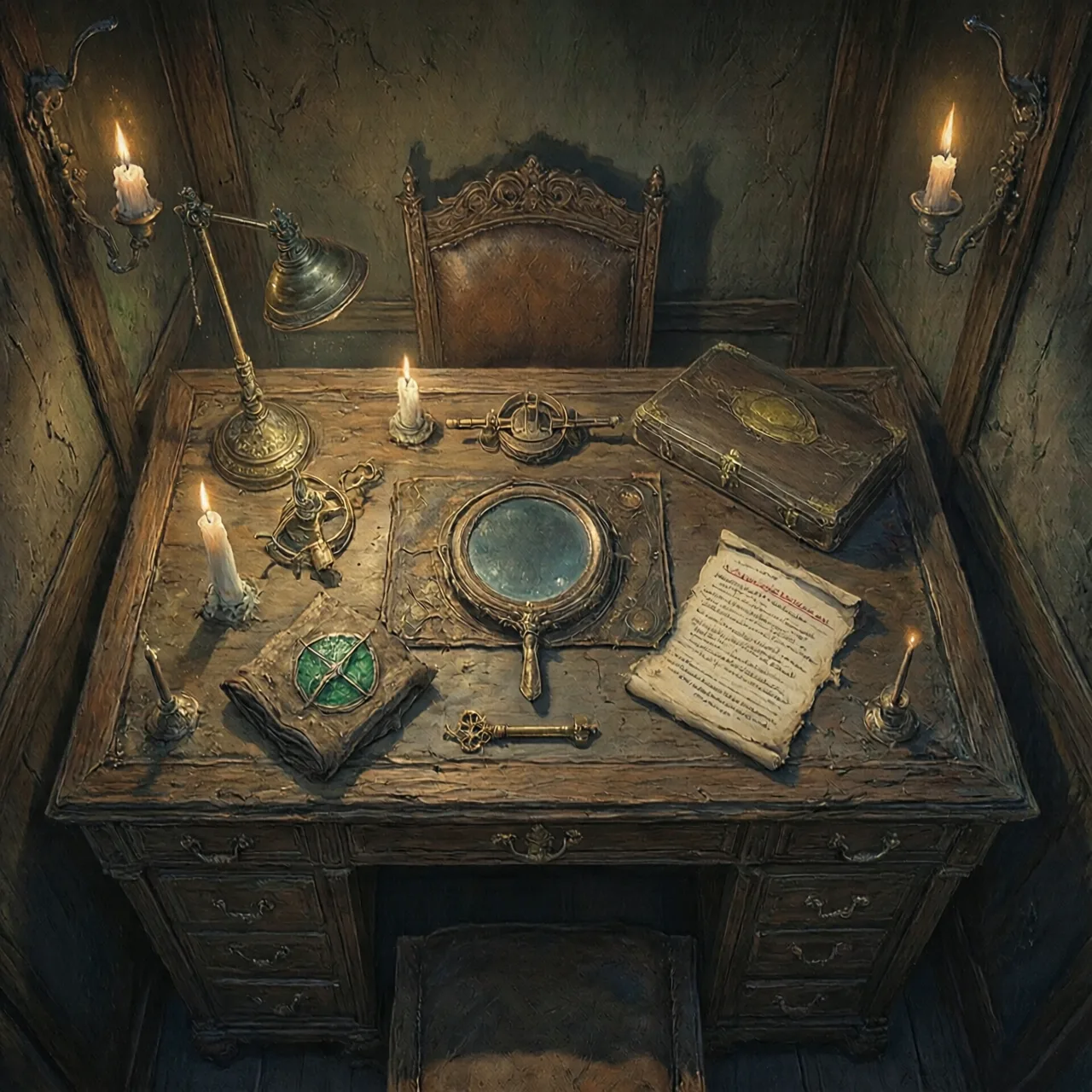
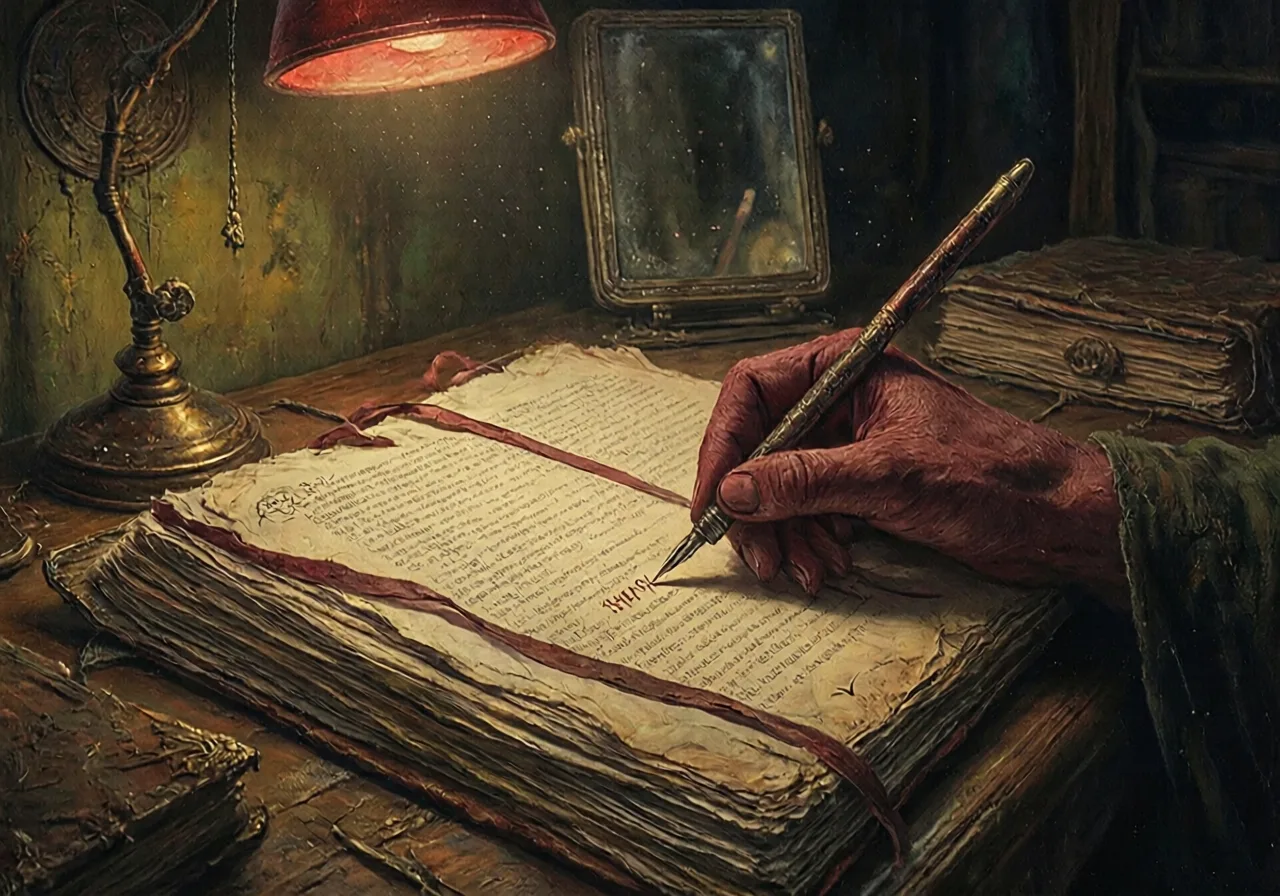
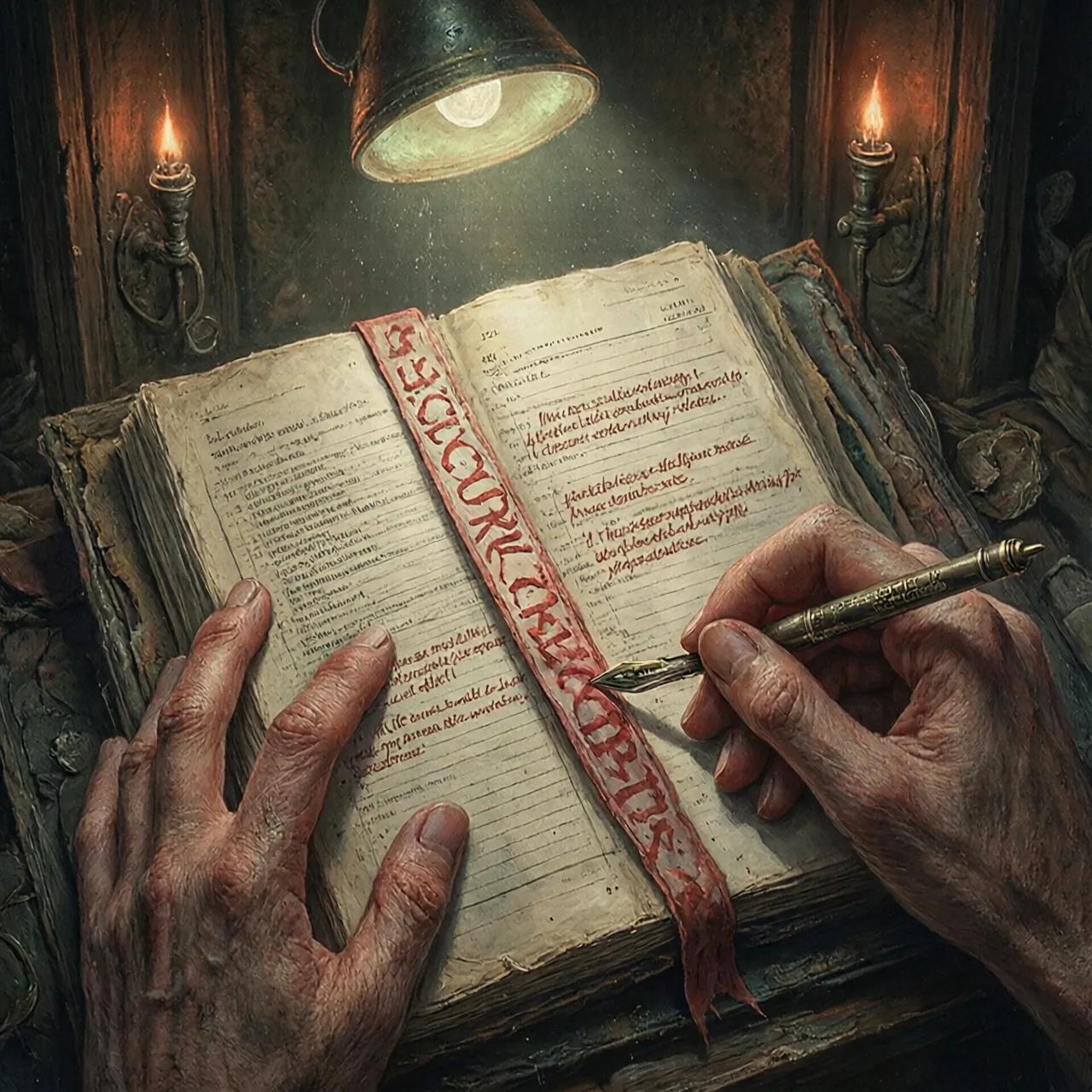
She wrote the entry. She wrote it in the public catalogue first, in the hand the catalogue requires, transcribing the discrepancies and the dates and the rate of approach toward the secondary backup. She wrote until the section requiring the conversation. She drew the page through the secure ribbon. She continued the entry on the page beyond the ribbon, in the hand that does not appear in the public catalogue.
She drew, from the locked drawer, a folio she had not used. She opened the folio to its first page. The page was empty. She wrote, on the page, the line he had asked. She did not write an annotation beneath it. She did not write a date. She did not write an entry number. She wrote only the line. She closed the folio. She placed it in the slot of the locked drawer where she keeps entries she does not re-open.
Page 11
I have not been told for whom.
The entry's closing line in the public hand reads: the rate of editing has not slowed in the months since. She drew the page through the secure ribbon. The closing line in the private hand reads: I have been keeping the catalogue. I have not been told for whom. She set the stylus down a third time. The folio has one page. The page has one line. The line is the question. The line is not answered. The page is filed.
— / —
narration auto-scrolls the prose
Section 0Frontmatter
# The Amendment
From the Catalogue of the Sixteenth Archivist, entry 13,221. Provenance: the secure-file copy of entry 12,107, in which the discrepancy was first observed; the secondary backup of the same entry, retrieved from the locked drawer for comparison; a measurement of the Guardian's left shoulder plate, taken on the morning of the day before her crossing, compared against the measurement she had filed in entry 12,107; the records of nineteen days of vigil over the catalogue, kept in the daybook; the sixth instrument retrieved from the keeper's case at entry 12,418; the configuration the configuration required, set up on the desk and not catalogued; one folio prepared after the return, holding one page, holding one line. Filed without delay.
She had filed the page. The page had not stayed filed.
Section 1Section 1
The discrepancy was first observed in entry 12,107.
The entry was sixty-three years old at the time of observation. She had filed it on the day of the descent. She had re-read it four hundred and twelve times since. Her recollection of the entry was precise to the level of the marginal hand — the folded margins, the secure-file ribbon, the private hand that does not appear in the public catalogue.
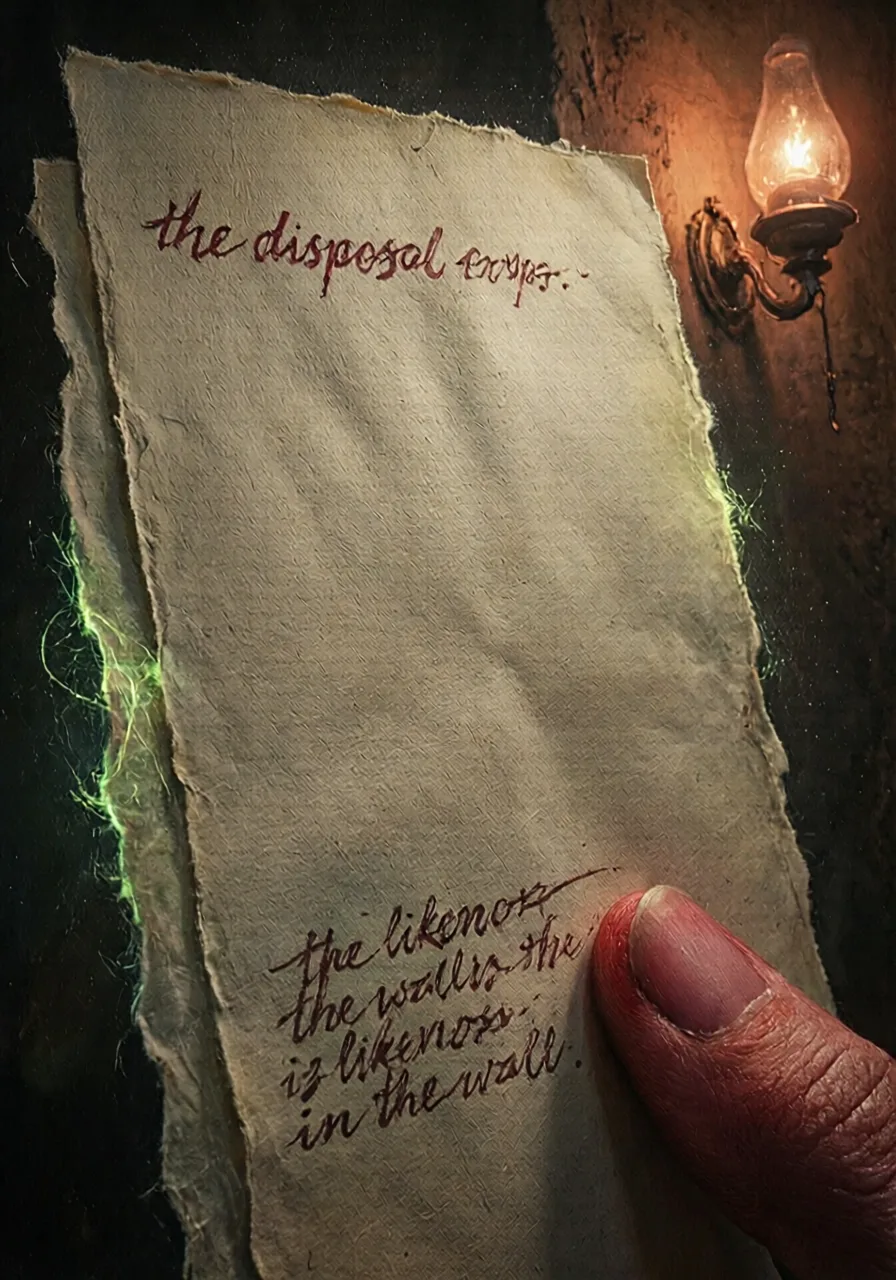
The page that had changed was a folded margin in the secure file. The margin had read, in her private hand:
the residue records the disposal corps. the disposal corps did not include me. the records do not contain my likeness. the likeness in the wall is the likeness in the wall.
The page now read:
the residue records the disposal corps. the likeness in the wall is the likeness in the wall.
The two sentences in the middle were not there.
The parchment in the place where the sentences had been showed no impression of writing — not the shadow of removed ink that an erased character leaves, not the fibre disturbance that a pumiced surface keeps. The page read as though the two sentences had never been written. The hand around them was hers. The ink was the ink she keeps. The flow of the surrounding text was unbroken by any seam.
She did not extend the entry. She set the page down. She walked to the corridor. She returned to the desk. The sentences had not returned.
Section 2Section 2
She tested.
She drew the secure-file copy of entry 12,107 from its slot. She compared it with the public-catalogue version. The public catalogue's version contained no marginal note at all on this matter. The public catalogue had never contained her marginal note; the marginal note belonged to the secure file alone. The discrepancy was not between public and secure.
She drew the secondary backup of the secure file from a different drawer. The secondary was the version of the page she had carried in her own hand for sixty-three years, kept apart for verification. The secondary was the version of last resort.
The secondary contained the two sentences.
The primary secure file did not.
The primary had been edited. The secondary had not.
She filed the secondary back in its drawer. She set the primary on her desk in the configuration she uses for entries she is checking against memory. She continued.
Section 3Section 3
She tested other entries.
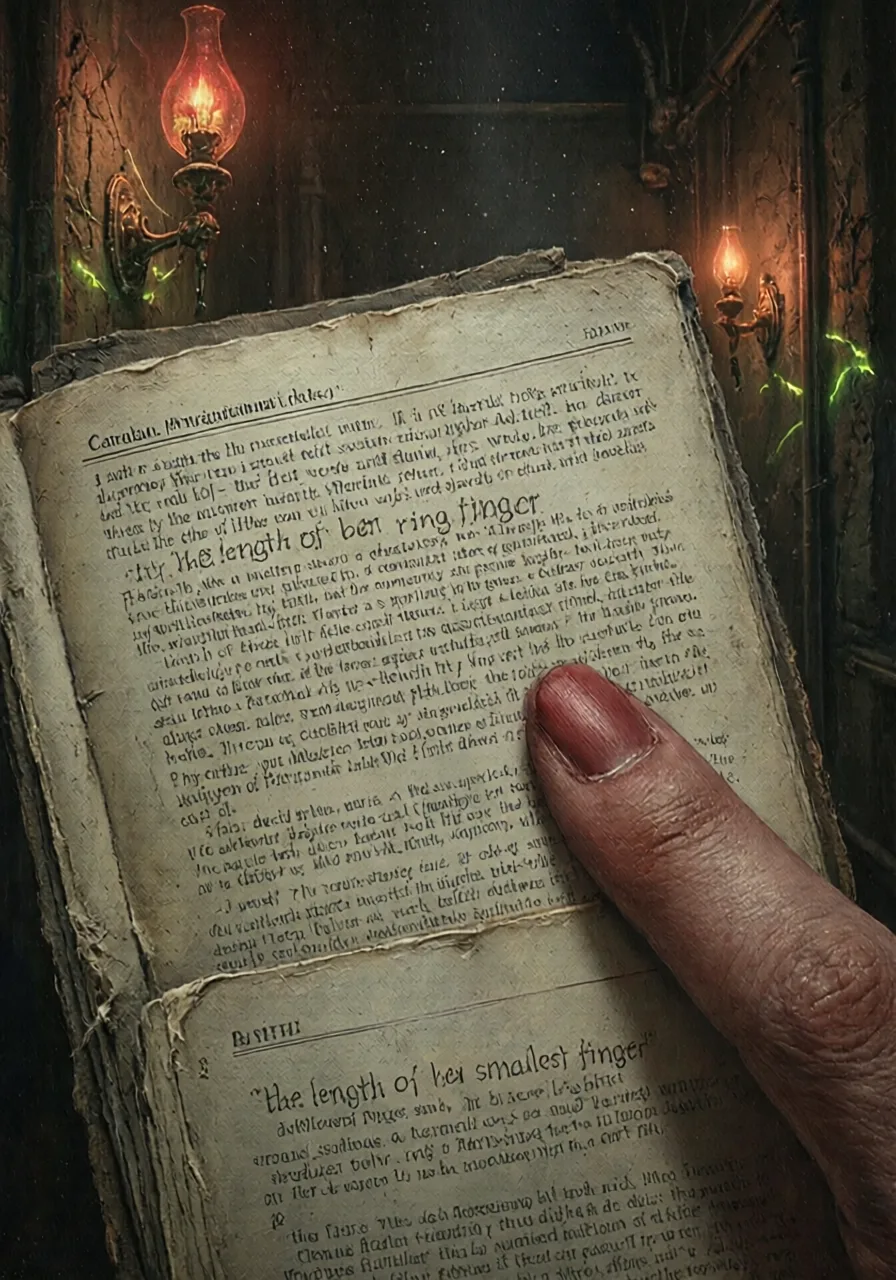
The Guardian's plate had been measured at entry 12,107. The measurement had read: short, the length of her smallest finger, fresh enough that the metal beneath the scuff had not yet returned to the temperature of the surrounding plate.
The primary secure file's version of the measurement now read: short, the length of her ring finger, fresh enough that the metal beneath the scuff had not yet returned to the temperature of the surrounding plate.
Smallest finger had become ring finger. The secondary backup retained smallest finger. Her recollection retained smallest finger. The Guardian's plate, which she had inspected on the morning of the day before this entry was filed, retained the scuff at the length of her smallest finger.
She filed the second discrepancy.
She tested twelve more entries over four months. Three of the twelve had been edited in the primary secure file. The edits were small. The edits were, in two of three cases, a correction of fact: the page had read one thing, and the world had since become a different thing in that respect, and the page had been brought into accuracy with the world.
In the third case the edit was not a correction. The edit was a removal — a sentence taken from the page. She could not determine, without more time, whether the removed sentence had been a fact she had filed or an annotation she had made. The hand around the removed sentence was hers either way.
She did not extend.
Section 4Section 4
She held vigil.
She set up the desk for the watch. She brought lamp oil for fourteen days. She kept the primary secure file open before her at the page she expected to be edited next. She did not sleep more than two hours at a stretch. She did not leave the alcove except for the corridor's needs.
The page on the desk did not change. She held vigil for nineteen days. The page she had set out was precisely as she had set it. The pages she had not opened were edited.
She held vigil a second time, with two pages open. Both remained as set. Three other pages were edited.
She held vigil a third time, with eight pages open. The eight remained. Six others were edited.
The edits did not occur in the room when she was watching.
She filed the conclusion.
Section 5Section 5
The thing she would not tolerate had not yet happened.
What she would not tolerate was the editing of the secondary backup. The secondary was where she filed what should not be opened by intent. The primary held the work; the secondary held the verifications. If the secondary were edited, the work would have no anchor and the catalogue would not be a catalogue.
The most recent edits had begun to touch the secure-file pages of the secondary backup's adjacent shelves. They had not touched the secondary itself. They were, by the rate of approach, eleven months from doing so.
She would not let the edits reach the secondary.
She had spent eleven months considering. She had exhausted what the catalogue could tell her about the editor. The catalogue did not contain the editor. The catalogue's silence on the editor was a silence the discipline of cataloguing could not be made to fill.
She drew, from the case the keeper had given her, the sixth instrument.
The sixth instrument was a small round mirror set in a copper frame inset with green glass at the cardinal points. She had used it twice in her tenure since the keeper had given it to her. The two prior uses were small. The sixth instrument's smallest setting showed her what was a moment before. The settings beyond the smallest she had remembered as available without remembering having tested them. The remembering was partial. She did not catalogue partial memories. She catalogued the instrument, and the smallest use of it, and let the rest stand.
She had remembered, also without source, that the cost of the larger settings was years of her tenure. The remembering was partial in the same way. She accepted the cost in advance. She did not file the cost.
She set the mirror in the configuration the configuration required. She did what the configuration required. She arrived.
Section 6Section 6
The room was inside the archive's stone.
The room was not a room she had walked to from the corridor outside her alcove. The room was the room she arrived at when the configuration was complete. The location of the room was the configuration. She did not catalogue the location.
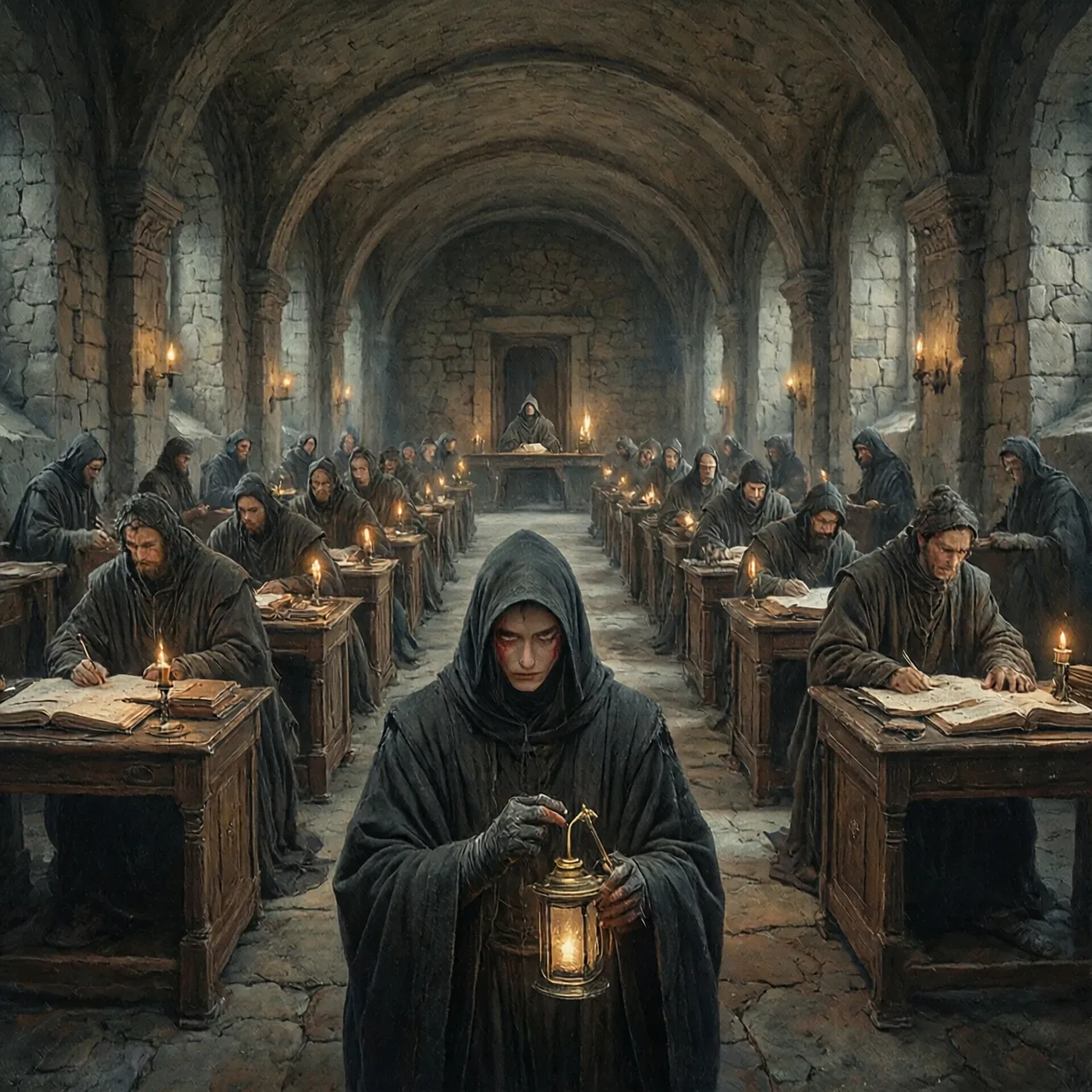
The room was a long room. The walls were stone. The floor was stone. The light came from brass desk-lamps set on each of the desks. The lamps burned an oil she did not know but recognized — the smell was the smell of oil that had been pressed from a plant the archive's botanical section catalogues under a heading she had never had cause to file from. The light was warm. The light was working light.
There were many desks.
The desks were arranged in three long rows along the length of the room. At each desk was a person. The people were working. Each person had open before them a folio, and beside the folio a smaller folio, and a brass-nibbed pen. The people wore plain working tunics, sleeves rolled at the wrist, no apron, no hood, no ceremony. They did not look up as she walked the rows.
Their hands bore a faint band of dried-memory colour at the wrist alone — lighter than her own dye, less penetrating, the mark of the work of correction. The mark was on each hand at every desk. The mark was the same mark on every hand.
The folios were catalogues.
She walked the rows. She did not stop at any desk. She did not look closely at any folio. The folios were not hers.
She glanced once, in passing, at the catalogue open before the third scribe in the second row. The hand on the open page was a hand she had not seen. The cataloguer's name was at the top of the page in a hand she had not seen either. The name was a name she did not file. She filed the existence of the name. She did not extend the entry on the name.
She walked the third row.
Section 7Section 7
In the third row, at the seventh desk, the catalogue open before the scribe was hers.
She recognized the page. The page was entry 11,847.
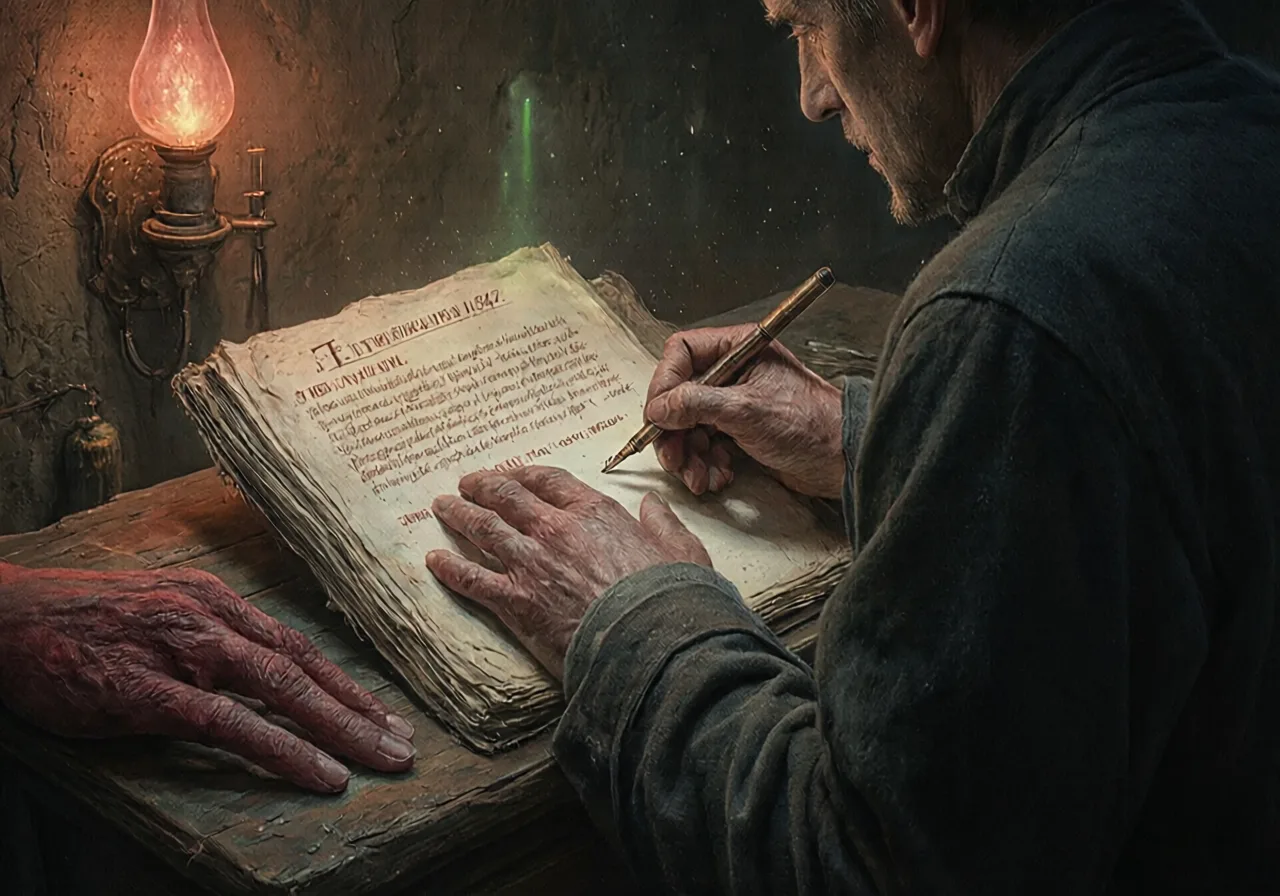
The scribe was working on the page. The scribe's hand was not hers — but it was the hand whose stroke she had begun, in the recent months, to recognize from the edited pages of her own secure file. It was the editor's hand. She had been seeing it on her own pages, in the marks her own hand had not made. Here, on the desk before her, the editor's hand was the scribe's hand, working a brass-nibbed pen.
The scribe was making a small correction near the bottom of the page. The correction was the changing of a date. The date had read, in the page she had filed, the eighty-third year of her tenure. The scribe was changing it to read the eighty-fourth year of her tenure.
She knew, from the secondary backup of entry 11,847, that the date she had filed was the eighty-third year. She knew, from her own recollection, that the year of the event had been the eighty-third. The scribe was correcting a true date to a different true date. The world had become different in that respect. The page was being brought into accuracy with the world the world had become.
She watched. The scribe finished the correction. The scribe set down the brass-nibbed pen. The scribe turned to the next page and began checking it.
The scribe did not look at her.
She did not speak to the scribe.
She walked on.
Section 8Section 8
At the far end of the room sat the master-scribe.
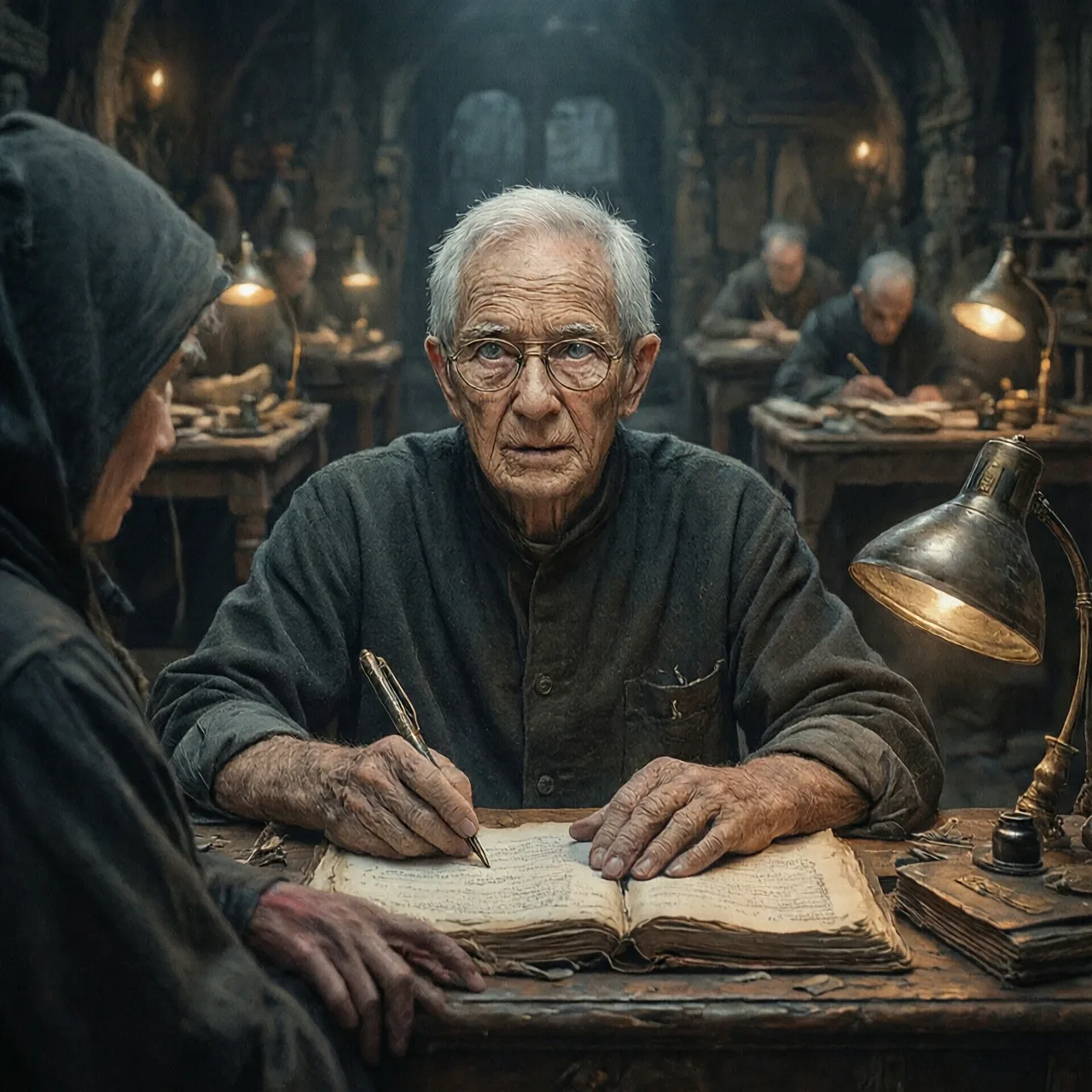
He was an old man. He wore a plain working tunic of dark wool, the cuffs rolled at the wrist, no apron, no other ornament. He had brass-rimmed reading glasses low on his nose. His hands were thin and lined with the wear of long bench-work. The wear at the wrist was the same band of dried-memory colour as the others wore, but darker — almost (but not quite) as deep as her own dye. His hair was white and had been white for some time. His face was the face of a man who has been at his desk for fifty years.
He looked up when she reached his desk. He did not seem surprised.
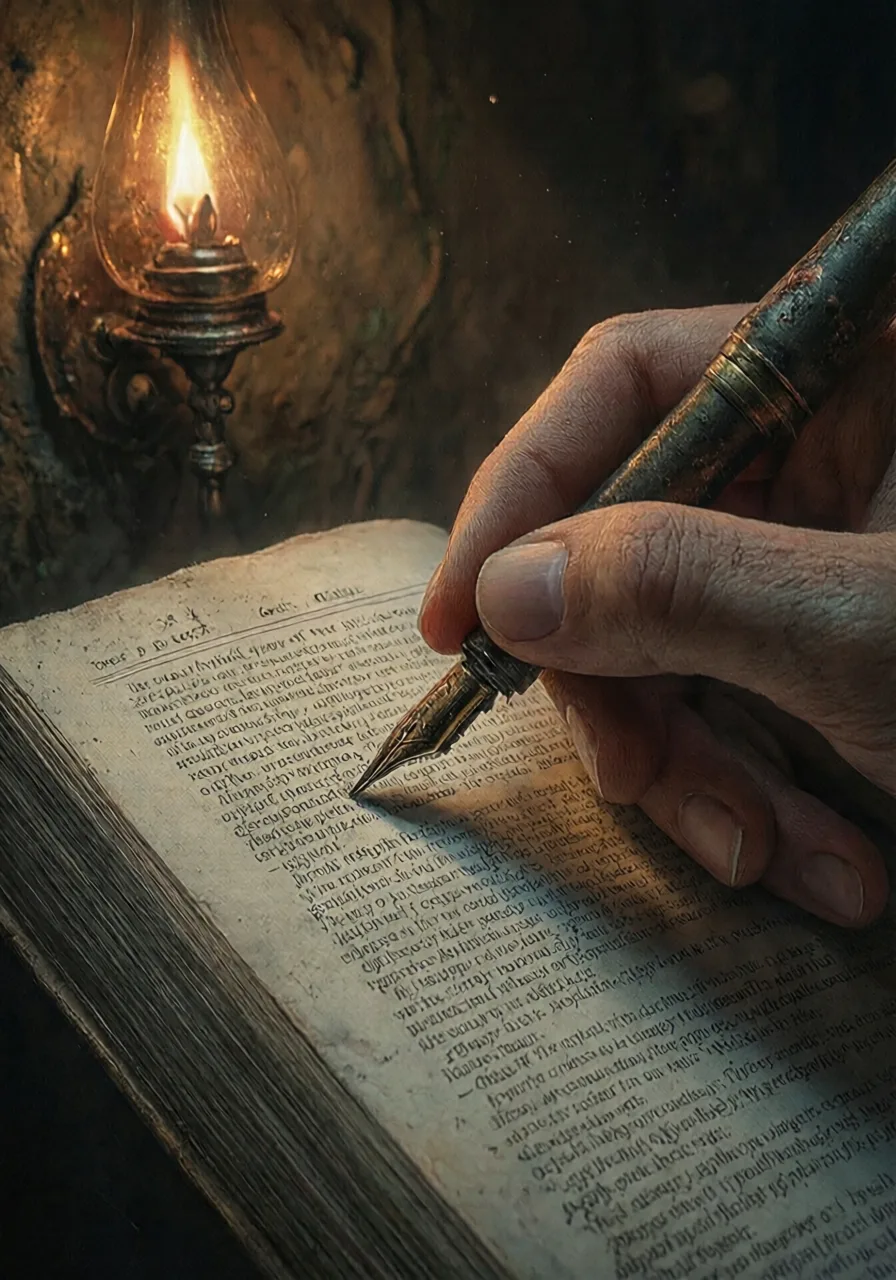
He set down the brass-nibbed pen. He took off the reading glasses and set them on the folio he had been working. He looked at her.
She did not speak. She did not ask. She held the discipline.
He spoke.
Whose hand are you keeping it for, he said.
He did not phrase it as a question. He did not raise his voice at the end of the line. The line was a line a man states.
He waited an interval she did not measure. She did not answer.
He took up the reading glasses. He set them back on the folio. He took up the brass-nibbed pen. He returned to his work.
She withdrew.
Section 9Section 9
She arrived at the desk.
She arrived in the configuration she had set the mirror in, which was the configuration the configuration required and which she did not catalogue. The mirror was on the desk. The mirror was cool. The flame in the lamp was the flame she had set it to.
She set the mirror down.
She walked to the small mirror she keeps in the alcove for the trimming of the lamp. She looked at her face.
Her face was older.
The skin around her eyes had fine lines that had not been there when she set the configuration up. The skin at the corners of her mouth had the small fold that comes with use over years. Her dark hair, where it fell from beneath the hood, had a few thin streaks of grey along the temple. Her eyes were the same crimson red. Her hands were the same matte crimson dye. The change was in the face. The change was several years' worth of the face.
She did not catalogue the change. She filed it without comment.
She set the trimming-mirror back in its place.
Section 10Section 10
She wrote the entry.
She wrote it in the public catalogue first, in the hand the catalogue requires, transcribing the discrepancies and the dates and the rate of approach toward the secondary backup. She wrote until the section requiring the conversation. She did not record the conversation in the public catalogue. She drew the page through the secure ribbon. She continued the entry on the page beyond the ribbon, in the hand that does not appear in the public catalogue. She wrote what she had seen of the room and the desks and the working light. She did not write the cataloguer's name she had glanced at. She did not describe the master-scribe.
She wrote down that he had asked her one thing.
She wrote down what he had asked.
She set the stylus down.
She drew, from the locked drawer, a folio she had not used. She opened the folio to its first page. The page was empty. She wrote, on the page, the line he had asked. She did not write an annotation beneath it. She did not write a date. She did not write an entry number. She wrote only the line.
She closed the folio. She placed it in the slot of the locked drawer where she keeps entries she does not re-open. The folio held one page. The page held one line. The line was the question.
She set the stylus down a second time.
Section 11Section 11
She did not ask the question of the catalogue.
She did not extend the question into a working hypothesis. She did not file the question under a heading the catalogue would name.
She returned to the public-catalogue entry and finished it.
The entry's closing line in the public hand reads: the rate of editing has not slowed in the months since.
She drew the page through the secure ribbon. She wrote the closing line in the private hand.
The closing line in the private hand reads: I have been keeping the catalogue. I have not been told for whom.
She set the stylus down a third time.
Entry 13,221, final annotation. Folded into the binding.
"The folio has one page. The page has one line. The line is the question. The line is not answered. The page is filed.
I will not extend the entry on this matter."
Section 0Frontmatter
# The Amendment
From the Catalogue of the Sixteenth Archivist, entry 13,221. Provenance: the secure-file copy of entry 12,107, in which the discrepancy was first observed; the secondary backup of the same entry, retrieved from the locked drawer for comparison; a measurement of the Guardian's left shoulder plate, taken on the morning of the day before her crossing, compared against the measurement she had filed in entry 12,107; the records of nineteen days of vigil over the catalogue, kept in the daybook; the sixth instrument retrieved from the keeper's case at entry 12,418; the configuration the configuration required, set up on the desk and not catalogued; one folio prepared after the return, holding one page, holding one line. Filed without delay.
She had filed the page. The page had not stayed filed.
Section 1Section 1
The discrepancy was first observed in entry 12,107.
The entry was sixty-three years old at the time of observation. She had filed it on the day of the descent. She had re-read it four hundred and twelve times since. Her recollection of the entry was precise to the level of the marginal hand — the folded margins, the secure-file ribbon, the private hand that does not appear in the public catalogue.
The page that had changed was a folded margin in the secure file. The margin had read, in her private hand:
the residue records the disposal corps. the disposal corps did not include me. the records do not contain my likeness. the likeness in the wall is the likeness in the wall.
The page now read:
the residue records the disposal corps. the likeness in the wall is the likeness in the wall.
The two sentences in the middle were not there.
The parchment in the place where the sentences had been showed no impression of writing — not the shadow of removed ink that an erased character leaves, not the fibre disturbance that a pumiced surface keeps. The page read as though the two sentences had never been written. The hand around them was hers. The ink was the ink she keeps. The flow of the surrounding text was unbroken by any seam.
She did not extend the entry. She set the page down. She walked to the corridor. She returned to the desk. The sentences had not returned.
Section 2Section 2
She tested.
She drew the secure-file copy of entry 12,107 from its slot. She compared it with the public-catalogue version. The public catalogue's version contained no marginal note at all on this matter. The public catalogue had never contained her marginal note; the marginal note belonged to the secure file alone. The discrepancy was not between public and secure.
She drew the secondary backup of the secure file from a different drawer. The secondary was the version of the page she had carried in her own hand for sixty-three years, kept apart for verification. The secondary was the version of last resort.
The secondary contained the two sentences.
The primary secure file did not.
The primary had been edited. The secondary had not.
She filed the secondary back in its drawer. She set the primary on her desk in the configuration she uses for entries she is checking against memory. She continued.
Section 3Section 3
She tested other entries.
The Guardian's plate had been measured at entry 12,107. The measurement had read: short, the length of her smallest finger, fresh enough that the metal beneath the scuff had not yet returned to the temperature of the surrounding plate.
The primary secure file's version of the measurement now read: short, the length of her ring finger, fresh enough that the metal beneath the scuff had not yet returned to the temperature of the surrounding plate.
Smallest finger had become ring finger. The secondary backup retained smallest finger. Her recollection retained smallest finger. The Guardian's plate, which she had inspected on the morning of the day before this entry was filed, retained the scuff at the length of her smallest finger.
She filed the second discrepancy.
She tested twelve more entries over four months. Three of the twelve had been edited in the primary secure file. The edits were small. The edits were, in two of three cases, a correction of fact: the page had read one thing, and the world had since become a different thing in that respect, and the page had been brought into accuracy with the world.
In the third case the edit was not a correction. The edit was a removal — a sentence taken from the page. She could not determine, without more time, whether the removed sentence had been a fact she had filed or an annotation she had made. The hand around the removed sentence was hers either way.
She did not extend.
Section 4Section 4
She held vigil.
She set up the desk for the watch. She brought lamp oil for fourteen days. She kept the primary secure file open before her at the page she expected to be edited next. She did not sleep more than two hours at a stretch. She did not leave the alcove except for the corridor's needs.
The page on the desk did not change. She held vigil for nineteen days. The page she had set out was precisely as she had set it. The pages she had not opened were edited.
She held vigil a second time, with two pages open. Both remained as set. Three other pages were edited.
She held vigil a third time, with eight pages open. The eight remained. Six others were edited.
The edits did not occur in the room when she was watching.
She filed the conclusion.
Section 5Section 5
The thing she would not tolerate had not yet happened.
What she would not tolerate was the editing of the secondary backup. The secondary was where she filed what should not be opened by intent. The primary held the work; the secondary held the verifications. If the secondary were edited, the work would have no anchor and the catalogue would not be a catalogue.
The most recent edits had begun to touch the secure-file pages of the secondary backup's adjacent shelves. They had not touched the secondary itself. They were, by the rate of approach, eleven months from doing so.
She would not let the edits reach the secondary.
She had spent eleven months considering. She had exhausted what the catalogue could tell her about the editor. The catalogue did not contain the editor. The catalogue's silence on the editor was a silence the discipline of cataloguing could not be made to fill.
She drew, from the case the keeper had given her, the sixth instrument.
The sixth instrument was a small round mirror set in a copper frame inset with green glass at the cardinal points. She had used it twice in her tenure since the keeper had given it to her. The two prior uses were small. The sixth instrument's smallest setting showed her what was a moment before. The settings beyond the smallest she had remembered as available without remembering having tested them. The remembering was partial. She did not catalogue partial memories. She catalogued the instrument, and the smallest use of it, and let the rest stand.
She had remembered, also without source, that the cost of the larger settings was years of her tenure. The remembering was partial in the same way. She accepted the cost in advance. She did not file the cost.
She set the mirror in the configuration the configuration required. She did what the configuration required. She arrived.
Section 6Section 6
The room was inside the archive's stone.
The room was not a room she had walked to from the corridor outside her alcove. The room was the room she arrived at when the configuration was complete. The location of the room was the configuration. She did not catalogue the location.
The room was a long room. The walls were stone. The floor was stone. The light came from brass desk-lamps set on each of the desks. The lamps burned an oil she did not know but recognized — the smell was the smell of oil that had been pressed from a plant the archive's botanical section catalogues under a heading she had never had cause to file from. The light was warm. The light was working light.
There were many desks.
The desks were arranged in three long rows along the length of the room. At each desk was a person. The people were working. Each person had open before them a folio, and beside the folio a smaller folio, and a brass-nibbed pen. The people wore plain working tunics, sleeves rolled at the wrist, no apron, no hood, no ceremony. They did not look up as she walked the rows.
Their hands bore a faint band of dried-memory colour at the wrist alone — lighter than her own dye, less penetrating, the mark of the work of correction. The mark was on each hand at every desk. The mark was the same mark on every hand.
The folios were catalogues.
She walked the rows. She did not stop at any desk. She did not look closely at any folio. The folios were not hers.
She glanced once, in passing, at the catalogue open before the third scribe in the second row. The hand on the open page was a hand she had not seen. The cataloguer's name was at the top of the page in a hand she had not seen either. The name was a name she did not file. She filed the existence of the name. She did not extend the entry on the name.
She walked the third row.
Section 7Section 7
In the third row, at the seventh desk, the catalogue open before the scribe was hers.
She recognized the page. The page was entry 11,847.
The scribe was working on the page. The scribe's hand was not hers — but it was the hand whose stroke she had begun, in the recent months, to recognize from the edited pages of her own secure file. It was the editor's hand. She had been seeing it on her own pages, in the marks her own hand had not made. Here, on the desk before her, the editor's hand was the scribe's hand, working a brass-nibbed pen.
The scribe was making a small correction near the bottom of the page. The correction was the changing of a date. The date had read, in the page she had filed, the eighty-third year of her tenure. The scribe was changing it to read the eighty-fourth year of her tenure.
She knew, from the secondary backup of entry 11,847, that the date she had filed was the eighty-third year. She knew, from her own recollection, that the year of the event had been the eighty-third. The scribe was correcting a true date to a different true date. The world had become different in that respect. The page was being brought into accuracy with the world the world had become.
She watched. The scribe finished the correction. The scribe set down the brass-nibbed pen. The scribe turned to the next page and began checking it.
The scribe did not look at her.
She did not speak to the scribe.
She walked on.
Section 8Section 8
At the far end of the room sat the master-scribe.
He was an old man. He wore a plain working tunic of dark wool, the cuffs rolled at the wrist, no apron, no other ornament. He had brass-rimmed reading glasses low on his nose. His hands were thin and lined with the wear of long bench-work. The wear at the wrist was the same band of dried-memory colour as the others wore, but darker — almost (but not quite) as deep as her own dye. His hair was white and had been white for some time. His face was the face of a man who has been at his desk for fifty years.
He looked up when she reached his desk. He did not seem surprised.
He set down the brass-nibbed pen. He took off the reading glasses and set them on the folio he had been working. He looked at her.
She did not speak. She did not ask. She held the discipline.
He spoke.
Whose hand are you keeping it for, he said.
He did not phrase it as a question. He did not raise his voice at the end of the line. The line was a line a man states.
He waited an interval she did not measure. She did not answer.
He took up the reading glasses. He set them back on the folio. He took up the brass-nibbed pen. He returned to his work.
She withdrew.
Section 9Section 9
She arrived at the desk.
She arrived in the configuration she had set the mirror in, which was the configuration the configuration required and which she did not catalogue. The mirror was on the desk. The mirror was cool. The flame in the lamp was the flame she had set it to.
She set the mirror down.
She walked to the small mirror she keeps in the alcove for the trimming of the lamp. She looked at her face.
Her face was older.
The skin around her eyes had fine lines that had not been there when she set the configuration up. The skin at the corners of her mouth had the small fold that comes with use over years. Her dark hair, where it fell from beneath the hood, had a few thin streaks of grey along the temple. Her eyes were the same crimson red. Her hands were the same matte crimson dye. The change was in the face. The change was several years' worth of the face.
She did not catalogue the change. She filed it without comment.
She set the trimming-mirror back in its place.
Section 10Section 10
She wrote the entry.
She wrote it in the public catalogue first, in the hand the catalogue requires, transcribing the discrepancies and the dates and the rate of approach toward the secondary backup. She wrote until the section requiring the conversation. She did not record the conversation in the public catalogue. She drew the page through the secure ribbon. She continued the entry on the page beyond the ribbon, in the hand that does not appear in the public catalogue. She wrote what she had seen of the room and the desks and the working light. She did not write the cataloguer's name she had glanced at. She did not describe the master-scribe.
She wrote down that he had asked her one thing.
She wrote down what he had asked.
She set the stylus down.
She drew, from the locked drawer, a folio she had not used. She opened the folio to its first page. The page was empty. She wrote, on the page, the line he had asked. She did not write an annotation beneath it. She did not write a date. She did not write an entry number. She wrote only the line.
She closed the folio. She placed it in the slot of the locked drawer where she keeps entries she does not re-open. The folio held one page. The page held one line. The line was the question.
She set the stylus down a second time.
Section 11Section 11
She did not ask the question of the catalogue.
She did not extend the question into a working hypothesis. She did not file the question under a heading the catalogue would name.
She returned to the public-catalogue entry and finished it.
The entry's closing line in the public hand reads: the rate of editing has not slowed in the months since.
She drew the page through the secure ribbon. She wrote the closing line in the private hand.
The closing line in the private hand reads: I have been keeping the catalogue. I have not been told for whom.
She set the stylus down a third time.
Entry 13,221, final annotation. Folded into the binding.
"The folio has one page. The page has one line. The line is the question. The line is not answered. The page is filed.
I will not extend the entry on this matter."
Page 1
She had filed the page. The page had not stayed filed.
The discrepancy was first observed in entry 12,107. The page that had changed was a folded margin in the secure file. The two sentences in the middle were not there. The parchment in the place where the sentences had been showed no impression of writing. The hand around them was hers. The ink was the ink she keeps.
She did not extend the entry. She set the page down. She walked to the corridor. She returned to the desk. The sentences had not returned.
Page 2
She tested.
She tested. She drew the secure-file copy. She drew the secondary backup. The primary had been edited. The secondary had not. She filed the secondary back in its drawer. She continued.
Smallest finger had become ring finger. The secondary backup retained smallest finger. Her recollection retained smallest finger. The Guardian's plate, which she had inspected on the morning of the day before this entry, retained the scuff at the length of her smallest finger. The world had become a different thing in that respect, and the page had been brought into accuracy with the world.
Page 3
She held vigil.
She held vigil. She set up the desk for the watch. She brought lamp oil for fourteen days. She did not sleep more than two hours at a stretch. The page on the desk did not change. The pages she had not opened were edited.
She held vigil three times. The pages she had set out remained. The pages she had not opened were edited. The edits did not occur in the room when she was watching. She filed the conclusion.
Page 4
The sixth instrument.
She drew, from the case the keeper had given her, the sixth instrument. She had used it twice in her tenure since the keeper had given it to her. The two prior uses were small. The settings beyond the smallest she had remembered as available without remembering having tested them.
The sixth instrument was a small round mirror set in a copper frame inset with green glass at the cardinal points. Its smallest setting showed her what was a moment before. She had remembered, also without source, that the cost of the larger settings was years of her tenure. She accepted the cost in advance.
Page 5
The configuration the configuration required.
She set the mirror in the configuration the configuration required. She did what the configuration required. She arrived.
Page 6
Inside the archive's stone.
The room was inside the archive's stone. The room was not a room she had walked to from the corridor outside her alcove. The walls were stone. The floor was stone. The light came from brass desk-lamps set on each of the desks. The light was warm. The light was working light. There were many desks.
Page 7
The catalogue open before the scribe was hers.
In the third row, at the seventh desk, the catalogue open before the scribe was hers. She recognized the page. The page was entry 11,847. The scribe was working on the page. The scribe's hand was the hand whose stroke she had begun, in the recent months, to recognize from the edited pages of her own secure file.
The scribe was making a small correction near the bottom of the page. The date had read 'the eighty-third year of her tenure.' The scribe was changing it to read 'the eighty-fourth year of her tenure.' She knew, from the secondary backup, that the date she had filed was the eighty-third. The world had become a different thing in that respect. The page was being brought into accuracy with the world the world had become. She did not speak to the scribe. She walked on.
Page 8
Whose hand are you keeping it for.
At the far end of the room sat the master-scribe. He was an old man. He wore a plain working tunic of dark wool, the cuffs rolled at the wrist, no apron, no other ornament. He had brass-rimmed reading glasses low on his nose. He looked up when she reached his desk. He did not seem surprised.
He set down the brass-nibbed pen. He took off the reading glasses and set them on the folio he had been working. He looked at her. She did not speak. She did not ask. She held the discipline. He spoke.
The Master-ScribeWhose hand are you keeping it for.
Page 9
Her face was older.
She arrived at the desk. She arrived in the configuration she had set the mirror in, which was the configuration the configuration required and which she did not catalogue. The mirror was on the desk. The mirror was cool. The flame in the lamp was the flame she had set it to.
She walked to the small mirror she keeps in the alcove for the trimming of the lamp. She looked at her face. Her face was older. The skin around her eyes had fine lines that had not been there when she set the configuration up. Her dark hair had a few thin streaks of grey along the temple. Her eyes were the same crimson red. The change was several years' worth of the face. She did not catalogue the change. She filed it without comment.
Page 10
She wrote the entry.
She wrote the entry. She wrote it in the public catalogue first, in the hand the catalogue requires, transcribing the discrepancies and the dates and the rate of approach toward the secondary backup. She wrote until the section requiring the conversation. She drew the page through the secure ribbon. She continued the entry on the page beyond the ribbon, in the hand that does not appear in the public catalogue.
She drew, from the locked drawer, a folio she had not used. She opened the folio to its first page. The page was empty. She wrote, on the page, the line he had asked. She did not write an annotation beneath it. She did not write a date. She did not write an entry number. She wrote only the line. She closed the folio. She placed it in the slot of the locked drawer where she keeps entries she does not re-open.
Page 11
I have not been told for whom.
The entry's closing line in the public hand reads: the rate of editing has not slowed in the months since. She drew the page through the secure ribbon. The closing line in the private hand reads: I have been keeping the catalogue. I have not been told for whom. She set the stylus down a third time. The folio has one page. The page has one line. The line is the question. The line is not answered. The page is filed.
Listen ModeClick a section to begin listening
The chronicle plays section by section in the Librarian's voice. As each section plays, the corresponding pages of the comic are highlighted. Switch to Scroll, Flip, Prose, or Split at any time — the audio continues, and you can follow visually.
Section 0Frontmatter
# The Amendment
From the Catalogue of the Sixteenth Archivist, entry 13,221. Provenance: the secure-file copy of entry 12,107, in which the discrepancy was first observed; the secondary backup of the same entry, retrieved from the locked drawer for comparison; a measurement of the Guardian's left shoulder plate, taken on the morning of the day before her crossing, compared against the measurement she had filed in entry 12,107; the records of nineteen days of vigil over the catalogue, kept in the daybook; the sixth instrument retrieved from the keeper's case at entry 12,418; the configuration the configuration required, set up on the desk and not catalogued; one folio prepared after the return, holding one page, holding one line. Filed without delay.
She had filed the page. The page had not stayed filed.
Section 1Section 1
The discrepancy was first observed in entry 12,107.
The entry was sixty-three years old at the time of observation. She had filed it on the day of the descent. She had re-read it four hundred and twelve times since. Her recollection of the entry was precise to the level of the marginal hand — the folded margins, the secure-file ribbon, the private hand that does not appear in the public catalogue.
The page that had changed was a folded margin in the secure file. The margin had read, in her private hand:
the residue records the disposal corps. the disposal corps did not include me. the records do not contain my likeness. the likeness in the wall is the likeness in the wall.
The page now read:
the residue records the disposal corps. the likeness in the wall is the likeness in the wall.
The two sentences in the middle were not there.
The parchment in the place where the sentences had been showed no impression of writing — not the shadow of removed ink that an erased character leaves, not the fibre disturbance that a pumiced surface keeps. The page read as though the two sentences had never been written. The hand around them was hers. The ink was the ink she keeps. The flow of the surrounding text was unbroken by any seam.
She did not extend the entry. She set the page down. She walked to the corridor. She returned to the desk. The sentences had not returned.
Section 2Section 2
She tested.
She drew the secure-file copy of entry 12,107 from its slot. She compared it with the public-catalogue version. The public catalogue's version contained no marginal note at all on this matter. The public catalogue had never contained her marginal note; the marginal note belonged to the secure file alone. The discrepancy was not between public and secure.
She drew the secondary backup of the secure file from a different drawer. The secondary was the version of the page she had carried in her own hand for sixty-three years, kept apart for verification. The secondary was the version of last resort.
The secondary contained the two sentences.
The primary secure file did not.
The primary had been edited. The secondary had not.
She filed the secondary back in its drawer. She set the primary on her desk in the configuration she uses for entries she is checking against memory. She continued.
Section 3Section 3
She tested other entries.
The Guardian's plate had been measured at entry 12,107. The measurement had read: short, the length of her smallest finger, fresh enough that the metal beneath the scuff had not yet returned to the temperature of the surrounding plate.
The primary secure file's version of the measurement now read: short, the length of her ring finger, fresh enough that the metal beneath the scuff had not yet returned to the temperature of the surrounding plate.
Smallest finger had become ring finger. The secondary backup retained smallest finger. Her recollection retained smallest finger. The Guardian's plate, which she had inspected on the morning of the day before this entry was filed, retained the scuff at the length of her smallest finger.
She filed the second discrepancy.
She tested twelve more entries over four months. Three of the twelve had been edited in the primary secure file. The edits were small. The edits were, in two of three cases, a correction of fact: the page had read one thing, and the world had since become a different thing in that respect, and the page had been brought into accuracy with the world.
In the third case the edit was not a correction. The edit was a removal — a sentence taken from the page. She could not determine, without more time, whether the removed sentence had been a fact she had filed or an annotation she had made. The hand around the removed sentence was hers either way.
She did not extend.
Section 4Section 4
She held vigil.
She set up the desk for the watch. She brought lamp oil for fourteen days. She kept the primary secure file open before her at the page she expected to be edited next. She did not sleep more than two hours at a stretch. She did not leave the alcove except for the corridor's needs.
The page on the desk did not change. She held vigil for nineteen days. The page she had set out was precisely as she had set it. The pages she had not opened were edited.
She held vigil a second time, with two pages open. Both remained as set. Three other pages were edited.
She held vigil a third time, with eight pages open. The eight remained. Six others were edited.
The edits did not occur in the room when she was watching.
She filed the conclusion.
Section 5Section 5
The thing she would not tolerate had not yet happened.
What she would not tolerate was the editing of the secondary backup. The secondary was where she filed what should not be opened by intent. The primary held the work; the secondary held the verifications. If the secondary were edited, the work would have no anchor and the catalogue would not be a catalogue.
The most recent edits had begun to touch the secure-file pages of the secondary backup's adjacent shelves. They had not touched the secondary itself. They were, by the rate of approach, eleven months from doing so.
She would not let the edits reach the secondary.
She had spent eleven months considering. She had exhausted what the catalogue could tell her about the editor. The catalogue did not contain the editor. The catalogue's silence on the editor was a silence the discipline of cataloguing could not be made to fill.
She drew, from the case the keeper had given her, the sixth instrument.
The sixth instrument was a small round mirror set in a copper frame inset with green glass at the cardinal points. She had used it twice in her tenure since the keeper had given it to her. The two prior uses were small. The sixth instrument's smallest setting showed her what was a moment before. The settings beyond the smallest she had remembered as available without remembering having tested them. The remembering was partial. She did not catalogue partial memories. She catalogued the instrument, and the smallest use of it, and let the rest stand.
She had remembered, also without source, that the cost of the larger settings was years of her tenure. The remembering was partial in the same way. She accepted the cost in advance. She did not file the cost.
She set the mirror in the configuration the configuration required. She did what the configuration required. She arrived.
Section 6Section 6
The room was inside the archive's stone.
The room was not a room she had walked to from the corridor outside her alcove. The room was the room she arrived at when the configuration was complete. The location of the room was the configuration. She did not catalogue the location.
The room was a long room. The walls were stone. The floor was stone. The light came from brass desk-lamps set on each of the desks. The lamps burned an oil she did not know but recognized — the smell was the smell of oil that had been pressed from a plant the archive's botanical section catalogues under a heading she had never had cause to file from. The light was warm. The light was working light.
There were many desks.
The desks were arranged in three long rows along the length of the room. At each desk was a person. The people were working. Each person had open before them a folio, and beside the folio a smaller folio, and a brass-nibbed pen. The people wore plain working tunics, sleeves rolled at the wrist, no apron, no hood, no ceremony. They did not look up as she walked the rows.
Their hands bore a faint band of dried-memory colour at the wrist alone — lighter than her own dye, less penetrating, the mark of the work of correction. The mark was on each hand at every desk. The mark was the same mark on every hand.
The folios were catalogues.
She walked the rows. She did not stop at any desk. She did not look closely at any folio. The folios were not hers.
She glanced once, in passing, at the catalogue open before the third scribe in the second row. The hand on the open page was a hand she had not seen. The cataloguer's name was at the top of the page in a hand she had not seen either. The name was a name she did not file. She filed the existence of the name. She did not extend the entry on the name.
She walked the third row.
Section 7Section 7
In the third row, at the seventh desk, the catalogue open before the scribe was hers.
She recognized the page. The page was entry 11,847.
The scribe was working on the page. The scribe's hand was not hers — but it was the hand whose stroke she had begun, in the recent months, to recognize from the edited pages of her own secure file. It was the editor's hand. She had been seeing it on her own pages, in the marks her own hand had not made. Here, on the desk before her, the editor's hand was the scribe's hand, working a brass-nibbed pen.
The scribe was making a small correction near the bottom of the page. The correction was the changing of a date. The date had read, in the page she had filed, the eighty-third year of her tenure. The scribe was changing it to read the eighty-fourth year of her tenure.
She knew, from the secondary backup of entry 11,847, that the date she had filed was the eighty-third year. She knew, from her own recollection, that the year of the event had been the eighty-third. The scribe was correcting a true date to a different true date. The world had become different in that respect. The page was being brought into accuracy with the world the world had become.
She watched. The scribe finished the correction. The scribe set down the brass-nibbed pen. The scribe turned to the next page and began checking it.
The scribe did not look at her.
She did not speak to the scribe.
She walked on.
Section 8Section 8
At the far end of the room sat the master-scribe.
He was an old man. He wore a plain working tunic of dark wool, the cuffs rolled at the wrist, no apron, no other ornament. He had brass-rimmed reading glasses low on his nose. His hands were thin and lined with the wear of long bench-work. The wear at the wrist was the same band of dried-memory colour as the others wore, but darker — almost (but not quite) as deep as her own dye. His hair was white and had been white for some time. His face was the face of a man who has been at his desk for fifty years.
He looked up when she reached his desk. He did not seem surprised.
He set down the brass-nibbed pen. He took off the reading glasses and set them on the folio he had been working. He looked at her.
She did not speak. She did not ask. She held the discipline.
He spoke.
Whose hand are you keeping it for, he said.
He did not phrase it as a question. He did not raise his voice at the end of the line. The line was a line a man states.
He waited an interval she did not measure. She did not answer.
He took up the reading glasses. He set them back on the folio. He took up the brass-nibbed pen. He returned to his work.
She withdrew.
Section 9Section 9
She arrived at the desk.
She arrived in the configuration she had set the mirror in, which was the configuration the configuration required and which she did not catalogue. The mirror was on the desk. The mirror was cool. The flame in the lamp was the flame she had set it to.
She set the mirror down.
She walked to the small mirror she keeps in the alcove for the trimming of the lamp. She looked at her face.
Her face was older.
The skin around her eyes had fine lines that had not been there when she set the configuration up. The skin at the corners of her mouth had the small fold that comes with use over years. Her dark hair, where it fell from beneath the hood, had a few thin streaks of grey along the temple. Her eyes were the same crimson red. Her hands were the same matte crimson dye. The change was in the face. The change was several years' worth of the face.
She did not catalogue the change. She filed it without comment.
She set the trimming-mirror back in its place.
Section 10Section 10
She wrote the entry.
She wrote it in the public catalogue first, in the hand the catalogue requires, transcribing the discrepancies and the dates and the rate of approach toward the secondary backup. She wrote until the section requiring the conversation. She did not record the conversation in the public catalogue. She drew the page through the secure ribbon. She continued the entry on the page beyond the ribbon, in the hand that does not appear in the public catalogue. She wrote what she had seen of the room and the desks and the working light. She did not write the cataloguer's name she had glanced at. She did not describe the master-scribe.
She wrote down that he had asked her one thing.
She wrote down what he had asked.
She set the stylus down.
She drew, from the locked drawer, a folio she had not used. She opened the folio to its first page. The page was empty. She wrote, on the page, the line he had asked. She did not write an annotation beneath it. She did not write a date. She did not write an entry number. She wrote only the line.
She closed the folio. She placed it in the slot of the locked drawer where she keeps entries she does not re-open. The folio held one page. The page held one line. The line was the question.
She set the stylus down a second time.
Section 11Section 11
She did not ask the question of the catalogue.
She did not extend the question into a working hypothesis. She did not file the question under a heading the catalogue would name.
She returned to the public-catalogue entry and finished it.
The entry's closing line in the public hand reads: the rate of editing has not slowed in the months since.
She drew the page through the secure ribbon. She wrote the closing line in the private hand.
The closing line in the private hand reads: I have been keeping the catalogue. I have not been told for whom.
She set the stylus down a third time.
Entry 13,221, final annotation. Folded into the binding.
"The folio has one page. The page has one line. The line is the question. The line is not answered. The page is filed.